DOCTOR, the ELIZA-style conversational program on MIT CADR and LM-3
DOCTOR is a small ELIZA-style conversational demonstration, not a diagnostic expert system and not medical software. It turns an input line into symbols, selects keyword-associated decomposition rules, and rotates through scripted reassemblies that often reflect the user's words back as questions. DOCTOR is the engine; DOCSCR is executable Lisp that installs its vocabulary and rules on symbol property lists. Treating DOCSCR as a separate application would therefore split one program across its code and knowledge payload.
The inspected Genera catalog has no exact counterpart. This page documents the public MIT CADR and maintained LM-3 line only; it does not infer that similarly named Symbolics diagnostic or support facilities are descendants of this program.
The script contains profanity, sexual references, and dated language about mental health and sexuality. Those are historical properties of the rule set, not medically valid classifications. This article inventories their mechanics without reproducing the response corpus.
Evidence boundary
The evidence has three different dates and must not be collapsed into one release:
- Joseph Weizenbaum's 1966 ELIZA paper establishes the earlier engine/script architecture and the historical DOCTOR script context. It does not specify this Lisp Machine implementation.
- The public System 46 snapshot contains
LMDOC; DOCTOR 5, inventoried as 14 February 1977. It preserves an older engine but not the corresponding rule script in this snapshot. - The LM-3 System 303 Fossil tree is a maintained restoration branch. Its
system-303check-in preserves a later engine andDOCSCRtogether; the restoration check-in date is not the historical creation date of the code.
The exact artifacts inspected were:
| Layer | File and role | Bytes | SHA-256 |
|---|---|---|---|
| System 46 Git snapshot | src/lmdoc/doctor.5, older engine and private line reader |
7,088 | 538799a09abeaecf9b84e093017ec23b492a8aa5ff2da0652d493098450e6d72 |
| LM-3 historical copy | doc/doctor.text.5, repaired text copy of the older engine |
7,088 | 2a6691de2b640cdb8823de5b662d4cbb7959982ab7540c9c14f7615ff2f4a7f9 |
| LM-3 System 303 | demo/doctor.lisp.14, maintained engine |
6,525 | 8690bcba90b721f49b20295eeae94b5018e7d1b53c616a4c3b96037156cf15fa |
| LM-3 System 303 | demo/docscr.lisp.6, rule script |
18,705 | 1d899b060ebe0111f7f799b47c7952982b83c3e87eb97a9daef2477eb08bb7d2 |
| LM-3 System 303 | sys/sysdcl.lisp.200, HACKS system definition |
25,396 | 2999f1824666171d729dae611a09204ac0bd42373f30d7d22c733f904c27a6dd |
| LM-3 restoration record | patch/cwarns-hacks.lisp.1, saved compiler warnings |
4,617 | c8382d3f48f8f8af31de31665a345816957d33f1fd51857683869b6169b0fde7 |
The System 46 repository is pinned at Git commit 8e978d7d1704096a63edd4386a3b8326a2e584af. The LM-3 source is pinned at Fossil check-in 4df393c68d7f083ce42d5c377039d26043cc18a9031ace28258dc97f4137eb91, tagged system-303.
The two 7,088-byte historical files are not byte-identical. The System 46 artifact has four non-ASCII bytes near the final reminder to load the script; the LM-3 copy replaces those bytes so the phrase reads you expect. This is a local byte comparison, not evidence that the repaired copy was the exact file run in 1977.
A bounded search of the System 46 manual tree and the LM-3 documentation tree found no dedicated DOCTOR user manual. doctor.text.5 is Lisp source despite its location and extension, not an operator guide. The controls and detailed behavior below consequently come from code and the runtime probe, while the Weizenbaum paper supplies historical context only.
Lineage
Weizenbaum described ELIZA as a language-analysis framework whose behavior was largely determined by a replaceable script. The best-known script adopted a Rogerian conversational pose and was called DOCTOR. The CADR program preserves that division unusually plainly: doctor.lisp implements matching and reassembly, while docscr.lisp consists almost entirely of declarations that populate the engine's properties.
The maintained source headers identify the immediate inputs more narrowly:
- the engine came from a Multics pathname ending in
doctor::doctor.lisp; - the script came from a Multics pathname ending in
doctor::doctor.script; - comments credit
DLWwith removing obarray/readtable machinery, improving input, and later removing script readtable hacks; - the source path contains the initials
bsg, and the script comment calls some removed code “BSG hacks.”
Neither inspected source expands DLW or BSG, so this page does not guess at the names. The headers establish a Multics-to-Lisp-Machine source path, but not byte identity with Weizenbaum's original implementation or sole authorship of the intervening versions. The script header dates its readtable cleanup to 18 December 1980; that internal historical note must likewise be distinguished from the later Fossil restoration check-in date.
The System 46 artifact uses older storage, character, readtable, and evaluator idioms. The maintained LM-3 sequence .9 through .14 then records several restoration changes: constants for break characters, replacement of an undefined QUIT call, Zetalisp readtable/package modernization, removal of a temporary debug print, and final syntax cleanup. These revisions preserve the algorithm while changing some observable edge behavior.
Program boundary and entry
The System 303 system declaration places both files in package HACKS, under the logical pathname default SYS:DEMO;. Its MAIN module loads DOCTOR before DOCSCR. This order matters: the engine can be defined without a useful script, but the script is just property installation and does not provide a second top level.
Once the HACKS system or the two files are loaded, the callable entry is:
(HACKS:DOCTOR)There is no DEFDEMO registration for DOCTOR in the pinned tree, no Dynamic Windows frame, no System Menu entry, no Select key, no command table, and no mouse command. It runs synchronously in the invoking stream, normally a Lisp Listener, prints the one-time prompt Tell me about your problem., and then repeatedly reads and answers lines.
This absence of a window wrapper is a user-interface fact, not evidence that the program is incomplete. It is one of the callable programs collected by the large HACKS system rather than one of its registered visual demonstrations.
How the engine works
The maintained execution path can be summarized as:
input line
  -> uppercase, split, intern, and translate words
  -> build a keyword stack from PRIORITY properties
  -> try keyword RULES and decomposition patterns
  -> rotate to a reassembly or redirect to another rule set
  -> substitute captured spans, print, and optionally remember
  -> alternate stored memory with a generic fallback when no keyword wins
Reading, translation, and keyword selection
READIN obtains one string from standard READLINE, converts it to uppercase, and explodes it into characters. Space, tab, newline, and a small punctuation set delimit words. Each word is interned in the HACKS package. A TRANSLATION property can replace it in the sentence, principally to reverse first- and second-person forms or normalize variants.
Keyword selection is property-driven. A word with a PRIORITY property is added to KEYSTACK. A newly encountered keyword moves to the front only when its priority exceeds the current first entry; otherwise it is appended. The result always exposes the highest priority seen so far, but the remaining entries retain encounter effects rather than becoming a fully sorted list. When one keyword cannot produce a response, NEWKEY discards it and tries the next.
The script's file mode is base 8. An undotted priority such as 62 is therefore octal, while a trailing dot makes values such as 48. decimal. The case-folded static audit found priorities from decimal 0 through 55. Profanity rules occupy the maximum class; computer vocabulary is decimal 50; the added chicken, Multics, and Lisp families are decimal 48. These priorities are dispatch precedence, not confidence scores or medical weights.
Decomposition and capture
Each rule set contains ordered decomposition/reassembly groups. TEST matches one decomposition against the translated sentence and stores each matched piece in the global SPARGS array. Its source dimension is octal 20, or 16 elements in decimal:
| Pattern element | Meaning in the engine |
|---|---|
| atom | match exactly one equal symbol |
list with a non-NIL first element |
match one symbol from the alternatives in that list |
(NIL property) |
match one symbol carrying that property, such as BELIEF or FAMILY |
| positive number | capture exactly that many input symbols |
| zero | capture a variable-length span, stopping where the following pattern can match |
Reassembly is also list based. A numeric element refers to the corresponding capture slot and splices that word sequence into the response. A response can therefore appear to understand a phrase while doing only symbolic matching and substitution. The matcher starts at slot 1, leaving slot 0 unused, so the allocation permits at most 15 captured elements before an array-bound failure. The largest decomposition in the inspected script has eight elements. The engine itself has no explicit bounds check for a replacement script with too many elements.
Response rotation, redirects, and memory
The response selector is deterministic. ADVANCE destructively rotates the chosen reassembly list, so repeated matches cycle through its alternatives; no random-number function appears in either file. Rule state therefore survives between input lines and, because it is stored on package symbols, between separate calls to DOCTOR in the same world.
An atomic response can redirect to another named rule set. NEWKEY tries the next keyword. A PRE form reconstructs an intermediate sentence and sends it to another rule set. An EVAL form prints an optional reassembly and evaluates trusted Lisp embedded in the script.
MEMR properties provide a second state mechanism. After an ordinary answer, MEMORY may construct a response from the current sentence and append it to a special fallback rule. A flip-flop alternates this remembered material with the generic last-resort responses. This is delayed template reuse, not a semantic patient model: there is no database of diagnoses, truth maintenance, probability, or inference over clinical facts.
What DOCSCR represents
DOCSCR is not serialized data, a database image, or a compiled snapshot. It is an executable Lisp source file containing 185 top-level DEFPROP forms plus one comment form. Loading it mutates properties of interned HACKS symbols.
An inert, non-evaluating parse of the exact 18,705-byte file produced this inventory. The parser honored parentheses, semicolon comments, slash-escaped characters, and the file's case-folded symbol semantics before classifying the four arguments of each DEFPROP form.
| Property | Definitions | Role |
|---|---|---|
PRIORITY |
71 | keyword precedence; 70 case-folded names because Multics and multics occur separately in the text |
RULES |
73 | 42 full rule sets and 31 one-symbol rule values; 30 are written as redirects and one is the ZAP sentinel; there are 72 case-folded target names |
TRANSLATION |
23 | person reversal, contractions, plurals, and synonym normalization |
BELIEF |
5 | semantic class on feel, think, believe, wish, and bet |
FAMILY |
10 | semantic class on family terms and normalized variants |
MEMR |
3 | delayed-memory rules attached to MY, PROBLEM, and PROBLEMS |
The 42 full rule sets contain 93 decomposition patterns and 313 response alternatives. Their patterns use 147 variable-length zero captures and six exact-one captures; the three memory patterns add five and one respectively. The memory rules have 11 response alternatives. Source-level control responses are also countable: 25 NEWKEY redirects, 14 HOW redirects, six PRE forms, one EVAL form, and smaller redirect families for DREAM, YOU, DIT, XXYYZZ, WHAT, WAS, and COMPUTER. The matcher invokes BELIEF twice and FAMILY once.
These are declaration-corpus counts, not a claim that every declaration survives as a distinct live property. A later DEFPROP for the same symbol and property replaces the earlier value; the case-folding question around the two Multics spellings is the material example in this file.
The subject matter spans apologies, recollection, dreams, uncertainty, machines, family, self-description, comparisons, causation, quantifiers, and several joke or site-specific additions. A vocabulary list should not be read as an ontology. Most symbols merely lead to hand-written conversational templates, and many aliases share the same list.
Complete user-visible controls
DOCTOR defines no application keymap. Its complete application-owned control surface consists of its Lisp entry point, ordinary submitted lines, and one script token. Everything else is inherited from the invoking stream or the global window system.
| Input or action | Scope | Effect and evidence |
|---|---|---|
evaluate (HACKS:DOCTOR) |
DOCTOR | enter the read/analyze/answer loop after engine and script are loaded |
| type ordinary text | DOCTOR | tokenize and analyze the submitted line; printable characters have no immediate command meaning |
Return |
inherited READLINE |
submit the current line through the standard Listener input editor |
| submit an empty line | DOCTOR | ignore it and read another line |
enter the token 10-4 |
DOCSCR |
select the special ZAP rule; the 1977 engine calls QUIT, while the maintained .14 engine was observed to emit no response and continue reading rather than exit |
submit a line translating to YOU WANT ... LISP |
DOCSCR |
select the script's sole EVAL response, print its fixed text, and execute the stored (BREAK DOCTOR) form |
Abort or Control-Z |
global Listener/window system | abort the running computation back toward the Listener command level; not a DOCTOR binding |
Break |
global Listener/window system | enter a Lisp break loop; additionally, the script's special Lisp response deliberately calls BREAK |
Help, System, Terminal, and right-click System Menu |
global input/window system | retain their ordinary meanings; DOCTOR installs no help page, prefix, menu item, or mouse gesture |
While the maintained program waits in READLINE, the complete System 303 rubout-handler bindings remain available: numeric arguments; character, word, line, and Lisp-form movement; mark and region operations; deletion, transposition, quoting, redisplay, input and kill histories, completion, and context help. They are enumerated, including every key, in the Lisp Listener's input-editor tables. Duplicating those bindings as “Doctor commands” would give the wrong ownership and imply an application keymap that does not exist.
Historical private line reader
The 1977 doctor.5 engine predates that maintained interface and defines a private array-backed line reader around KBD-TYI. Its numeric dispatch is exhaustive in the file:
| Source character code | Implemented effect |
|---|---|
202 |
print QUIT, clear the accumulated line, and continue reading |
203 |
enter a BREAK labelled CALL, then clear the line |
207 |
remove the previous character and erase its displayed cell; do nothing at the start of the line |
215 |
print a newline and return the accumulated line |
any other code at least 200 |
ignore it |
| a lower code | echo it and append it to the line |
These are un-dotted numeric reader literals from the old source, not modern host keysyms. The inspected material does not establish their physical keyboard labels, so this page does not rename them as particular keys. The maintained .14 engine removes this reader and calls standard READLINE.
Workflows and observable behavior
Starting and conversing
- Load the
HACKSsystem, or loadDOCTORfollowed byDOCSCRinto packageHACKS. - Evaluate
(HACKS:DOCTOR)in a Listener or another interactive stream. - After the initial prompt, type a line and press
Return. - Continue entering lines. The prompt is not repeated; responses are separated by blank lines.
- Use the enclosing Listener's abort facility to leave reliably.
No file is opened by the conversation engine, and no graphical asset or font is loaded. Loading the source itself may require the site's configured file host, as the runtime probe demonstrated.
Why repeated answers change
Response change is not evidence of learning or randomness. Matching the same rule advances its shared reassembly cursor. Some accepted inputs also append a reconstructed phrase to the memory fallback. Restarting the function without reloading the rule properties does not reset either mechanism. A controlled comparison must therefore record whether the files or world were freshly loaded, not merely whether the prompt was re-entered.
Script development
The script is intentionally replaceable in the ELIZA tradition, but there is no in-program rule editor. A Lisp developer edits or evaluates DEFPROP forms, then exercises the engine again. Reloading declarations overwrites named properties but does not generally undo unrelated symbols or state left by a different script. A preservation test should use a disposable world or record the pre-load property state.
Security, persistence, and side effects
This program predates modern isolation expectations.
- Every input word is interned in package
HACKS. Arbitrarily varied input can grow the package and world even when no response remembers the text. - Loading
DOCSCRinstalls properties on many symbols. Response rotation then mutates those rule lists, and the memory path appends reconstructed material to a global fallback list. - The one
EVALresponse is trusted script code. In the inspected script it prints a fixed phrase and calls(BREAK DOCTOR); it does not evaluate the user's line as Lisp. A modified script can execute arbitrary Lisp with the process's authority. - The engine supplies no privacy, authentication, medical safeguards, or data classification. The surrounding Listener may retain submitted input in its history, and a later world save could persist interned symbols and mutated rule state.
- The engine itself performs no network access and writes no files. Its normal
SYS:source-loading path can nevertheless involve a network file host.
No raster font, vector font, icon, picture, sound, or other standalone asset is embedded in either source file. The only visible output is text rendered by the invoking stream's existing fonts.
Source-visible discrepancies and defects
Several details would be missed by reading only a general ELIZA description:
- The exit token regressed.
DOCSCRmaps10-4toZAP. The 1977 engine handlesZAPby callingQUIT. In maintained revision.11, that call was replaced by(RETURN-FROM ANALYZE T). The outerDOCTORloop immediately reads another line. The live.14probe confirmed the static prediction:10-4produced no answer and did not return the original Listener to Lisp evaluation. Two following Lisp-looking lines were echoed but not evaluated; a second Listener was required for the next test. - The saved warning is stale.
cwarns-hacks.lisp.1reports obsoleteEXPLODECandMAKNAMcalls and an undefinedHACKS::QUIT. The first two still apply to.14; theQUITwarning can only describe a pre-.11compile or a warning record carried forward without regeneration, because.14has no such call. - A debug print briefly escaped. Revision
.12wrapped the exploded input list inPRINT, which would expose tokenizer state on every line. Revision.13removes it;.14retains the quiet path. - The Multics rules may collide under case folding. The script installs both
Multicsandmulticsforms, then places a full rule list and a one-symbol alias on those spellings. The inert case-folded audit treats them as one symbol, in which case the final alias can replace the full rule and redirect to itself. Exact live reader/package behavior and the resulting response path remain a runtime open question. - The source says input improvement was unfinished. The maintained header labels its
READINimprovement “in progress,” consistent with the retained obsolete character-to-symbol pipeline and the unrestricted interning side effect.
These findings attach to the pinned files. They do not establish what a different historical load band, package case mode, or locally patched script did.
Runtime probes: System 303-0
Successful raw FILE-bridge conversation
A second fresh session used the harness's isolated LOCAL-BRIDGE FILE service. The bridge exposed the same pinned public System tree under tree; raw lowercase pathname components avoided Lisp Machine pathname canonicalization:
(load (fs:make-pathname
        :host "LOCAL-BRIDGE"
        :raw-directory '("tree" "demo")
        :raw-name "doctor"
        :raw-type "lisp"))

(load (fs:make-pathname
        :host "LOCAL-BRIDGE"
        :raw-directory '("tree" "demo")
        :raw-name "docscr"
        :raw-type "lisp"))
Both files reported loading into package HACKS. Calling (HACKS:DOCTOR) in the original Listener printed the source-defined opening prompt. After clearing only the old Listener display, the controlled exchange was:
| Researcher input | Observed response |
|---|---|
I FEEL WORRIED ABOUT PRESERVING COMPUTERS |
WHAT DO YOU THINK MACHINES HAVE TO DO WITH YOUR PROBLEM |
YOU MAKE ME THINK ABOUT HISTORY |
OH, I MAKE YOU THINK ABOUT HISTORY |
I REMEMBER EARLY COMPUTERS |
DON'T YOU THINK COMPUTERS CAN HELP PEOPLE |
This verifies line submission, keyword selection, pronoun/reflection rewriting, and scripted reassembly in the maintained runtime. It does not prove every rule, response rotation, memory fallback, or the scripted Lisp break. Submitting 10-4 next produced a blank response and left DOCTOR reading in Listener 1. The apparent lack of a prompt was not a return to Lisp: subsequent forms were echoed without results, while a newly created Listener evaluated normally.
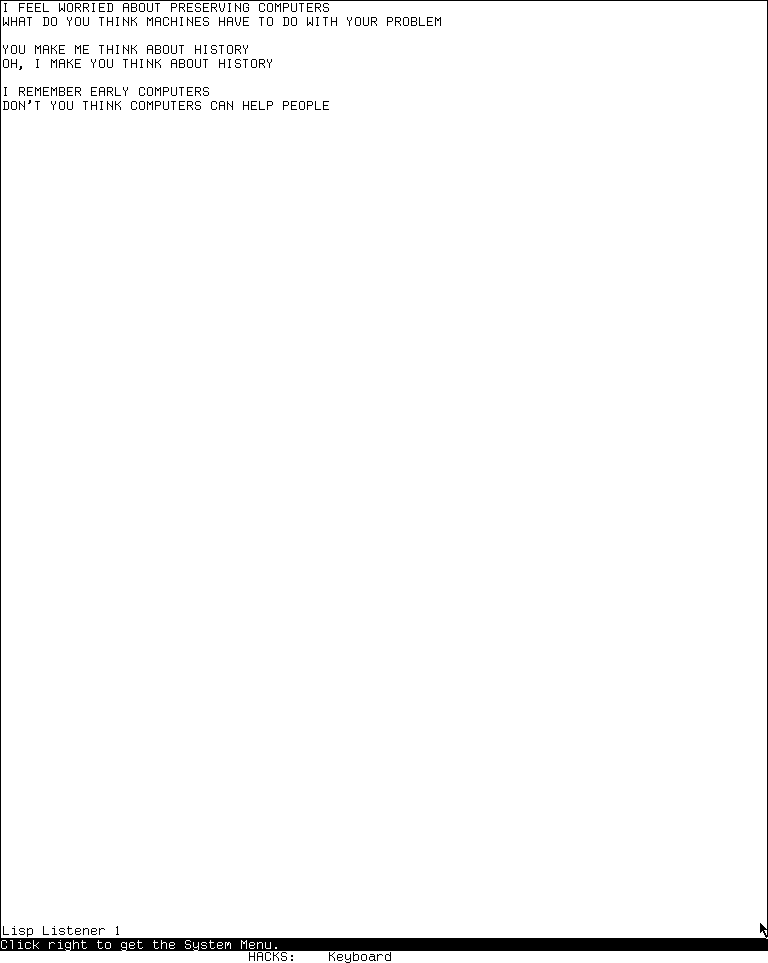
The published image is the exact 768-by-963 framebuffer from the clean conversation state. It contains public CADR runtime output and researcher-written input, not a source listing, manual page, licensed Genera material, or private conversation. Its publication is covered by the capture-specific rights review.
| Item | Recorded value |
|---|---|
| Session | hacks-doctor-d56-d57-20260718, generation 1; 2026-07-18 12:41:02–12:55:01 EDT |
| Guest and window | Experimental System 303.0; load band System 303-0; microcode 323; LOCAL-CADR [running], XID 2097202, 768 by 963 at (0,0) |
| Disk | public base and private-start SHA-256 bb16e46ad81decfe1efe691d36b6aa4ce3fd4ffb82474365de3520989d397cb5; public base unchanged at stop |
| Source and emulator | System check-in 4df393c68d7f083ce42d5c377039d26043cc18a9031ace28258dc97f4137eb91; private System tree SHA-256 21f5215de973aa6ccbddb817f2d64edd95ee1014c3028a9b0711ea7c741b807e; emulator revision 330d8248ec2e12af071e287920e681600f75df9ffd854aada5f8a64c9adad64d; start and execution SHA-256 707a77d23e28ea1c45ae0eb0145dc181fa7ba649b9defc30044d4f847ac2c5be |
| Curated exact capture | doctor-conversation.png, copied without transformation from raw 0015-doctor-clean-conversation.png; 1,891 bytes; PNG SHA-256 8b98e85838d96c5b86ff1e51d8174c963c9c81f8ea41e53161390e6856609e8e; decoded-pixel SHA-256 cfc6572b2e0472bc784ff35a1b6ca8defa912ed78b9a2968af886db693e84391 |
| Raw sidecar | 0015-doctor-clean-conversation.json, 4,432 bytes; SHA-256 8dfd8d378be7f128b826fc896d48985d0307bb5897ff60ca981ec14cfe950cde |
| Run record | 6,940 bytes; SHA-256 89cd8f2726471f0bde8efe411c1a142b97f96418e07f3594367d8f406e9b10a6 |
| Shutdown | Clean: forced_stop=false, state_may_be_incomplete=false, usim and Xvfb exit status 0, public base disk unchanged |
The same session loaded public HAKDEF and QIX for the separate HACKS suite probe. All raw captures and the private load-band copy remain under the ignored build tree.
Open questions
- How does live response rotation compare across a freshly reloaded script, and when does the memory fallback become visible in a controlled transcript?
- Does the scripted
YOU WANT ... LISPresponse enter the same break loop in this load band that static inspection predicts? - Does the live System 303 reader collapse
Multicsandmulticsin this file, and if so, does the final alias make that keyword path self-referential? - Which people are identified by the source initials
DLWandBSG, and who performed the original Multics-to-Lisp-Machine port? - Where is the exact rule script paired with the inventoried 1977 System 46 engine, and did it differ from
docscr.lisp.6beyond readtable cleanup and later local jokes? - Which physical Lisp Machine keys generated the old private reader's numeric codes? Source-visible effects are known, but the keyboard mapping is not.
- Was
doctor.lisp.14ever rebuilt into a surviving HACKS load artifact after the staleQUITwarning, or is the source ahead of the available compiled state?
Reproducibility and sources
The artifact sizes and hashes above can be reproduced with wc -c and sha256sum. The structural inventory was made without loading DOCSCR: tokenize the exact file while honoring semicolon comments and slash escapes, parse only balanced lists, select four-element forms headed by DEFPROP, case-fold symbol tokens, and classify the fourth element. Pattern and response totals then walk only full RULES and MEMR property values; one-symbol RULES values are aliases. This method deliberately performs no EVAL, interning, or property mutation.
- Joseph Weizenbaum, “ELIZA—A Computer Program For the Study of Natural Language Communication Between Man and Machine”, Communications of the ACM 9(1), 1966, pp. 36–45.
- Public System 46 snapshot,
LMDOC; DOCTOR 5and its media-inventory record, Git commit8e978d7d1704096a63edd4386a3b8326a2e584af. - LM-3 System 303,
DEMO; DOCTOR LISP 14,DEMO; DOCSCR LISP 6, and theHACKSsystem declaration, Fossil check-in4df393c68d7f083ce42d5c377039d26043cc18a9031ace28258dc97f4137eb91. - LM-3 restoration
HACKScompiler-warning record, used only as evidence about the saved build and its stale warning.
Last verified: 2026-07-18.