Symbolics Genera Dynamic Windows reimplementation specification
Status and reconstruction claim
This document specifies a new implementation of the native Dynamic Windows semantic stack represented by the preserved Symbolics Genera 8.5 environment. It is intended to let an engineering team recreate the system's interaction model, public programming concepts, and observable behavior through compatibility level D4 without reusing the original implementation. It covers the presentation substrate, typed input and output, handler resolution, presentation histories, completion, the Command Processor boundary, formatted output, output records, incremental redisplay, Dynamic Window streams, graphics integration, program frameworks, pane types, Accepting Values, menu programs, and sequence-reordering clients.
The current target is semantic and behavioral compatibility through DW-G85/D4, not a byte-identical Ivory world and not yet drop-in compatibility for arbitrary historical source. Exact public package/symbol names, argument lists, macro option grammars, condition and restart contracts, multiple-value conventions, and the full predefined type and handler libraries belong to the separately reserved DW-G85/D5 level. The implementation may use CLOS, another object system, retained scene graphs, a GPU, or a host event loop. It MUST nevertheless preserve the distinctions among application objects, presentation types, displayed presentations, output records, input contexts, handlers, commands, and raw TV windows. A conventional widget callback system with those names attached does not conform at D0-D4.
This is a rights-conscious technical specification, not a legal opinion or a claim that every unpublished implementation detail is unprotectable. Licensed source and decoded Help remain local and untracked. This page records interface names, file identities, original analysis, observed behavior, and independently stated algorithms; it does not reproduce proprietary source listings or substantial manual text.
What Dynamic Windows is, and is not
Dynamic Windows is a semantic user-interface layer on top of Genera's TV window system. Its defining relationship is:
application object
    + presentation type and parameters
    + displayed representation and region
    + active input context
    + applicable gesture handler
    -> object, translated object, action, or command
It is not merely:
- the low-level TV sheet/window hierarchy;
- a bitmap drawing library;
- the Command Processor alone;
- a set of program-frame panes;
- the later portable CLIM implementation; or
- a widget toolkit in which rectangles own callbacks.
Genera's system declaration keeps TV, PRESENTATION-SUBSTRATE, CP, DYNAMIC-WINDOWS, and DYNAMIC-WINDOW-CLIENTS as distinct ordered subsystems. A reimplementation MUST preserve those behavioral boundaries even if it packages them together.
Normative language and evidence codes
The words MUST, MUST NOT, SHOULD, SHOULD NOT, and MAY are normative. Exact Lisp interface names are retained when they identify a historical contract. Pseudocode describes required effects, not the original source.
| Code | Meaning |
|---|---|
G85-SRC |
Original analysis of readable licensed source selected for the installed Genera 8.5 / System 452.22 tree; no source text is reproduced |
G85-WORLD |
Compiled definitions, system state, or subsystem presence established in the licensed 8.5 world/VLOD |
G85-RUN |
Direct behavior through the isolated Genera Xvfb harness |
G8-MAN |
Public Symbolics Genera 8 manuals |
UIST89 |
McKay, York, and McMahon's contemporary Dynamic Windows paper |
INFERRED |
An implementation-independent synthesis, explicitly not attributed as original wording |
TODO-RUNTIME |
Source/manual-supported behavior not yet exercised in the preserved world |
A paper-era limitation is not automatically a Genera 8.5 requirement. A readable source definition is not automatically loaded in the preserved world. A screenshot establishes pixels and interaction, not hidden type descriptors or object identity. INFERRED marks a clean-room design rule synthesized to preserve an established observable invariant; it does not assert that Genera used that representation or algorithm. When source-established behavior and an inferred implementation rule share a section, each inferred paragraph is labeled explicitly.
Compatibility profiles and levels
The primary profile is DW-G85, the Dynamic Windows facilities in Genera 8.5 with System 452.22 source media and the identified 8.5 world. An implementation MAY add a historical DW-1989 profile for behavior documented by the contemporary paper, but MUST NOT use it to override later DW-G85 evidence.
| Level | Name | Required facilities |
|---|---|---|
| D0 | Presentation substrate | Type descriptors, type lattice, printers/parsers, views, presentation records, input contexts, histories, completion, gestures, handlers, and semantic diagnostics |
| D1 | Command interaction | Command definitions and objects, command tables/inheritance, keyboard accelerators, menus, typed and pointer arguments, command loop, and Help metadata |
| D2 | Dynamic output | Output histories, hit testing, highlighting, formatted output, output records, replay, and incremental redisplay |
| D3 | Program environment | Dynamic Window streams, graphics/viewport integration, panes, constraints/configurations, program-framework lifecycle, activities and selection |
| D4 | Reusable clients | Standalone and pane Accepting Values, menu program, reorder/alter sequences, branching undo, and Frame-Up-compatible generated frameworks |
| D5 | Historical source interface | Exact public package/symbol names, signatures, macro grammars, conditions/restarts, multiple values, predefined type signatures, standard handlers, and every source-facing selected subfacility |
A claim such as DW-G85/D2 means all lower levels also conform. DW-G85/D5 is reserved and MUST NOT be claimed until the API and selected-module coverage appendix has no D5-pending entry required by the historical program being compiled. D5 means drop-in historical source compatibility over D0-D4; it does not imply QFASL, Ivory object-layout, world-image, or private wire-format compatibility. Low-level TV behavior is a dependency. The TV window-system reimplementation specification specifies the preserved MIT CADR/LM-3 ancestor, not an exact Genera 8.5 TV contract. This document specifies only the Genera-TV dependency subset Dynamic Windows needs; exact Genera TV parity beyond that boundary remains out of scope and TODO-RUNTIME.
Evidence ledger
| Facility | Readable source evidence | World/compiled evidence | Observed behavior | Manual/paper evidence |
|---|---|---|---|---|
| Type and handler substrate | Type descriptors, definition macros, type walking, lookup, standard type modules, dynamic input, basic handlers | Presentation functions, types, handlers, and Presentation Inspector are resident in the base world | Integer presentations, type-specific Boolean rejection, handler inspection, and contextual pointer documentation | G8-MAN, UIST89 |
| Commands | Separate CP subsystem plus Dynamic Windows command integration | Dynamic Lisp Listener and program frames execute command objects from resident tables | Typed command names, completion, accelerators, command menus, and presentation-produced commands work | G8-MAN, UIST89 |
| Output and redisplay | Formatted-output, displayed-presentation, Dynamic Window, and redisplay modules | Base world retains presentation-sensitive output histories and redisplay machinery | Presentation Inspector, Display Debugger, Frame-Up, Inspector, and Accepting Values redraw semantic output | G8-MAN, UIST89 |
| Frameworks and panes | Framework generator, pane registry, Accepting Values, layout designer | Numerous resident applications are concrete program frameworks | Frame-Up split a pane and returned; standalone Set GC Options form accepted navigation and pointer abort | G8-MAN |
| Graphics | Graphics generics, patterns, raster mixin, viewport operations, graphing, binary graphics | Resident drawing applications and display programs use the facilities | Graphic and raster applications, Frame-Up model, and presentation highlighting draw in the live world | G8-MAN; later source extends the paper-era account |
| Viewport-aware margins | Ragged-border predicates, horizontal and vertical raster renderers, margin allocation, scroll-position invalidation, and standard pane compositions | The reviewed Debugger/Listener capture shows one active top edge; an active side edge remains TODO-RUNTIME |
No manual claim is required for the source-profile contract |
The world/compiled column is established by resident behavior and introspection of the preserved world, not by extracting proprietary machine code into the repository.
Section evidence map
This map is the evidence key for the normative sections below. Line spans refer to the exact licensed witnesses in Artifact identities. They are portable artifact-relative paths, not machine paths. G85-SRC establishes selected source behavior; it does not prove that every definition is the one currently patched into the running world.
| Specification section | G85-SRC / selected component evidence |
G85-WORLD and G85-RUN |
Manual/paper cross-check |
|---|---|---|---|
| Layer graph | patch/system-452/system-452.component-dir.~10~:370-457 |
The five named systems and their clients are resident; full cold-load tracing remains TODO-RUNTIME |
G8-MAN overview separates presentation, CP, Dynamic Windows, graphics, and frameworks |
| Type and data model | dynamic-windows/substrate-definitions.lisp.~44~:148-481; type-descriptor.lisp.~12~:81-316; type-walk.lisp.~17~:58-887; standard types in core-types.lisp.~34~:137-1957, number-types.lisp.~5~:148-781, sequence-types.lisp.~28~:55-1893, presentation-types.lisp.~722~:58-1775, and sys2/character-style-presentations.lisp.~64~:371-671 |
Presentation Inspector displayed live integer/symbol types and methods, but lattice edge cases and conditional live-name population remain TODO-RUNTIME |
G8-MAN; UIST89 type-lattice model |
| Typed output/history | accept-substrate.lisp.~19~:217-249; displayed-presentation.lisp.~47~:64-720; dynamic-window.lisp.~625~:225-848,1214-3844 |
Live Inspector and Presentation Inspector outputs retain sensitive objects | G8-MAN presentations and Dynamic Windows chapters; UIST89 |
| Typed input/editor/completion | accept-substrate.lisp.~19~:397-1339; io/input-editor.lisp.~332~:120-2309; io/readers.lisp.~251~:62-71; completion.lisp.~206~:743-1923 |
GC Boolean correction and pointer Abort are G85-RUN; the complete source map is specified below, while exhaustive loaded-world execution remains TODO-RUNTIME |
G8-MAN input-editor, Accept, and completion chapters |
| Handlers/gestures | define-handler.lisp.~12~:65-587; mouse-handler-lookup.lisp.~33~:1452-2220; dynamic-input.lisp.~498~:57-1313; dynamic-window-mixins.lisp.~204~:708-743; basic-handlers.lisp.~30~:127-1381; handler-debug.lisp.~33~:96-307; presentation-inspector.lisp.~4053~:588-1079; io/format.lisp.~369~:1006-1036; window/mouse.lisp.~472~:631-700,1153-1163,1862-1867 |
Presentation Inspector handler report is G85-RUN; synthetic tie tests, physical click matrix, selected-window routing, and the mutable 96-cell live map are TODO-RUNTIME |
G8-MAN; UIST89 translator-selection section |
| Commands | cp/comtab.lisp.~103~:55-423; cp/command-processor.lisp.~318~:532-2596; cp/read-accelerated-command.lisp.~142~:55-831; cp/substrate-commands.lisp.~6~:99-299 |
Resident listeners/frameworks exercise commands; the selected prefix and argument grammar is source-grounded, while loaded-table conflicts and prefix-Help presentation remain TODO-RUNTIME |
G8-MAN Command Processor chapters; UIST89 application construction |
| Formatted output/redisplay | formatted-output.lisp.~397~:76-2681; redisplay.lisp.~185~:57-2590 |
Visible framework redisplay is G85-RUN; two-pass counters and pixel-copy ordering are TODO-RUNTIME |
G8-MAN output, replay, and incremental-redisplay chapters |
| Graphics | graphics-flavors.lisp.~21~:59-192; graphics-generics.lisp.~246~:123-4005; raster-graphics-mixin.lisp.~157~:57-2393; define-viewport-graphics-operation.lisp.~62~:57-1459 |
Live clients draw and highlight; primitive edge/raster cases are TODO-RUNTIME |
G8-MAN graphics overview/dictionary; the later source exceeds UIST89's paper-era account |
| Viewport-aware ragged margins | dynamic-window-mixins.lisp.~204~:1260-1405,2808-2852; dynamic-window.lisp.~625~:3082-3089; dynamic-window-flavors.lisp.~29~:157-171 |
A top ragged edge and straight sides are visible in debugger-dynamic-choices.png; active left/right states remain TODO-RUNTIME |
Source-profile rule; see the ragged-border analysis |
| Frameworks/panes/activities | program-framework-panes.lisp.~32~:58-459; define-program-framework.lisp.~332~:55-340,1106-1233,1343-1426,1726-1789; window/activities.lisp.~35~:65-554 |
Frame-Up split-pane session is G85-RUN; exhaustive pane/lifecycle behavior is TODO-RUNTIME |
G8-MAN framework and pane chapters |
| Accepting Values/FQUERY/clients | accept-values.lisp.~244~:105-1797; io1/fquery.lisp.~104~:55-327; selected client modules |
GC options is G85-RUN; the complete standalone and optional pane binding maps are source-grounded, while their exhaustive loaded-world exercise and generic menu/reorder/alter clients are TODO-RUNTIME |
G8-MAN Accepting Values and query facilities |
The manual corroborates the public model but omits several source-visible rules: the four-state internal subtype result, attempted handler name/package tie-break and its apparent source typo, semantic blips in the input buffer, redisplay's collection/display identity check, the seventh standard TREE-BROWSER pane, and several failure-recovery paths. Conversely, a source-only branch remains labeled TODO-RUNTIME until a harmless synthetic oracle reaches it.
Layer graph and dependency rules
TV
TV supplies screens, sheets, raster operations, stream primitives, windows, mouse routing, menus, frames, color, and graphics foundations. Selected Dynamic Windows graphics and flavor mixins load during TV construction in the inspected release. This is a boot dependency, not evidence that TV and Dynamic Windows are the same system.
PRESENTATION-SUBSTRATE
The substrate owns type descriptors and methods, type definition, handler definition, histories, standard types, completion, typed acceptance, input contexts, and handler matching. It MUST be usable without the full program-framework layer.
CP
The Command Processor owns command tables and the command reader/executor. It uses presentation input and can be embedded in Dynamic Window programs, while remaining a separate command-language subsystem.
DYNAMIC-WINDOWS
The core adds formatted output, redisplay, box arithmetic, displayed-presentation records, Dynamic Window streams, viewport graphics, window combinations, graphing, color, and binary graphics.
DYNAMIC-WINDOW-CLIENTS
The client layer adds framework panes, DEFINE-PROGRAM-FRAMEWORK, Accepting Values, queries, and sequence-reordering utilities. Loading a client MUST NOT redefine the meaning of core presentation matching.
Semantic data model
Domain object
A domain object is application-owned state. Dynamic Windows MUST NOT require it to inherit from a UI class, contain a screen rectangle, or retain callbacks. Object identity MUST be preserved when a presentation is selected; reparsing printed text is only one alternate input path.
Presentation type specifier
PresentationTypeSpecifier {
  type_name
  data_arguments
  presentation_arguments
  meta_options
}
Data arguments refine semantic membership and subtype relationships. Presentation arguments control parsing, printing, view, prompts, defaulting, or other interaction without necessarily changing the accepted object set. Meta options are interpreted by the substrate rather than the type's membership predicate.
The implementation MUST retain the complete specifier through parsing, output, handler lookup, and diagnostics. It MUST NOT reduce every presentation type to a host language class.
Type descriptor
PresentationTypeDescriptor {
  name
  lambda_lists_for_data_and_presentation_arguments
  pretty_name_and_obsolete_state
  inheritance_generators_and_equivalent_types
  printer_parser_and_type_description_methods
  views_and_default_view_methods
  default_and_input_history_methods
  highlighting_choose_menu_and_accept_values_displayers
  subtype_supertype_walk_and_membership_operations
  lisp_type_or_membership_predicate
  cache_key_generators_and_cache_policy
  optional_binary_graphics_method
  protocol_flags_and_version
  definition_generation
}
A descriptor can provide printer, parser, type-name printer, describer, input-history policy, default preprocessing, postprocessing, highlighting-box computation, menu and Accepting Values displayers, views, subtype walking/predicates, equivalent host type, and binary-graphics encoding. Methods can be inherited or obtained through type expansion. (G85-SRC, G8-MAN)
G85-SRC establishes mutable descriptors, definition generations, and dependent caches. The following publication rule is INFERRED: readers MUST see the old complete descriptor or the new complete descriptor, never a partially installed method set. Completing a definition advances its generation and invalidates affected method, subtype, common-supertype, type-key, and handler caches. A replacement MAY use immutable descriptor snapshots rather than reproducing Genera's mutable representation.
Displayed presentation
DisplayedPresentation {
  object_or_locator
  source_form_or_location
  type_specifier
  view
  region_or_bounding_box
  parent: DisplayedPresentation | OutputRecord | null
  children
  sensitivity_policy
  highlight_policy
  stream_and_history_identity
  rendering_record_or_replay
  metadata
  liveness_state
}
The record MUST connect the exact object to its visible representation. Presentations may nest. A parent can share a highlighting region with children, allow or suppress sensitive inferiors, or present the same pixels at another semantic level. A record can remain in output history after scrolling out of the viewport, but it is pointer eligible only when its transformed region is currently visible.
The semantic object can be stored directly, recovered from an application location, or recomputed from a recorded form under the selected protocol. No output record may retain a dead stack/ephemeral reference after its dynamic extent. A null presentation marks deliberately nonsensitive output. A parent region can contain holes occupied by children, and a graphics presentation can refine rectangular hit testing by shape and priority/timestamp.
Input context entry
InputContextEntry {
  required_type_specifier
  superior_context_or_null
  throw_or_return_enabled
  options
  context_generation
}
Input contexts form a dynamic stack. The innermost active context gets the first opportunity to consume matching input. Compound parsers can push subordinate contexts while accepting components. A reduced context MAY add a predicate or transform but MUST retain enough ancestry for matching and diagnostics.
Entering a context MUST install its input-editor, mouse-motion wakeup, input-wait, and dynamic-blip behavior as required by the stream. Leaving it MUST announce the context change and remove transient highlighting and documentation in unwind-protected cleanup, including after Abort or an error.
Presentation blip and input-editor state
Pointer input is carried through the stream as a semantic blip rather than converted to display text:
PresentationBlip {
  presentation_or_semantic_result
  presentation_type
  triggering_raw_and_logical_gesture
  selected_handler
  object
  options_and_provenance
}

InputEditorState {
  buffer_elements              // characters, style changes, semantic blips
  point_and_optional_mark
  activation_and_rescan_state  // none, end-of-line, or activation
  per_stream_input_history
  shared_kill_ring_and_index
  numeric_argument
  command_map
  pending_static_blips
  dynamic_blip_handlers
  echo_and_display_state
}
The editor displays a compact placeholder for a presentation blip but MUST return the semantic element on rescan. Ordinary movement and deletion treat it atomically. An old blip whose presentation has been deleted MUST signal a controlled dead-blip condition; it must not dereference stale output history.
Handler descriptor
PresentationHandler {
  kind: translator | action | presentation_to_command | command_menu | blank_area
  stable_name
  source_type
  target_type
  context_type
  logical_gesture_set
  object_tester
  context_or_result_tester
  translation_or_action_function
  priority
  documentation_and_pointer_documentation
  menu_policy
  highlight_policy
  context_independent
  exclude_other_handlers
  blank_area_enabled
  definition_generation
}
A handler is selected by semantic types and active context, not installed directly on one rectangle. The same handler can apply to every visible object of a type; the same object can have different applicable handlers in different contexts.
An action is a noncomposing translator whose useful result is its side effect and which normally resumes the original accept operation. A presentation-to-command translator targets the semantic command type. Blank-area handlers use a no-type source sentinel and are considered only when no presentation owns the location.
Output and redisplay records
OutputRecord {
  kind
  region
  children
  replay_or_renderer
  parent
}

RedisplayPiece extends OutputRecord {
  unique_id
  cache_value
  cache_test
  displayer_continuation
  collection_and_display_generation
  contents_valid
  movement_allowed
  child_pieces_and_nonchild_output
  old_region
  new_region
  state: matched | unchanged | moved | changed | inserted | deleted
}
Presentation records and redisplay pieces can be nested inside formatted-output records. They MUST remain distinct: presentation records answer “what object/type is here?”, while redisplay pieces answer “what output can be retained or changed?”.
Command and command table
CommandDefinition {
  name
  argument_specs_and_options
  body
  documentation
  menu_and_accelerator_metadata
  declared_visible_values
}

CommandTable {
  name
  parent_tables
  command_definitions
  accelerators
  menu_levels_and_items
  presentation_handlers
  mutation_epoch
}
A command object is a command name plus already accepted semantic arguments. It is independent of whether those arguments came from typing, completion, menus, or pointer gestures. Positional or conditional arguments not read yet MUST remain distinguishable from arguments explicitly supplied as NIL.
Presentation type system
Surface syntax
The selected substrate accepts three presentation-type shapes:
- an atomic type name;
(name . data-arguments); and- a full form containing name and data arguments followed by presentation arguments.
The compatibility frontend MUST decode all three without confusing presentation arguments with semantic data arguments. A descriptor can require data arguments, forbid atomic use, permit a Common Lisp type bridge, or mark itself presentation-only. Cache keys for appearance/parsing operations include presentation arguments; pure membership keys MAY omit arguments the descriptor proves irrelevant.
Definition and canonicalization
A type definition MUST declare separate data and presentation argument lists and MAY declare a supertype/expansion. Type specifiers are canonicalized by:
- resolving the name to a current descriptor;
- parsing supplied arguments and applying declared defaults;
- preserving data and presentation arguments separately;
- expanding aliases only as needed for the requested method or relationship;
- detecting expansion cycles; and
- retaining the original or reconstructible surface specifier for prompts and diagnostics.
Redefinition MUST increment an epoch and invalidate descriptor, method, subtype, and handler caches that could depend on the prior definition.
Canonical cache keys MUST be collision-safe. Genera bounds and compresses large type keys as an optimization. The INFERRED clean-room safeguard is that another implementation may retain full immutable keys, and a compact-key collision MUST never produce a false membership, method, subtype, or handler result. Descriptors with mutable or opaque arguments MAY opt out of caching.
Membership and subtyping
The relation presentation-subtypep(A,B) answers whether every semantic value of specifier A is acceptable where B is requested. Internally it has four possible results: true, false, unknown, or a conditional predicate which decides the relation for concrete arguments. A public two-valued wrapper MAY collapse unresolved results, but handler resolution MUST retain conditional information. It MUST account for:
- declared presentation-type inheritance/expansion;
- argument-dependent subtype rules;
- compound types such as conjunction, disjunction, membership, or predicate-refined types;
- an equivalent Lisp/host type only where the descriptor explicitly supplies one; and
- an unknown result when the relationship cannot be proved statically.
Presentation subtyping MUST NOT be replaced by raw host TYPEP alone. Two presentations of the same underlying integer can have distinct UI meanings, and a semantic subtype can be independent of object representation.
subtype(A, B, seen):
  normalize A and B
  if (A,B) is already in seen: return unknown
  remember (A,B)
  handle equality, top, bottom, and no-type sentinels
  ask A's descriptor-specific subtype method; retain a conditional result
  recursively try A's declared, generated, and equivalent supertypes
  try Flavor/CLOS precedence, structure ancestry, and declared host-type bridges
  return true on proof; otherwise the best conditional/unknown/false result
Traversal MUST detect cycles. Parameterized aliases or host-type expansions must terminate with an unresolved/false result or a structured error rather than recurse forever.
Method dispatch
Type-method lookup proceeds from the exact type descriptor through declared expansions/supertypes until a method for the requested role is found. Argument values must be available to methods whose behavior depends on them. The result MAY be cached against the canonical specifier, method role, and relevant epochs.
At minimum, a DW-G85/D0 implementation MUST provide method roles for:
| Family | Roles |
|---|---|
| Text conversion | presentation printer, parser, type-name printer, describer |
| Semantic relationship | membership/equivalent host type, subtype and supertype walking/predicates |
| Input lifecycle | default preprocessing, history choice, input postprocessing |
| Display modes | view choice, menu display, Accepting Values display, chooser |
| Feedback | highlighting-box or region policy |
| Encoding | binary-graphics representation where supported |
Standard type-library boundary
The inspected selected modules contain 133 unqualified presentation-type definition forms: 44 core, 19 numeric, 15 sequence, 48 general, and 7 character-style. The general module also contains two explicitly SCL:-qualified definition calls, for 135 macro-family calls in a literal scan. Repeated MEMBER definitions, conditional forms, and package variants mean neither number is a count of unique live names. A reconstruction MUST ship a type library covering these semantic families:
- Lisp values and symbols;
- numbers, ranges, radices, and numeric subtypes;
- sequences, members, subsets, and structured compound values;
- pathnames, files, directories, and hosts;
- time and dates;
- fonts and character styles;
- systems, functions, classes, Flavors, and CLOS objects;
- windows, activities, printers, network and namespace objects; and
- application-extensible presentation types.
The source-form inventory is:
- Core (44):
EXPRESSION,GPRINT::EXPRESSION-LENGTH-ELLIPSIS,FORM,EVALUATED-FORM,OUT-OF-BAND-CHARACTER,CONS,LIST,NULL,NOT,PARSE-ERROR-WALL,OR,AND,SYMBOL,KEYWORD,PACKAGE,FUNCTION,COMPILED-FUNCTION,GENERIC-FUNCTION,CLOS-INTERNALS:FUNCALLABLE-INSTANCE,LEXICAL-CLOSURE,DYNAMIC-CLOSURE,COMPILED-FUNCTION-PC,COMPILER:COMPILED-FUNCTION-AND-PC,CHARACTER,STANDARD-CHAR,STRING-CHAR,SIMPLE-STRING,UNBOUND-LOGIC-VARIABLE,HASH-TABLE,DECLARE,SIMPLE-ARRAY,READTABLE,LOCATIVE,SIMPLE-BIT-VECTOR,ATOM,STREAM,COMMON,SATISFIES,DATA-TYPE,CLI::EQUIVALENT,INSTANCE,CLOS-INTERNALS:MEMBER-OF-CLASS,CLOS-INTERNALS::MEMBER-OF-CLASS-NAMED, andSTRUCTURE. - Numeric (19):
NUMBER,INTEGER,MOD,BIT,UNSIGNED-BYTE,SIGNED-BYTE,BIGNUM,COMPLEX,FIXNUM,FLOAT,SHORT-FLOAT,SINGLE-FLOAT,DOUBLE-FLOAT,LONG-FLOAT,FUTURE-COMMON-LISP:REAL,RATIONAL,RATIO,SMALL-RATIO, andBIG-RATIO. - Sequence (15 forms):
STRING,SEQUENCE,VECTOR,ARRAY,BIT-VECTOR,SIMPLE-VECTOR,SEQUENCE-ENUMERATED,MEMBER-SEQUENCE, twoMEMBERforms,SUBSET,ALIST-SUBSET,SEQUENCE-ELEMENT,ALIST-MEMBER, andSEQUENCE-SUBSET. - General (48 unqualified plus two
SCL:calls):BOOLEAN,INVERTED-BOOLEAN,T,NIL,PATHNAME,FS:DIRECTORY-PATHNAME,FS:WILDCARD-PATHNAME,FS:OPEN-FILE,MENU-CHOOSE,TOKEN-OR-TYPE,NULL-OR-TYPE,TYPE-OR-STRING,TIME:UNIVERSAL-TIME,TIME:TIME-INTERVAL,TIME:TIME-INTERVAL-60THS,TIME:TIMEZONE-SYMBOL,TIME:TIMEZONE-NUMBER,TIME:TIMEZONE,FONT,SYS:FONT-NAME,SCT:SYSTEM,SCT:SUBSYSTEM,SCT:SYSTEM-VERSION,SCT:SYSTEM-BRANCH,SYMBOL-NAME,NET:OBJECT,NETI:NAMESPACE-CLASS,NETI:NAMESPACE-OBJECT,NET:LOCAL-HOST,NETI:LOCAL-NETWORK,LOCAL-PRINTER,PRINTER,TV:SHEET,TV:WINDOW,DW:DYNAMIC-WINDOW,TV:MICROCODED-GRAPHICS-ALU,TV:ALU-FOR-SHEET,SI:RESOURCE-NAME,SI:INITIALIZATION-LIST-NAME,FS:PATHNAME-HOST,FLAVOR-NAME,CLOS:CLASS-NAME,GENERIC-FUNCTION-NAME,CLOS-INTERNALS:GENERIC-FUNCTION-NAME,FLAVOR:INSTANCE-VARIABLE-ACCESSOR,FUNCTION-SPEC,SI:LISP-SYNTAX,KEYWORD-VALUE-PAIRS,KEYWORD-VALUE-PAIR, andTV:WINDOW-FLAVOR.SCT:SYSTEM-BRANCHandFLAVOR:INSTANCE-VARIABLE-ACCESSORare the two explicitlySCL:-qualified calls. - Character style (7):
CHARACTER-STYLE-FAMILY,CHARACTER-STYLE-FACE,CHARACTER-STYLE-SIZE,CHARACTER-STYLE,CHARACTER-STYLE-FOR-DEVICE,CHARACTER-STYLE-DEVICE-FONT, andCHARACTER-FACE-OR-STYLE.
Exact argument lists and conditional live-name population remain an ABI metadata and world-oracle appendix. This inventory is sufficient to prevent a reimplementation from silently omitting an entire semantic family; it is not a claim that all 135 forms produce simultaneous distinct loaded types.
Inventory evidence: G85-SRC at dynamic-windows/core-types.lisp.~34~:137-1957, dynamic-windows/number-types.lisp.~5~:148-781, dynamic-windows/sequence-types.lisp.~28~:55-1893, dynamic-windows/presentation-types.lisp.~722~:58-1775, and sys2/character-style-presentations.lisp.~64~:371-671. Their exact byte identities are recorded in Artifact identities.
Numeric range types MUST reject values outside the requested range after syntactic parsing. Sequence/member/subset types MUST honor their supplied comparison functions and return associated semantic values rather than equating display strings. The character-style types cover family, face, size, device mapping, a combined style, and face-or-style selection. G85-SRC establishes these families; which conditional definitions are live in the patched world remains a metadata/oracle task.
Typed output and presentation recording
PRESENT
Conceptually:
present(object, type_specifier, stream, view=stream_default, options):
  canonical = canonicalize(type_specifier)
  assert object satisfies canonical, unless options explicitly suppress checking
  begin presentation record with object, canonical, view, and sensitivity policy
  dispatch canonical's presentation-printer for view
  collect all text/graphics output and nested records
  compute or obtain highlight region
  attach record to current output history/record parent
  return object and/or printer-defined values according to compatibility API
An implementation MAY combine record construction with a scene graph, but the semantic record MUST exist independently of screen pixels.
An object/type mismatch MUST signal a structured, continuable presentation error. It cannot silently create a sensitive record that claims the wrong semantic type.
WITH-OUTPUT-AS-PRESENTATION
The scoped output form records arbitrary application drawing as one presentation. It MUST:
- retain the supplied object and full type specifier;
- collect the region of all enclosed output or accept an explicit region;
- preserve nested presentations;
- unwind cleanly after abort or error;
- avoid leaving a hit-testable record for output that never committed; and
- honor sensitivity and shared-box options.
Record ordering and hit testing
Records are ordered consistently with output and nesting. Hit testing at a pointer location MUST:
- transform device coordinates into stream/history coordinates;
- exclude records outside the visible viewport or clipped region;
- descend from visually and semantically innermost eligible records outward;
- respect a parent's policy for sensitive inferiors;
- test the active context and applicable handlers; and
- return the candidate sequence needed for priority/gesture resolution.
A bounding box MAY overapproximate drawn pixels. Selection follows the recorded region, not alpha-testing the framebuffer, unless a type supplies a more precise region test.
Output history
A Dynamic Window retains output records beyond the current viewport until explicitly cleared, superseded, or reclaimed by a documented policy. Scrolling changes the viewport over this history; it does not turn pixels into semantic objects. Clearing history MUST invalidate presentation hit testing and redisplay associations for the removed records.
Applications MUST clear or replace stale presentations when their objects cease to be valid. As an INFERRED implementation technique, a new implementation SHOULD use weak references or explicit lifecycle hooks where safe. The observable requirement is that a visible stale record MUST NOT invoke an operation on an unrelated replacement object.
Output history is mutable, not append-only. It MUST support replacing a presentation's semantic value/type, moving it with inferiors, erasing/deleting it, region redisplay, scroll shifts, clearing/compaction, and replay after exposure. The following atomicity rule is INFERRED: pixel changes and the semantic/spatial index commit together, or an exception invalidates the region and forces repaint rather than leaving clickable stale pixels.
Typed input and ACCEPT
Required modes
ACCEPT requests an object of a presentation type and MUST permit these input paths when supported by the type and context:
- typed syntax parsed by the presentation parser;
- completion over a type-specific possibility set;
- selection from presentation history;
- acceptance of a currently displayed compatible presentation;
- translation of a displayed presentation into the requested type;
- compound recursive acceptance of component values; and
- default acceptance, editing, or replacement.
All successful paths return a semantic object satisfying the requested context after postprocessing. The caller must not need to distinguish whether it was typed or pointed unless it explicitly requests input-source metadata.
Input transaction
accept(type, stream, prompt, default, options):
  canonicalize type and preprocess default
  push InputContextEntry
  establish input-editor and completion/history state
  loop:
    wait for keyboard, pointer gesture, or handler-produced event
    if text activation:
      parse under canonical type
      on incomplete input: continue editing/completing
      on type error: report locally and retain editable input
    if pointer gesture:
      resolve applicable handler under complete context stack
      direct translation -> candidate object
      action -> perform action, then continue accepting
      command result -> return/queue according to command-reader context
    validate predicate and type membership
    postprocess and record history if enabled
    commit editor state and return value
  on abort/error: pop context and remove transient feedback without committing
Context push/pop and transient highlighting MUST use unwind-protected cleanup.
Defaults, history, and completion
- A default is typed semantic state, not preinserted display text. The type can preprocess it and choose how it appears.
- Editing a default and selecting a default are distinct actions when the type supports both.
- History is partitioned or selected by presentation type policy. Recalled objects must be checked against the current full specifier and predicate.
- Completion MUST distinguish incomplete, ambiguous, unique, and invalid input. It SHOULD present possible completions using the same semantic type/view mechanisms.
- Parser errors MUST identify the failing type/context and leave the editor recoverable.
Presentation blips and stream rescan
The input editor and parser are deliberately separate. The parser consumes the editor's saved buffer. When the user edits already scanned material, the editor nonlocally returns to the read boundary and the parser runs again over the corrected buffer without re-echoing it. Parser code can therefore execute more than once and SHOULD avoid irreversible side effects before acceptance commits.
The editor buffer can contain presentation blips as well as characters. On screen a blip is abbreviated; during rescan it is returned as the semantic pointer event or translated value. :activation, preemptable input, command characters, static blips, dynamic blip handlers, notifications, and stream input-wait callbacks can return control before ordinary text activation. Already buffered input MUST survive these events.
EDITING:
  wait for character, editor command, activation, EOF, notification, or blip
  self-insert/edit -> mutate buffer and efficient echo; remain EDITING
  presentation blip -> insert one atomic semantic element; remain EDITING
  activation -> return activation boundary to parser
  parser requests rescan -> reset scan point and enter RESCANNING
  full rubout -> return the configured empty-input outcome

RESCANNING:
  return saved characters/styles/blips without waiting or re-echoing
  at saved boundary -> resume EDITING or return activation according to state
The selected source limits insertion to one million characters. A replacement SHOULD enforce a documented resource bound and signal a correctable condition rather than truncate, wrap an index, or split a semantic blip.
Input-editor dispatch and complete base command map
This subsection is the complete selected System 452.22 initialization of the base Input Editor character map. It is normative at DW-G85/D0; it is not a claim that a site has not changed the mutable map. A site-specific profile MUST dump the effective map after all ADD-IE-COMMAND and DELETE-IE-COMMANDS calls and record each replacement. A per-call :EDITOR-COMMAND entry shadows a base entry with the same character.
Dispatch precedes the command map in this exact order:
input-editor event
├─ list event
│  ├─ recognized nonpresentation redisplay special -> ignore it
│  ├─ other nonpresentation list -> beep and discard it
│  ├─ once-only presentation blip -> return it immediately
│  ├─ window-wakeup presentation blip -> run its configured callback/refresh path
│  ├─ input-editor presentation blip -> insert its history payload
│  ├─ other presentation blip -> insert one atomic semantic element
│  └─ presentation blip with activate option -> activate after the applicable path above
├─ NIL event (a discarded blip) -> perform no dispatch action
├─ rescan predicate accepts while reader/editor state differs -> save event and rescan
├─ configured do-not-echo character or EOF -> activate without normal insertion
├─ configured blip-character predicate -> return a blip with current numeric argument
├─ configured activation predicate -> return an activation blip
├─ configured command predicate -> return a command blip and rescan
├─ configured unmodified pass-through character -> insert without style conversion
├─ per-call :EDITOR-COMMAND map -> invoke its handler
├─ mutable base command map below -> invoke its handler
├─ Abort, M-Abort, Suspend, or M-Suspend -> standard keyboard interceptor
├─ any still-unhandled modified decimal digit -> extend numeric argument
├─ any still-unhandled modified minus -> set negative-sign argument state
├─ C-U -> start at four or multiply the current argument by four
├─ other nongraphic or format character -> beep, discard it, and clear numeric state
└─ graphic, Return, Tab, Backspace, or diacritic -> self-insert
The activation, command, rescan, and blip predicates are dynamic context options. They therefore override apparent base meanings. For example, a completion reader can consume Tab, Return, End, Help, C-?, or C-/ before the base map. Conversely, End is not a base end-of-buffer alias: without a context that activates on End, it reaches the nongraphic/unbound branch.
| Exact base binding | Command and source-defined effect | Numeric-argument behavior |
|---|---|---|
Refresh; C-L |
Repaint the editable input; preserve prompt/buffer state | Ignored |
| Page | Erase current typeout when one exists | Ignored |
M-<; M-Up; Home |
Move to beginning of complete input buffer | Ignored |
M->; M-Down |
Move to end of complete input buffer and request visible cursor | Ignored; End is not an alias |
| Clear Input | Delete the complete buffer and force rescan/full-rubout handling | Ignored |
C-F; Right |
Move forward by atomic buffer elements | Signed count |
C-B; Left; Overstrike |
Move backward by atomic buffer elements | Signed count |
C-D |
Delete after point | Signed count; explicit argument affects kill-history policy |
| Rubout | Delete before point | Signed count; explicit argument affects kill-history policy |
C-T |
Exchange the adjacent pair selected by beginning/middle/end rules | Ignored |
C-A; M-Left |
Move to beginning of current line | Ignored |
C-E; M-Right |
Move to end of current line | Ignored |
C-P; Up |
Move to previous line while retaining the current column when possible | Count |
C-N; Down |
Move to next line while retaining the current column when possible | Count |
C-K |
Without an argument, kill to line end or kill the newline when already there; with one, kill that many lines | Count changes the operation |
M-F; M-B |
Move forward/backward by words under the current syntax table | Signed count |
M-D; M-Rubout |
Delete forward/backward by words | Signed count |
M-T |
Exchange the two words surrounding the source-selected boundaries | Ignored |
M-U; M-L; M-C |
Uppercase, lowercase, or capitalize the selected forward word span | Signed word count |
C-M-F; C-M-B |
Move over one balanced expression | Ignored |
C-M-K; C-M-Rubout |
Delete one balanced expression forward/backward | Ignored |
M-Backslash |
Delete horizontal Space/Tab around point | Default inserts zero spaces; explicit argument inserts that many |
| M-| | Normalize horizontal Space/Tab around point | Default inserts one space; explicit argument inserts that many |
| Line | Insert a nonactivating newline followed by two Space characters | Ignored |
C-O |
Insert one newline, then move point backward by the numeric count | Default count one; it does not insert the count's number of newlines |
C-Q |
Enter the quote-next-character stage described below | Ignored |
C-M-J |
Enter nested typed acceptance for a new input character style | Ignored |
| Help | Display context-sensitive input documentation | Argument selects the source's alternate display policy |
C-Help |
Display the effective Input Editor command/binding list | Ignored |
| Escape | Display entries from the current stream/type input history | Argument limits entries; zero means all |
C-Escape |
Display shared kill-history entries | Argument limits entries; zero means all |
C-Y |
Yank from shared kill history | Argument selects entry; zero displays history; C-U preserves the source's mark/point orientation rule |
M-Y |
Replace the preceding compatible yank with another entry | Requires a prior yank; argument rotates; zero displays history |
C-M-Y |
Yank from input history | Same selection/zero/C-U rules as C-Y |
C-W |
Kill marked input region | Ignored; no mark beeps/barfs |
M-W |
Copy marked text, preferring marked TV text and otherwise the input region | Ignored |
Super-W |
Push marked TV-region strings only | Ignored; no marked text beeps/barfs |
C-Space; C-<; C-> |
Set mark at point, buffer beginning, or buffer end | Ignored |
C-Shift-Y |
Prompt for a match and yank matching shared kill history | Argument selects match; zero displays matching history |
M-Shift-Y |
Rotate the preceding matching yank | Requires prior matching-yank state; argument rotates; zero displays matches |
C-M-Shift-Y |
Prompt for a match and yank matching input history | Argument selects match; zero displays matching history |
Scroll; C-V |
Scroll vertically forward | No argument means a screen; argument means that many lines |
M-Scroll; M-V; Back-Scroll |
Scroll vertically backward | No argument means a screen; argument means that many lines |
Super-Scroll |
Scroll horizontally forward | No argument means a screen; argument means that many columns |
M-Super-Scroll; Super-Back-Scroll |
Scroll horizontally backward | No argument means a screen; argument means that many columns |
C-Scroll |
Scroll typeout vertically forward | No argument means a screen; argument means that many lines |
C-M-Scroll; C-Back-Scroll |
Scroll typeout vertically backward | No argument means a screen; argument means that many lines |
C-M-S |
Read one character register, save the selected window and viewport position, then restore that position immediately | Prefix argument ignored |
C-M-R |
Read one character register and restore only if it names the same scrolling window | Prefix argument ignored; missing/mismatched register beeps/barfs |
Super-G |
Clear marked-region strings through the TV marking protocol | Ignored; no marked text beeps/barfs |
C-S; Super-S; Find |
Search displayed strings forward | Ignored |
C-R; Super-R; M-Find |
Search displayed strings backward | Ignored |
| Cut | Delete all marked TV text and push the concatenation to shared and console kill histories | Ignored |
| Copy | Copy all marked TV text to shared and console kill histories | Ignored |
| Paste | Yank from console kill history | Same argument/zero behavior as C-Y |
M-Paste |
Rotate the preceding console paste | Requires mark/prior paste; argument rotates; zero displays history |
The base multi-stage and repeat grammar is therefore:
numeric argument
├─ modified digit -> decimal digit state
├─ modified minus -> sign state
├─ repeated modified digits -> signed decimal accumulation
├─ C-U -> 4, then 16, then 64, ...
└─ next editing command -> consume or ignore as stated above; reset argument state

C-Q
├─ unmodified character -> insert it literally without returning control to parser
├─ modified character -> editor barf/beep path; insert nothing
└─ noncharacter event -> keep reading for a character

C-M-S or C-M-R
└─ nested character ACCEPT -> use that semantic character as the viewport register
"Modified" in the Input Editor numeric branch means any nonzero character-bit state that has not already matched a dynamic option or command; it is broader than only Control and Meta. A normal command, self-insert, or random-control error resets the argument to one. Commands that do not consult it still consume and reset it. The balanced-expression commands are one such intentional example.
Consecutive compatible kills coalesce; a nonkill command breaks coalescing. Yank rotation is valid only after a compatible yank. Ordinary input history is selected by stream/type policy while the kill ring is shared. Semantic blips remain indivisible for character operations and may count as one Lisp expression for structural motion. The source also defines, but gives no base key to, display-internal-state, four matching-history display commands, vertical-scroll-beginning, vertical-scroll-end, and clear-history. They are extension points, not hidden bindings.
The complete source map and dispatch order above are no longer an oracle gap. Runtime behavior over styles, blips, history edges, failed viewport registers, and site mutations remains TODO-RUNTIME; those probes test the stated contract rather than license an omitted chord.
Completion state machine
Completion MUST retain at least five result states: no match, ambiguous prefix, left-substring match, unique extension, and exact/complete match. Sources may be sequences, arrays, alists, symbol sets, or indexed trees. They must honor configured case folding, delimiter conversion, display names, semantic values, and equality tests.
| Gesture | Required completion behavior |
|---|---|
| Complete | Extend only by text common to the current candidate set |
| Super-Complete | Request the strongest/maximal completion policy |
| Tab | Complete and append a separator when the result becomes valid |
| End | Terminate only when complete; may accept a documented left-substring match |
C-? |
List current possibilities |
C-/ |
Apropos-style possibility search |
| Help | Explain the expected type and show possibilities where useful |
| Right mouse | Offer the same semantic choices in a menu |
C-Return |
Force unmatched text only when the type explicitly permits arbitrary input |
Ambiguity provides nondestructive feedback. Replacing text MUST preserve quoting and put point after the inserted material. Closed enumerated types cannot be bypassed by C-Return. An alist-backed completion returns the associated object, not the display name. Ellipsis choices expand only in the matching completion context. This is the complete selected completion-gesture inventory; maximal-completion and left-substring edge results still require TODO-RUNTIME oracle comparison, not an invented extra chord.
Evidence: G85-SRC at io/input-editor.lisp.~332~:120-2309, io/readers.lisp.~251~:62-71, and dynamic-windows/completion.lisp.~206~:743-1923; G8-MAN independently describes activation, rescan, preemption, parser/editor separation, and input-editor options. Only representative correction and pointer-blip paths are currently G85-RUN.
Compound types
A compound presentation parser may call ACCEPT recursively. The outer parser MUST maintain a procedural inverse relationship with its printer at the semantic level: values printed in an accepted view should be reconstructible or selectable even when the textual syntax is not a literal Lisp form. Nested input contexts MUST let the pointer satisfy the innermost component while retaining the outer continuation.
Gestures and handler resolution
Logical gestures
Handlers name logical gestures such as Select, Describe, Menu, or application-defined gestures. A gesture mapping converts raw button/modifier/key events into those names. Applications MUST NOT need to hard-code host button numbers. The mapping is part of the user/environment profile and can vary without redefining every translator.
The selected initialization first creates one unique primary gesture for every one of 32 Shift/Control/Meta/Super/Hyper bit states on each of three buttons: 96 raw characters in all. The table lists the additional aliases installed on named states. Every unlisted state, including Hyper-only and other multi-modifier combinations, retains only its unique primary gesture. A physical chord can therefore name more than one logical gesture so different handlers can bind the same chord in different semantic contexts.
Primary names preserve the historical formatter: numeric bit state 3 is specially spelled CONTROL-META, while other combinations use Hyper, Super, Meta, Control, then Shift order. For example state 19 has primary META-CONTROL-SHIFT-{LEFT|MIDDLE|RIGHT} names even though source character syntax uses the c-m-sh order for its Monitor/Unmonitor aliases.
The complete primary-state inventory is below. Each row expands to the three raw characters <prefix>LEFT, <prefix>MIDDLE, and <prefix>RIGHT; state 0 uses no prefix. This is an exhaustive 96-cell map, not a representative subset.
| State | Historical primary prefix | State | Historical primary prefix |
|---|---|---|---|
| 0 | (empty) | 16 | SHIFT- |
| 1 | CONTROL- |
17 | CONTROL-SHIFT- |
| 2 | META- |
18 | META-SHIFT- |
| 3 | CONTROL-META- |
19 | META-CONTROL-SHIFT- |
| 4 | SUPER- |
20 | SUPER-SHIFT- |
| 5 | SUPER-CONTROL- |
21 | SUPER-CONTROL-SHIFT- |
| 6 | SUPER-META- |
22 | SUPER-META-SHIFT- |
| 7 | SUPER-META-CONTROL- |
23 | SUPER-META-CONTROL-SHIFT- |
| 8 | HYPER- |
24 | HYPER-SHIFT- |
| 9 | HYPER-CONTROL- |
25 | HYPER-CONTROL-SHIFT- |
| 10 | HYPER-META- |
26 | HYPER-META-SHIFT- |
| 11 | HYPER-META-CONTROL- |
27 | HYPER-META-CONTROL-SHIFT- |
| 12 | HYPER-SUPER- |
28 | HYPER-SUPER-SHIFT- |
| 13 | HYPER-SUPER-CONTROL- |
29 | HYPER-SUPER-CONTROL-SHIFT- |
| 14 | HYPER-SUPER-META- |
30 | HYPER-SUPER-META-SHIFT- |
| 15 | HYPER-SUPER-META-CONTROL- |
31 | HYPER-SUPER-META-CONTROL-SHIFT- |
| Exact raw state | Selected logical meanings |
|---|---|
| Left | Select |
| Middle | Describe; Select-and-Edit |
| Right | Menu |
| Shift-Left | Select-and-Activate; Alternate-Select |
| Shift-Middle | Inspect; Delete; Remove |
| Shift-Right | System-Menu |
| Control-Left | Hold-and-Mark-Region |
| Control-Middle | Yank-Word |
| Control-Right | Marking-and-Yanking-Menu |
| Control-Shift-Middle | Mark-Word |
| Meta-Left | Edit-Function; Edit-Definition |
| Meta-Middle | Evaluate-Form; Disassemble |
| Meta-Shift-Right | Window-Operation-Menu |
| Super-Left | Select-Object |
| Super-Middle | Describe-Presentation |
| Super-Right | Presentation-Debugging-Menu |
| Super-Shift-Left | Reprint-Differently |
| Super-Shift-Middle | Edit-Viewspecs |
| Control-Meta-Left | Set-Breakpoint |
| Control-Meta-Middle | Clear-Breakpoint |
| Control-Meta-Right | Modify; Set-Complex-Breakpoint |
| Control-Meta-Shift-Left | Monitor-Location |
| Control-Meta-Shift-Middle | Unmonitor-Location |
The physical encoder chooses the highest newly-down button bit, so Left+Middle is Middle and every simultaneous newly-down set containing Right is Right. It waits a configurable interval for release/repress of that same button, suppresses double-click construction when keyboard input is pending, ORs Shift into a recognized second click, and stops after the second click. Consequently there is no triple-click encoding; a NIL interval disables double-click construction entirely; and Shift+single and an unmodified double click are indistinguishable. An exact CHAR-MOUSE-EQUAL Shift-Right/Right-double match is consumed by Essential Mouse before Dynamic Windows: it opens System Menu when console-enabled and otherwise beeps, with no Dynamic Windows fallback. Direct logical-character tests MUST therefore be separated from physical transition tests.
Gesture metadata also says whether raw text is required, whether a presentation description should be requested, and whether documentation appears without a normal semantic match. Remapping a chord MUST invalidate handler and pointer-documentation caches.
The fixed selected-source contract comprises all 96 primary cells, initialization aliases/order, highest-newly-down-button and Shift-OR double rules, lookup/context/dead semantics, and built-in handler definitions. Mutable/profile inputs comprise gesture remapping, loaded handlers and command tables, active contexts and selected window, tester/capability/object state, host keyboard-to-internal modifier mapping, double-click timeout including NIL-off, and local-versus-remote debounce. A conformance report MUST record these inputs rather than presenting initialization as an immutable global keymap.
Applicability
A handler is potentially applicable when:
- the presented type is equal to or a subtype of the handler's source type;
- the handler's result target can satisfy an active input context, or its command table applies in the current command environment;
- the event maps to the handler's logical gesture;
- its tester succeeds for the object, record, context, and environment; and
- its menu/blank-area/nesting policy permits the current invocation.
For selected displayed type D, handler source type S, requested context type C, and declared handler result type R, source applicability requires D <: S and target applicability requires R <: C. A translation that returns an object failing the context predicate MUST be rejected after translation. Here R is a variable, not the historical universal presentation type named T.
Resolution algorithm
Routing to this algorithm is selected-window-sensitive. If the selected window implements :PRESENTATION-INPUT-BLIP-HANDLER, the clicked window supplies the hit presentation and coordinates but the event is enqueued through the console system-I/O buffer, so the selected window's active contexts and command table govern resolution. Otherwise input is forced to the clicked window. On blank area, the generic unmodified-Left Select This Window handler applies only when clicked and selected window aliases differ.
The following is normative at the semantic level:
resolve(pointer, raw_event, context_stack, command_table):
  actual_char = raw_event's exact mouse character
  chord_chars = LEFT, MIDDLE, and RIGHT characters sharing actual_char's modifier bits

  (presentation, highlighted_context) =
    innermost_sensitive_presentation(pointer, chord_chars,
                                     obey_suppress_highlighting = true)
  # This walks the hit presentation's enclosing-presentation chain under the
  # shared-sensitive-box/context rules; it is not a Cartesian scan of all hits.
  if presentation exists:
    try actual_char on that presentation in highlighted_context
    if a handler is found: invoke it and normalize its result as below

    seen_presentation_types = EQ identity set
    for context in context_stack from innermost to outermost:
      if context.presentation_type is EQ to a previously seen type: continue
      remember context.presentation_type
      try actual_char on the same presentation in context
      if a handler is found: invoke it and normalize its result as below

  (actual_presentation, ignored_context) =
    innermost_sensitive_presentation(pointer, [actual_char],
                                     obey_suppress_highlighting = false)
  if actual_presentation exists:
    seen_presentation_types = EQ identity set
    for context in context_stack from innermost to outermost:
      if context.presentation_type is EQ to a previously seen type: continue
      remember context.presentation_type
      try actual_char on actual_presentation in context
      if a handler is found: invoke it and normalize its result as below

  consider applicable blank-area or command-menu handlers
  if no matching handler: signal dead-blip; beep only if unhandled; return (dead-blip)
  if a found handler returns NIL without an explicit non-NIL type, or explicit (dead-blip):
    return (dead-blip) directly without the no-match signal/beep path
Each try maps the actual character to its ordered primary gesture and aliases, then indexes handlers by presentation type and gesture. It expands all-gesture handlers for direct/menu mode, requires displayed type below handler source type and handler target below requested context type, runs object and context/result testers, rejects explicit no-applicability, applies menu-presence and exclusion rules, and sorts the surviving candidates by the selected priority/context/direct-menu rules. Translation is speculative only where result-dependent testing requires it, and rejection reasons remain available to diagnostics.
The subtype directions are normative: the displayed type is below the handler source, and the handler target is below the requested context. Reversing either test admits results the acceptor cannot consume or lets overly specific handlers claim general objects. Nesting preference comes from the explicit two-pass presentation selection and same-presentation context retry above. The selected source's final same-priority name comparator contains an apparent comparison typo, so this profile does not turn intended package/name order into a false compatibility claim: a conforming preserved-world profile MUST dump the effective order wherever such a tie exists. An implementation MUST retain diagnostic reasons for candidate rejection so behavior can be inspected.
Exact Right on a presentation opens an Operation menu whose unstyled entries precede styled submenu entries; each group sorts case-insensitively by label, duplicates are removed, and the most recent choice is remembered separately per menu type. The styled candidates include Marking and Yanking Menu whenever an active si:input-editor context makes that named menu nonempty. The generic blank-area menu always offers Window Operation Menu, adds System Menu when console-enabled, can add Select This Window when the alias tester succeeds, and adds Marking and Yanking Menu when an active si:input-editor context makes that menu nonempty. A nonempty menu dismissed without a choice returns silent semantic (dead-blip) through the found-handler path. An empty applicable menu beeps explicitly before returning the same semantic result. Presentation Debugging is not a blank-area member; loading Presentation Inspector can make its Super-Right named menu nonempty for ordinary nonanonymous presentations when the debugging tester succeeds.
Configured built-in handler catalog
This catalog closes the selected-source three-module identity/gesture boundary. It contains 54 active definitions and 66 source-emitted handler records: 42 definitions and 50 records in BASIC-HANDLERS, four definitions and seven records in HANDLER-DEBUG, and eight definitions and nine records in Presentation Inspector. The apparent SI:COM-COPY-FILE-TO-LIB form is inside a block comment and is not a definition. The ordinary-Zmacs selected-source inheritance boundary contains a bounded 47-definition/59-record subset: one Presentation Inspector definition contributes two Presentation Debugging records, while its seven presentation-to-command translators require a compatible nested Command Processor context. Whether every record was resident or later redefined in the preserved world remains a runtime question.
typed+blank means one declared typed record plus a generated NO-TYPE blank-area record. An omitted priority is zero. An omitted translator gesture is :SELECT; a NIL gesture is menu-only. Op, Blank, MY, and PD mean the ordinary Operation, blank-area Operation, Marking and Yanking, and Presentation Debugging menu categories. Effects are original technical descriptions, not copied source documentation.
| Definition; source line | Kind; displayed to target | Gesture / raw chord | Gate or priority | Composition; menu; scope | Effect |
|---|---|---|---|---|---|
IDENTITY; BH 127 |
translator; T to T |
Select / Left | context non-NIL; displayed type/object satisfies requested type |
composable; Op; typed | Return object/displayed type; command-name context adds nonactivation, no quote and space suffix |
EXPRESSION-IDENTITY; 143 |
translator; EXPRESSION to T |
Left | 1.5; stand-in-aware applicability | composable; Op; typed | Return displayed type when valid, otherwise runtime type |
EXACT-IDENTITY; 165 |
translator; EXPRESSION to T |
Left | 6; displayed/requested type names equal and value applicable | composable; Op; typed | Exact identity with command-name echo options |
SELECT-OBJECT; 197 |
translator; T to T |
Select Object / Super-Left | nonraw presentation and runtime type satisfies context | composable; no menu; typed | Return object as EXPRESSION |
SELECT-OBJECT-QUOTED; 213 |
translator; T to FORM |
Super-Left | active context, nonraw; NIL declines |
composable; no menu; typed | Quote symbol/cons; preserve keyword, Boolean and other values |
SELECT-EXPRESSION-AND-ACTIVATE; 233 |
translator; EXPRESSION to T |
Shift-Left | stand-in-aware applicability | composable; Op; typed | Identity translation with activation |
SELECT-AND-ACTIVATE; 254 |
translator; T to T |
Shift-Left | displayed object/type satisfies context | composable; Op; typed | Return object/type with activation |
QUOTED-EXPRESSION; 268 |
translator; EXPRESSION to FORM |
Left | 1.5; active form context, not already Form or raw | composable; Op; typed | Quote symbol/cons and preserve other expression values |
EVALUATED-EXPRESSION; 288 |
translator; EXPRESSION to FORM |
Shift-Left | 1.5; same form-context gate | composable; Op; typed | Return expression unchanged for evaluation |
DESCRIBE; 320 |
translator; EXPRESSION to FORM |
Middle | 1.5; nonraw Lisp object and active genuine-form context | composable; Op; typed | Construct Describe form with quoting as needed |
DESCRIBE-FORM; 337 |
translator; FORM to FORM |
Middle | 1.5; genuine-form context | composable; Op; typed | Construct Describe around the form |
INSPECT-EXPRESSION; 347 |
translator; EXPRESSION to FORM |
Shift-Middle | Lisp/form-context restriction | composable; Op; typed | Construct Inspect form with quoting as needed |
INSPECT-FORM; 361 |
translator; FORM to FORM |
Shift-Middle | form-context restriction | composable; Op; typed | Construct Inspect around the form |
REPLACE; 372 |
action; EXPRESSION to top-level command context |
C-M-Right | replaceable value and window handles value replacement | noncomposing; Op; typed | Ask window to replace selected value |
SI:COM-SHOW-FILE; 400 |
to-command; pathname to CP command | Left | nondirectory, nonbinary, sequentially accessible | composable; Op; typed | Build Show File command |
SI:COM-LOAD-BINARY-FILE; 414 |
to-command; pathname to CP command | Left | 0.5; default binary canonical type | composable; Op; typed | Build Load File for binary pathname |
SI:COM-LOAD-FILE; 426 |
to-command; pathname to CP command | menu-only | nonbinary, nondirectory, sequentially accessible | composable; Op; typed | Build Load File command |
SI:COM-DELETE-FILE; 439 |
to-command; pathname to CP command | menu-only | result passes active CP context | composable; Op; typed | Build Delete File command |
SI:COM-UNDELETE-FILE; 445 |
to-command; pathname to CP command | menu-only | result passes active CP context | composable; Op; typed | Build Undelete File command |
MENU; 498 |
action; T to T |
Right | ordinary submenu nonempty | noncomposing; defines Op; typed | Open Operation menu |
BLANK-AREA-MENU; 509 |
action; NO-TYPE to T |
Right | blank submenu nonempty | noncomposing/context-independent; defines Blank; blank | Open blank-area menu |
EDIT-VIEWSPECS; 674 |
action; T to T |
Super-Shift-Middle | presentation-capable window and type has view choices | noncomposing/context-independent; Op; typed | Edit output parameters and re-represent |
REPRESENT-DIFFERENTLY; 697 |
action; T to T |
Super-Shift-Left | alternate presentation type computable | noncomposing/context-independent; Op; typed | Cycle representation |
SYSTEM-MENU; 801 |
action; T to T |
Shift-Right | console System Menu enabled | noncomposing/context-independent; styled Op; typed | Open System Menu |
SYSTEM-MENU-BLANK-AREA; 814 |
action; NO-TYPE to T |
Shift-Right | same console gate | noncomposing/context-independent; styled Blank; blank | Open System Menu from blank area |
WINDOW-OPERATION-MENU; 826 |
action; T to T |
Meta-Shift-Right | unconditional tester | noncomposing/context-independent; styled Op; typed | Run Window Editor near converted click |
WINDOW-OPERATION-MENU-BLANK-AREA; 843 |
action; NO-TYPE to T |
Meta-Shift-Right | unconditional tester | noncomposing/context-independent; styled Blank; blank | Same from blank area |
SELECT-WINDOW; 861 |
action; NO-TYPE to T |
Left | clicked alias differs from selected alias | noncomposing/context-independent; styled Blank; blank | Mouse-select clicked window |
YANK-FROM-HISTORY; 890 |
translator; history element to Input Editor | Left | unconditional | composable; Op; typed | Notify history and return element text |
YANK-WORD; 901 |
translator; raw text to Input Editor | C-Middle | delimiters yield nonempty span | noncomposing; MY; typed | Return pointed syntactic unit text |
MARK-WORD; 970 |
action; raw text to Input Editor | C-Shift-Middle | window supports region strings and span exists | noncomposing; MY; typed | Highlight word or line-at-end |
YANK-MARKED-TEXT; 1052 |
translator; T to Input Editor |
menu-only | marked text exists | noncomposing; MY; typed+blank | Return marked text and unmark |
YANK-FROM-KILL-RING; 1064 |
translator; T to Input Editor |
menu-only | kill history nonempty | noncomposing; MY; typed+blank | Return top kill entry |
SAVE-MARKED-TEXT; 1078 |
action; T to Input Editor |
menu-only | marked text exists | noncomposing; MY; typed+blank | Push text to kill ring and unmark |
UNMARK-MARKED-TEXT; 1089 |
action; T to Input Editor |
menu-only | marked text exists | noncomposing; MY; typed+blank | Remove marking only |
CLEAR-MARKED-TEXT; 1105 |
translator; T to Input Editor |
menu-only | marked text and output-history compression | noncomposing; MY; typed+blank | Clear marked output-history text |
MARKING-AND-YANKING-MENU; 1118 |
action; T to Input Editor |
C-Right | MY submenu nonempty | noncomposing; styled Op; defines MY; typed | Open MY menu |
MARKING-AND-YANKING-MENU-BLANK-AREA; 1133 |
action; no-type to Input Editor | C-Right | MY submenu nonempty | noncomposing; styled Blank; defines MY; blank | Open MY menu from blank area |
CLICK-AND-HOLD-MARK-REGION; 1149 |
action; T to Input Editor |
C-Left | displayed strings supported | noncomposing; no menu; typed+blank | Track pointer and mark traversed text |
CLICK-AND-HOLD-MARK-REGION-MENU; 1164 |
action; T to Input Editor |
menu-only | displayed strings supported | noncomposing; MY; typed+blank | Enter interactive region marking |
EXTEND-MARKED-TEXT; 1311 |
action; T to Input Editor |
menu-only | displayed strings and existing mark | noncomposing; MY; typed+blank | Extend from nearest marked endpoint |
IN-BAND-MENU; 1369 |
translator; no-type to in-band menu | Right | matching in-band input context | composable; no menu; blank | Return one-shot in-band acceptance |
PRESENTATION-TYPE-TO-NAME; HD 150 |
translator; presentation type to name | Left | result/context validation | composable; Op; typed | Return selected type name |
DESCRIBE-PRESENTATION; HD 237 |
translator; T to FORM |
Super-Middle | nonanonymous unless debugging flag permits | composable; PD; typed+blank | Produce Describe form for record |
EDIT-PRESENTATION-HANDLER; HD 247 |
translator; T to CP command |
menu-only | debug gate and valid Edit Definition command context | noncomposing; PD; typed+blank | Build Edit Definition for selected handler |
PRESENTATION-DEBUGGING-MENU; HD 294 |
action; T to T |
Super-Right | PD submenu nonempty | noncomposing/context-independent; styled Op, not Blank; defines PD; typed+blank | Open Presentation Debugging menu |
INVOKE-PRESENTATION-INSPECTOR; PI 1068 |
action; T to T |
menu-only | nonanonymous/debug gate | noncomposing; PD; typed+blank | Open/reuse inspector on record/context/window/program |
The remaining seven Presentation Inspector records are part of the complete selected-source denominator but not ordinary Zmacs leaves. All are composable, have priority zero, and appear in the ordinary Op menu when their target Command Processor context admits the constructed command.
| Definition; source line | Displayed to target | Gesture / raw chord | Constructed command and context boundary |
|---|---|---|---|
COM-SHOW-PRESENTATION-HANDLERS; PI 623 |
PRESENTATION to CP:COMMAND |
Middle / Describe | Inspector Show Handlers This Presentation; requires an active CP command predicate that admits it |
COM-DESCRIBE-HANDLER; PI 635 |
PRESENTATION-MOUSE-HANDLER to CP:COMMAND |
Middle / Describe | Inspector Describe Handler; same target-context gate |
COM-SHOW-HANDLER-APPLICABILITY; PI 906 |
PRESENTATION-MOUSE-HANDLER to CP:COMMAND |
Left / Select | Inspector Show Handler Applicability; same target-context gate |
COM-SHOW-HANDLER-CONTEXT-APPLICABILITY; PI 912 |
HANDLER-IN-CONTEXT to CP:COMMAND |
Left / Select | Inspector Show Handler Context Applicability; same target-context gate |
COM-SET-PRESENTATION; PI 969 |
PRESENTATION to CP:COMMAND |
Left / Select | Inspector Set Presentation; same target-context gate |
EDIT-PRESENTATION-MOUSE-HANDLER; PI 972 |
PRESENTATION-MOUSE-HANDLER to CP:COMMAND |
Meta-Left / Edit Function | Build SI:COM-EDIT-DEFINITION; reachable only in a nested CP context that admits that command |
EDIT-PRESENTATION-TYPE; PI 982 |
PRESENTATION-TYPE to CP:COMMAND |
Meta-Left / Edit Function | Build SI:COM-EDIT-DEFINITION; same conditional nested-context edge |
Handler Debug also defines three named commands in command table Presentation: Show Mouse Handlers, Show Presentation Type, and Show Handlers for Types. Presentation Inspector adds Show Presentation Handlers From Type to that table and has ten local commands/menu labels: Show Handlers This Presentation, Show Handlers All Presentations, Describe Handler, Show Handler Applicability, Show Handler Context Applicability, Show Input Context, Show Presentation Hierarchy, Set Presentation, Help, and Exit. These are command-table entries, not raw-key bindings inherited by Zmacs. The seven rows above are the typed pointer routes into those commands; INVOKE-PRESENTATION-INSPECTOR is the only Presentation Inspector definition on ordinary Zmacs's inherited PD menu edge.
The ordinary Zmacs reader requests (OR PRESENTATION-COMMAND SI:INPUT-EDITOR). Input Editor handlers are therefore inherited candidates. FORM, CP:COMMAND, IN-BAND-MENU, and presentation-type-name translators need a corresponding nested input context; pathname command translators are not ordinary Zmacs leaves merely because they are globally registered. ZWEI BP expands to Dynamic Windows RAW-TEXT, so the raw-text rows do apply to Zmacs.
Application and inherited precedence is exact:
- Zmacs
COMPATIBLE-COMTAB-LOOKUPhas all-gestureTand is searched before named gestures. If its tester finds an effective fixed comtab leaf, it wins and routes the exact raw mouse character through ZWEI; otherwise inherited named candidates continue. - Search walks requested-context subtypes and displayed-type supertypes. Non-
Tdisplayed handlers precede handlers declared onT. Score adds explicit priority, two for exact requested-context type name, and four for exact displayed-type name. The source's final equal-score name comparator accidentally reads handler two twice, so equal-score order remains a live oracle. - No definition above excludes other gesture buckets. Menu-only handlers are considered only through an applicable menu-defining action of the same category. Direct handlers remain menu candidates unless menu is
NIL. - Menu assembly reruns type/test/context gates, removes same-label or same-value duplicates in the same/context-independent context, places unstyled before styled entries, sorts each group case-insensitively, and remembers last choice per category. An empty submenu makes its defining action inapplicable. Direct invocation of an empty menu beeps/dead-blips; dismissing a nonempty menu dead-blips silently.
- Actions are noncomposing. Ordinary side-effect completion reaches the action macro's
NILfallback and normalizes to dead-blip; menu actions can return their nested menu result before that fallback. The explicit noncomposing translators are Yank Word, Yank Marked Text, Yank From Kill Ring, Clear Marked Text, and Edit Presentation Handler. Other translator results must satisfy the target context predicate. :BLANK-AREA Ton displayedTadds a no-type record; it does not duplicate a no-type definition. A displayed no-type record whose object type is not no-type cannot use blank handlers.- With no surviving candidate, dispatch signals dead-blip, beeps only when unhandled, and returns dead-blip. A found handler returning
NILwith no non-NILtype returns dead-blip without the no-match signal/beep. There is no generic modifier-stripping fallback.
Handler results
| Kind | Required effect |
|---|---|
| Translator | Return a new semantic object for the target input context |
| Action | Perform an interaction that may expose or alter choices, then continue the original acceptance unless explicitly completed |
| Presentation-to-command | Construct a command object with the presented object and any further accepted arguments |
| Command-menu | Invoke or construct a command according to the current command table/menu level |
| Blank-area | Offer an operation when no more specific presentation owns the pointer location |
Documentation and highlighting MUST be computed from the same effective candidates used for dispatch. The bottom mouse line must not promise an operation whose tester would reject the eventual click.
Caching and invalidation
Handler lookup MAY be cached by canonical source type, target context, gesture, command table, and relevant epochs. Cache entries MUST be invalidated when a type, handler, gesture mapping, command table, or predicate-dependent registration changes. Object-specific tester results SHOULD NOT be cached beyond a stability scope unless the tester declares a valid cache key.
The 1989 paper reports performance and global-cache difficulties. A new implementation is not required to reproduce those inefficiencies; it IS required to reproduce dispatch results and cache invalidation behavior observable by applications.
Evidence: G85-SRC at define-handler.lisp.~12~:65-587, mouse-handler-lookup.lisp.~33~:1452-2220, dynamic-input.lisp.~498~:243-367,1160-1239, dynamic-window-mixins.lisp.~204~:708-743, basic-handlers.lisp.~30~:127-1381, handler-debug.lisp.~33~:96-307, presentation-inspector.lisp.~4053~:588-1079, clcp/iofns.lisp.~273~:2562-2584, io/format.lisp.~369~:1006-1036, and window/mouse.lisp.~472~:631-700,1153-1163,1862-1867; UIST89 independently corroborates source and target subtype direction, nested contexts/presentations, testers, priorities, menus, and documentation. The inspected live handler report is G85-RUN; equal-priority and exclusion conflicts remain TODO-RUNTIME.
Highlighting and pointer documentation
When the pointer enters or changes effective presentation/handler:
- wait a short, configurable dwell interval before expensive semantic lookup (the selected implementation uses 20 scheduler ticks, about one third second);
- remove prior transient highlighting using saved/replayable output;
- select the innermost presentation and effective handlers;
- use an enclosing presentation for documentation only when it shares the relevant sensitive box under the source policy;
- compute the current presentation's type-specific highlight region;
- draw the highlight using a reversible or separately recorded style;
- generate documentation in a protected print environment, merge equivalent descriptions, and compress it to available width; and
- update one or, when configured, two mouse-documentation lines.
Moving away, changing contexts, redisplaying, scrolling, deexposing, or aborting MUST remove stale highlighting and documentation. The highlight is feedback, not part of the application's output history. A failing documentation function MUST be contained: its entry may be suppressed and reported diagnostically, but it cannot break the input loop or leave a highlight installed.
Evidence: G85-SRC, dynamic-input.lisp.~498~:57,427-1156; live pointer documentation in Accepting Values and Presentation Inspector is G85-RUN. The dwell value and two-line compression edge behavior are TODO-RUNTIME as user-visible timing/layout oracles.
Command Processor integration
Command definitions
A command definition declares semantic arguments using presentation types, optional defaults and prompts, a body, and menu/accelerator/documentation metadata. The command reader MUST build a command object by accepting each argument in order. Pointer and typed input can be mixed within one command.
Only keyword-style option groups are admitted by the selected command-definition grammar. Positional arguments not read yet are represented as optional/unread slots; that state is distinct from an explicitly supplied NIL. A later argument can become visible or required conditionally on earlier semantic values. Parser and unparser operate on the same command object. Unless a command explicitly declares visible values, incidental multiple values from its body are hidden from listener history.
Command tables
Command tables MAY inherit from multiple parent tables. Lookup MUST be deterministic and detect cycles. The selected rule is depth-first traversal in declared parent order, with the first found binding winning. A table can contribute:
- command definitions or references;
- typed command-name completion;
- keyboard accelerators, including whether single-character reading is enabled;
- menu levels and item order;
- presentation translators and command translators; and
- generated Help/documentation.
Mutating a table MUST invalidate effective-command, accelerator, menu, and handler caches for its descendants.
The default name map is case-insensitive and keyboard accelerators can be enabled or disabled per table. The global registry must preserve explicit if-exists behavior and stable table identity when callers retain the object.
Prefixes, accelerators, and command-or-form reading
Accelerators are direct mappings or prefix-tree states. A prefix is not itself a completed command unless explicitly bound as one. Inherited accelerators follow the same table-order contract as command names. Numeric arguments can precede an accelerator, are visible in its prompt, and are delivered through the accelerator's argument contract.
READ-COMMAND:
  establish command input context, active table, program wakeups, and Help
  read keyboard gesture, presentation blip, or edited command text
  if gesture extends an accelerator prefix:
    retain prefix and numeric state; show legal continuations; read again
  if gesture completes an accelerator:
    construct its command object and arguments
  if text begins a full command:
    complete/parse command name, then ACCEPT each typed argument
  if a presentation translator yields a command:
    validate it through the same command-object path
  if form evaluation is enabled and the selected syntax denotes a form:
    return the form to the framework evaluator
  on correction:
    retain editable input and retry without executing a partial command
The selected command-or-form reader treats alphabetic input as command-preferring and recognizes colon/comma-prefixed paths for full-command/form interpretation. A failed command parse MUST NOT fall through to evaluation unless the documented reader state allows it. Exact prefix-key presentation and every colon/comma corner are TODO-RUNTIME; implementations MUST first match the source state machine rather than guess from modern shell conventions.
Command loop
program_command_loop(frame):
  while frame remains active:
    choose terminal_io and selected interaction pane
    establish frame command table and input context
    read command from typed name, accelerator, menu, or presentation translator
    execute command with semantic arguments
    handle abort locally and serious conditions through the configured debugger path
    run post-command hooks
    request full or incremental pane redisplay according to framework policy
The visible command menu and typed interactor MUST be two surfaces over one command model. A menu click must not call a separate callback that bypasses argument typing, command documentation, or command-loop hooks.
Noun-verb and verb-noun use
The implementation MUST support both:
- command first, then typed or pointed operands; and
- object first, then a presentation-to-command gesture or menu choice.
The resulting command object and application effect SHOULD be equivalent when the same command and semantic arguments are chosen.
Evidence: G85-SRC, cp/comtab.lisp.~103~:55-423, cp/command-processor.lisp.~318~:532-1082,1396-1792,2328-2596, and cp/read-accelerated-command.lisp.~142~:55-214,368-831; G8-MAN corroborates typed arguments, hierarchical tables, completion, Help, and accelerators. Resident program loops are G85-RUN; synthetic inheritance/prefix conflicts are TODO-RUNTIME.
Formatted output
Formatted output provides declarative layout, not semantic object identity by itself. Presentation forms nested inside formatted cells add that identity.
Formatting continuations can execute once for measurement/collection and later for display or replay. Values intended to be stable MUST be snapshotted or captured immutably; values explicitly declared shared are reread. The selected implementation warns about mutated snapped variables. Application callbacks in a continuation SHOULD therefore be repeat-safe and MUST NOT assume a single execution.
Box model
Each formatted construct produces a box with minimum, desired, and resulting extent, children, and alignment/break policy. Required construct families include:
- tables, rows, and cells;
- item lists arranged by rows or columns;
- filling text, indentation, textual lists, and conditional line breaks;
- multiple columns with premeasurement;
- replayable and resortable output;
- abbreviation by width, height, ellipsis, or newline substitute;
- centering, underlining, and temporary character styles;
- explicit-coordinate output and embedded subwindows;
- surrounding rectangular or curved borders;
- graphs/trees with node and edge layout; and
- output-size measurement and hardcopy coordinate conversion.
Layout proceeds in at least two logical phases: measure/collect constraints, then assign positions and render/replay. A new implementation MAY merge phases when output metrics are known, but it MUST preserve nested alignment and conditional-break results.
Tables and item lists
A table MUST align cell boundaries across rows, honor intercolumn/interrow spacing, and support alignment within cells. An item list MUST choose or obey row/column geometry, preserve item order, and retain individual output/presentation records. A cell's semantic records move with the cell and remain hit-testable at assigned coordinates.
Filling derives its default column from usable viewport/inside width; when no geometry exists the selected implementation uses an approximately 95-character fallback. Spacing accepts numeric distance, measured strings, character/pixel units, or measured continuation output. Those forms MUST normalize to one coordinate unit before layout. Simulation must reproduce styles, presentations, indentation, filling, graphics cells, and coordinates without accidentally attaching measured presentations to the live output history.
Deferred lexical state
Historical formatted-output and redisplay forms can capture lexical state for replay. A reimplementation MUST define capture semantics explicitly. Values needed for a stable replay SHOULD be snapshotted at record creation; values declared shared or dynamic MUST be reread when replayed. The API MUST provide an escape for intentionally mutable shared variables so cached output does not silently freeze application state.
Evidence: G85-SRC, formatted-output.lisp.~397~:76-2681; G8-MAN documents the public formatting families and replay model. Runtime clients demonstrate visible formatted output, but width rounding, continuation execution counts, every border, hardcopy inversion, and the geometry-free fill fallback remain TODO-RUNTIME.
Incremental redisplay
Redisplay contract
An application describes a new output-record tree. Stable unique IDs relate new redisplay pieces to old pieces. A cache value and comparison test say whether content remains semantically unchanged. Geometry can change even when content does not.
Reconciliation algorithm
COLLECT:
  run the application displayer against a simulated/recording stream
  for each updating piece in encounter order:
    match an old sibling by scoped unique ID and compatible piece class
    if no ID was supplied, fall back to the next compatible old position
    compare cache values with the piece's declared test
    retain old recorded output only when cache matches and contents remain valid
    otherwise collect new output and inferiors

LAYOUT:
  compute natural sizes, table constraints, row/column/cell geometry, and final boxes

PLAN-MOVES:
  promote reusable unchanged pieces
  identify safe pixel copies for pieces whose boxes moved
  order overlapping copies so no source pixels are destroyed before use
  calculate stale/exposed regions and presentation relocations

DISPLAY:
  encounter exactly the same piece identities, classes, and order as COLLECT
  copy safe unchanged pixels; replay any unchanged piece that cannot be copied
  erase stale regions in overlap-safe order
  execute/replay changed pieces and attach their presentations
  update boxes, cursor, parentage, output history, and spatial indexes

COMMIT:
  atomically install the new piece tree and generation; discard stale presentations

ON ERROR OR COLLECTION/DISPLAY MISMATCH:
  invalidate the affected subtree and force a coherent full redraw
Unique IDs need only be unique within the declared redisplay scope. Duplicate IDs in one scope MUST be diagnosed or handled deterministically; silently matching one at random is nonconforming.
The collection/display identity rule is fundamental. Application display code can be executed twice, and a branch that emits a different piece sequence in the display pass is not allowed to attach old pixels or presentations to a different semantic piece. Independently redisplayable formatting whose geometry depends on surrounding flow MUST escalate to the nearest safe ancestor rather than update in isolation.
Correctness rules
- An unchanged cache value is an application assertion. The framework MAY offer a debugging mode that recomputes and compares output.
- A changed child's old region must be erased even if the new child draws less area.
- Moving a record updates every nested presentation's transformed region.
- Reordering overlapping siblings must preserve final visual order even if each is individually unchanged.
- Scrolling and clipping can make a retained record newly visible or invisible; presentation eligibility follows current visibility.
- Clearing output history removes matching redisplay and presentation records.
Evidence: G85-SRC, redisplay.lisp.~185~:57-2590; G8-MAN corroborates unique IDs, cache values, independent output, and pane-level incremental redisplay. The exact collection/layout/promotion/copy/display machinery is source-established; pixel-copy ordering, execution counts, mismatch recovery, and duplicate-ID behavior remain TODO-RUNTIME oracle tests.
Dynamic Window stream
A Dynamic Window is a TV stream augmented with output history, presentation recording, formatted-output/redisplay contexts, viewport/scroll state, logical gestures, and pointer feedback. It MUST still obey the underlying TV lifecycle, selection, exposure, clipping, and input-buffer rules.
At minimum its state model includes:
DynamicWindowState {
  tv_window_state
  output_history_root
  viewport_origin_and_extent
  presentation_index
  redisplay_root_and_transaction
  current_view
  active_input_context_stack
  command_table_environment
  highlight_and_mouse_documentation_state
  graphics_medium_or_raster_adapter
  ragged_margin_state = {left, top, right, bottom}
}
Vertical and horizontal scrolling MUST transform both rendered output and semantic regions. Output scrolled out of the viewport remains in history until cleared but is not selectable through an invisible location.
Required Genera-TV and stream subset
Dynamic Windows assumes that its host provides:
- hierarchical sheets/windows and parent/child coordinate transforms;
- inside and viewport geometry, clipping, exposure, refresh, damage, and scrolling;
- character output, cursor state, text styles, and line metrics;
- keyboard and pointer queues plus stream listen/wait/wakeup operations;
- frame/constraint pane creation and configuration;
- process ownership and an Abort/nonlocal-exit boundary;
- selection, mouse documentation, menus, activities, and System Menu/Select hooks;
- raster operations or a semantically equivalent rendering backend; and
- ordinary stream operations such as input, output, fresh-line, cursor movement, and capability introspection.
Dynamic Windows adds typed semantic output history; it does not replace those host contracts. A reimplementation SHOULD place them behind a narrow interactive-stream and window-backend protocol. The public MIT TV specification is useful lineage evidence, but only these requirements are normative for this DW-G85 profile.
Output modes and coordinate spaces
Drawing and recording are independent dimensions. Normal output draws and records; history-only output records without drawing; direct/clear-region output draws without recording. Text, formatted output, and graphics MUST preserve that distinction so measurement, replay, erasure, and live output do not accidentally create or omit semantic history.
At least five spaces must be distinguishable: application/logical graphics, stream-inside, viewport, parent/screen, and raster-local coordinates. Every recorded box declares or can convert from its space. Scroll and pane movement translate boxes; pointer hit testing transforms into the space in which the recorded operation was defined. Hardcopy may invert the vertical axis without changing the logical presentation geometry.
Viewport-aware ragged margins
For a Dynamic Window with the ragged-border margin component, each edge MUST remain a straight rule when no retained extent continues beyond that edge and MUST become the repeating ragged rule when its predicate is true:
left   = viewport.left > 0
top    = secondary_viewport_exists OR viewport.top > 0
right  = viewport.right < maximum_x_position
bottom = secondary_viewport_exists OR viewport.bottom < maximum_y_position
The four values are independent except for the secondary-viewport rule, which forces both top and bottom true. The component MUST allocate and draw top and bottom. Left and right MUST also be allocated and drawn by default, but an application MAY disable that pair with the selected profile's horizontal-too option. Disabling the pair does not change the continuation predicates themselves.
The horizontal and vertical ragged paths have a ten-device-pixel period. A strict visual implementation MUST preserve the selected source's right alignment for a partial horizontal period and bottom alignment for a partial vertical period. The configured thickness defaults to two pixels; allocation adds two pixels for the diagonal excursion. A false edge uses the same allocated margin and a straight filled rule rather than collapsing the margin.
After viewport movement, the component MUST compare all enabled edge predicates with its cached state. It MUST erase the old form and draw the new form only for edges whose predicate changed. This update is margin raster output, not retained Dynamic Window output; it MUST NOT add presentation or redisplay records. If the pane is unavailable for drawing during a failed scroll, the backend MUST leave it marked for a complete margin repaint rather than commit cached state that disagrees with the visible edge. The last sentence is INFERRED recovery policy; the source establishes the ordinary erase/draw order but not a portable host failure protocol.
Evidence: G85-SRC, dynamic-window-mixins.lisp.~204~:1260-1405,2808-2852, dynamic-window.lisp.~625~:3082-3089, and dynamic-window-flavors.lisp.~29~:157-171. The reviewed debugger-dynamic-choices.png is G85-RUN for one top-ragged, side-straight state. The ragged-border analysis records the broader caller inventory and exact screenshot boundary. Active side edges remain TODO-RUNTIME.
Process ownership, locks, and callbacks
The source establishes owning-process operations, asynchronous exposure/scroll work, registry protection, generations, and nonlocal callback exits. The following serialization policy is INFERRED: each output history has one serialization boundary, and an exposure/scroll process cannot mutate history concurrently with an application displayer without a transaction or owning-process handoff. Type, handler, gesture, and command registries MAY use locks plus generations or immutable snapshots. Input wakeups MUST not lose already buffered characters or blips.
The following callback-lock rule is also INFERRED: no implementation SHOULD invoke arbitrary application printers, parsers, testers, translators, redisplayers, or documentation functions while holding a global registry lock. Every callback can signal or exit nonlocally; unwind cleanup must release locks, pop contexts, remove feedback, and mark partially changed regions for repaint.
Activities and remote degradation
Activity selection and reuse are host-TV services consumed by frameworks. A framework definition registers an activity only when its policy requests it; creating an individual Dynamic Window frame does not repeat that registration. Activity compatibility must be checked before reusing a frame. Registration, resident definition, activity availability, and a live instance are four distinct states.
Plain, background, or remote streams can lack spatial history, pointer input, raster graphics, or local pane creation. PRESENT/ACCEPT, completion, commands, FQUERY, and Accepting Values MUST capability-test and degrade to textual behavior where their semantics permit it. They MUST NOT fabricate pointer sensitivity or assume every TV stream is a Dynamic Window. Serial Accepting Values and FQUERY preserve typed values, defaults, validation, and Abort even when layouts and mouse choices disappear.
Evidence: G85-SRC, dynamic-window.lisp.~625~:225-3844, accept-substrate.lisp.~19~:397-1339, accept-values.lisp.~244~:403-510, and window/activities.lisp.~35~:65-554; G8-MAN establishes the public TV/stream, activity, and remote facility boundaries. Ordinary live windows are G85-RUN; exact plain/background/remote fallbacks and cross-process exposure races are TODO-RUNTIME.
Graphics and viewport integration
Dynamic Windows graphics operate through generic operations and a raster mixin over TV. A conforming implementation MUST provide:
DrawingState {
  coordinate_transform
  line_thickness_and_scale
  line_end = butt
  line_joint = miter
  dashed = false
  dash_pattern = [10, 10]
  dash_phase = 0
  partial_dashes = true
  scale_dashes = false
  alu = draw
  source_pattern_or_tile_or_stipple
  gray_level = 1
  color_or_null
  opaque = true
  clipping_mask
  current_point_and_path
  scan_conversion_flags
}
The transform wrapper applies explicit transform, translation, rotation, and combined scale in the selected source order, then clipping and drawing state. A port MUST test its matrix convention so nested wrappers match that observable order.
- points, lines, polylines/polygons, rectangles, ellipses/arcs where supplied by the selected profile;
- text and character-style integration;
- clipping to the viewport and Dynamic Window inside region;
- coordinate transforms between application/viewport, history, sheet, and device;
- Boolean/raster operations and patterns compatible with the TV substrate;
- presentation recording around arbitrary graphical output; and
- replay/redisplay of graphical records.
The source primitive family includes points; single/multiple lines; rectangles; triangles; polygons and regular polygons; circles, ellipses, and arcs; Bézier curves, splines, and winding-rule paths; rasters/images; strings/glyphs; current-position operations; and raster/bit-block transfer. An unsupported device primitive MAY be software rendered, but geometry, clipping, source opacity, ALU, recording, and sensitivity MUST remain equivalent.
The graphics API MAY use vector primitives internally, but the final Genera 8.5 VLM profile is raster displayed. Hit testing is based on presentation regions, not on reconstructing vector objects from pixels.
Binary graphics is an encoding/stream facility separate from on-screen presentation records. Types that provide a binary encoder can serialize supported graphical values; absence of an encoder MUST be reported rather than falling back to an unreadable printed Lisp object.
Logical raster operations normalize at least to draw (inclusive OR), erase (destination AND NOT source), flip (XOR), and no-op. Color devices may map these to a device operation. With an opaque source, zero source pixels participate in background behavior; with a transparent source they leave the destination unchanged. A mutable raster recorded in output history MUST be copied or made replay-stable so later application mutation cannot rewrite historical output silently.
A recorded graphics operation retains its operation and normalized arguments, bounding box, priority/timestamp, replay behavior, coordinate adjustment for moves, safe erase/invalidation behavior, and optional refined nonrectangular hit test. The three output modes are:
| Mode | Draw now | Record |
|---|---|---|
| normal | yes | yes |
| history-only | no | yes |
| direct/clear-region | yes | no |
An irreversible ALU MUST be erased by repainting the affected background, not by assuming XOR. Refined geometry takes precedence over a coarse box for pointer selection. Genera's private binary-graphics stream is versioned and opcode-based; byte-exact wire compatibility remains outside the base profile and TODO-RUNTIME.
Evidence: G85-SRC, graphics-flavors.lisp.~21~:59-192, graphics-generics.lisp.~246~:123-4005, raster-graphics-mixin.lisp.~157~:57-2393, define-viewport-graphics-operation.lisp.~62~:57-1459, and binary-graphics.lisp.~43~; G8-MAN supplies the public graphics contracts. Visible drawing is G85-RUN; primitive edge rules, transform rounding, and byte encoding are TODO-RUNTIME.
Program frameworks
Declarative definition
DEFINE-PROGRAM-FRAMEWORK conceptually expands one declaration into:
- a program/frame class or flavor;
- declared program state and accessors;
- a command table and command-defining facility;
- pane definitions;
- one or more named frame configurations/constraints;
- terminal-I/O and selected interaction pane policy;
- activation, selection, deactivation, deexposure, kill, command-loop, and redisplay hooks;
- a top-level creation/selection function and process policy; and
- optional activity, System Menu, and Select-key registration.
The generated pieces MUST remain inspectable. Framework generation MUST reject duplicate pane/state names, unresolved panes in configurations, command-table cycles, and impossible default interaction panes before registering a partially functional program.
Program state
State variables belong to the program instance and can be used lexically by generated commands and redisplayers. Declared defaults become program-flavor slot defaults and are established when the program instance is made. Caller-supplied state-variable overrides are applied while the owning frame is being initialized, before ordinary program use. The selected framework does not define a separate generic "initialization hook" between pane construction and the top-level loop; an application that needs extra instance initialization supplies it through its flavor/class facilities. Redefinition MUST define how existing instances migrate or require recreation; it must not silently reinterpret old slot storage.
Lifecycle
DEFINE:
  parse and validate program, pane, configuration, and state declarations
  define/update the program flavor, frame-option constructor, and command table
  if selectable, define the activity and optional Select-key/System-Menu entries

INSTANTIATE:
  ask TV to make a program frame
  during frame pre-initialization, make the program instance and apply state overrides
  copy pane descriptions and selected/query/terminal/label role options into the frame
  let the TV frame/constraint lifecycle construct the initial panes and configuration
  after frame initialization, diagnose an unusable NIL selected pane

ACTIVATE/SELECT:
  let TV perform activation and selection
  invoke the after-activation and after-selection program hooks at those phases
  update the console's selected-program bookkeeping after selection

TOP-LEVEL/RUN:
  in the frame process, bind terminal, query, standard-input, and standard-output streams
  invoke the configured program top level
  under the default top level, perform initial redisplay in the command input context
  read accelerator, command, translated presentation, form, Help, or wakeup
  execute in program context; record visible values/history by policy
  handle Abort at a stable command boundary; repeat

RECONFIGURE:
  serialize against the owning frame process
  install/reuse panes according to configuration policy
  rebind role streams; resize/expose; redisplay affected panes

REUSE:
  search activity frames by program identity and the optional reuse predicate
  select a compatible existing frame instead of creating one when policy permits
  if caller-supplied state overrides are present, reset them, clear the frame, and reset its process

DEACTIVATE/DEEXPOSE/KILL:
  invoke the before-deactivation hook before TV deactivation
  invoke before- and after-deexposure hooks around TV deexposure and update console bookkeeping
  invoke the before-kill hook before TV destroys the frame
  retain the definition-time activity registration until the program definition changes
Activity registration is therefore a definition-time effect, not a CREATE-phase effect, and starting the default top level is not a second generic initialization hook. A framework can specify :selectable nil; that defines a reusable internal program without defining its activity or System Menu/Select-key entries. Registration, loaded definition, activity availability, and a live instance are distinct facts.
Panes
The selected source registers seven standard pane families and permits further dynamic registration:
| Pane type | Contract |
|---|---|
| Accept Values | Display typed queries and choices, edit through presentation input, synchronize program state, and redisplay dependencies |
| Display | Application output with full or incremental redisplayer, size/height policy, and optional typeout window |
| Title | Short program/status output with size and redisplay policy |
| Command Menu | Render a command-table menu level with row/column and alignment options |
| Interactor | Compact Command Processor input/output with optional typeout handling |
| Listener | Taller history-oriented interactor with optional typeout handling |
| Tree Browser | Display hierarchical semantic nodes with expansion/selection and framework integration |
Therefore pane type enumeration MUST be dynamic; a designer or introspector cannot hard-code this table as the permanently complete universe.
Display panes accept a string or a function redisplayer under mutually compatible options. Their incremental policy distinguishes full clear/redraw, updating-output, viewport-limited updating, and an application-owned redisplayer. Forced redisplay invalidates/clears existing records. A redisplayer error MUST offer a controlled skip/debug/retry path while leaving the frame structurally usable.
Configurations and constraints
Pane configurations form a tree of rows, columns, panes, and size constraints over the underlying TV frame. The solver must allocate exact integer geometry and preserve the TV frame invariants. Switching configurations deexposes absent panes, exposes present panes, updates selected/terminal-I/O panes if needed, and invalidates formatted and presentation regions affected by movement.
Pane parsing validates unique names, infers conventional query/selected/terminal/label roles, and can turn output-measured sizing into a request to the TV constraint system. If no explicit configuration is supplied, every declared pane appears in a default vertical column. A configuration switch MUST occur in a safe owning-process context, rebind all role streams, and repaint newly exposed or resized panes.
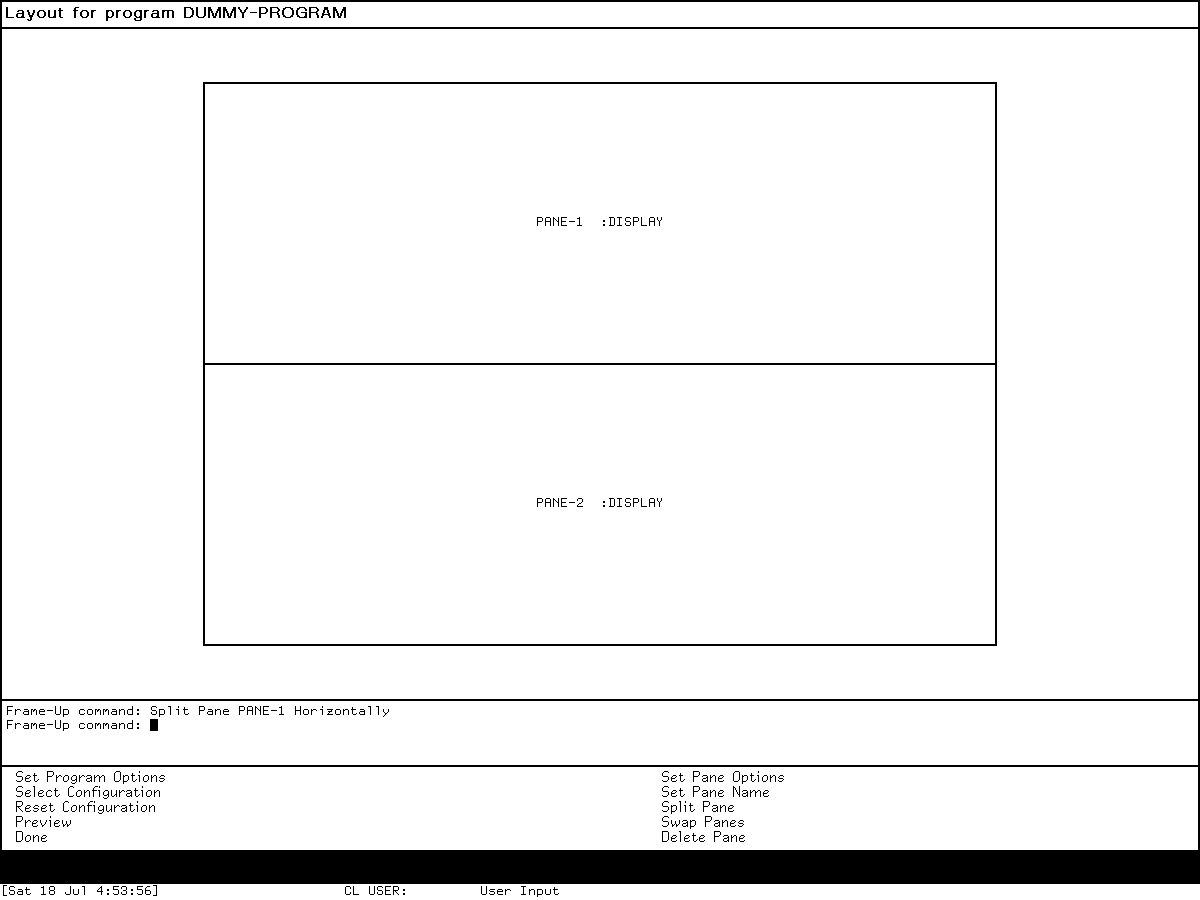
Bounded runtime evidence: the reviewed Frame-Up capture shows one live split-pane configuration after the recorded synthetic layout interaction. It supports the pane/configuration claim, not every constraint rule or framework lifecycle branch. Portable provenance and the image-specific rightsholder/fair-use analysis are in the Genera screenshot asset catalog; the image is scholarly evidence, not a decorative gallery item or a runtime dump.
An activity advertises a name, selection key/System Menu entry, compatibility test, and creation/reuse operation. Selection SHOULD find and raise an existing compatible frame before creating another when reuse is enabled; it must not rerun destructive initialization merely to expose the old frame.
Evidence: G85-SRC, program-framework-panes.lisp.~32~:58-459, define-program-framework.lisp.~332~:55-340,1106-1233,1343-1426,1726-1789, and window/activities.lisp.~35~:65-554; G8-MAN documents frameworks, the original six overview pane families, configuration, and redisplay options. The Frame-Up split is G85-RUN; default-column creation, every pane type, role inference, measured sizing, reuse, and failure restarts remain TODO-RUNTIME.
Accepting Values
Query model
AcceptingValuesQuery {
  id
  presentation_type
  prompt
  value
  default_and_default_state
  changed_by_user
  presentation_type_actually_read
  redisplay_piece
  start_position
  required_or_confirmation_policy
  dependency_or_cache_value
  displayed_value_presentation
  chooser_or_samples
  continuation
}
ACCEPTING-VALUES repeatedly runs a display body inside redisplay. Query IDs MUST be stable across iterations so values and presentations match. Editing a query updates its semantic value, validates it, records history when enabled, and redisplays the query plus any dependent output whose cache changed.
When an explicit query identifier is absent, the selected source derives one from a string prompt, or otherwise from the presentation type. The query table compares keys with EQUAL. Repeated same-prompt/type queries therefore MUST supply distinct explicit identifiers. An unchanged query can adopt a changed application default according to the selected default policy; a user-changed query retains its value unless the application explicitly resets it.
SIZE/DISCOVER:
  run body; establish query identities and natural output size
DISPLAY:
  rerun body through updating output; match each query by identity
READ:
  accept pointer choice, field edit, navigation, Refresh, End, Abort, or command
EDIT FIELD:
  edit inline, in a limited area, at form end, or in a separate window
  parse through ACCEPT; on failure retain old semantic value and correction text
RESYNCHRONIZE:
  rerun body; add/remove conditional queries; preserve matching changed values
RETURN:
  rerun in return mode so each query yields its final semantic value
The facility dispatches by stream capability. Plain/remote streams use serial prompts; a Dynamic Window can edit inline; a non-Dynamic TV stream can use a separate screen/window; an Accept Values pane participates in its owning framework.
Interaction contract
The standalone DW-G85/D4 form is a keyboard-accelerated program whose local command table inherits exactly standard scrolling and standard arguments. It does not inherit Colon Full Command, Unshifted Arguments, or the Input Editor map at its idle command boundary. The selected source initializes this complete direct map:
| Exact idle binding | Standalone Accepting Values result | Argument policy |
|---|---|---|
| Refresh | Force complete form redisplay and mark query redisplay necessary | Disallowed |
| Help | Display Accepting Values guidance plus the effective accelerator list | Disallowed |
| End | Validate required/confirmed queries, then commit and return | Disallowed |
| Abort | Signal Abort without accepting the form | Disallowed |
| Space | Replace the highlighted query, or choose the highlighted enumerated choice | Disallowed |
C-E |
Edit the highlighted query from its old value; on a highlighted enumerated choice, choose it just like Space | Disallowed |
C-D |
Reset the highlighted query to NIL; on a highlighted enumerated choice, signal the source's cannot-remove accelerator error | Disallowed |
C-N |
Move to the next query | Signed count allowed |
C-P |
Move to the previous query | Signed count allowed |
C-F |
Move to the next displayed choice in the current query | Signed count allowed |
C-B |
Move to the previous displayed choice in the current query | Signed count allowed |
Space, C-E, and C-D signal an accelerator error when neither a query nor choice is highlighted. Query/choice motion never wraps. Positive motion from a NIL cursor finds the first query or choice; negative motion from NIL beeps. Motion beyond either end beeps and preserves the preceding cursor. Negative counts reverse direction. A zero query count reselects the current query when non-NIL and beeps when there is no current query. For a zero choice count the selected source takes a single-value branch and supplies NIL as the presentation to the highlighting setter; a strict implementation MUST retain that call path rather than silently invent wrap or no-op behavior. The exact condition/result of that edge in the loaded world is TODO-RUNTIME.
The inherited standard scrolling table contributes this exact map. These are accelerators at the idle form boundary, not aliases from the Input Editor table:
| Exact inherited binding | Result | Argument policy |
|---|---|---|
| Scroll | Scroll the selected vertical window forward | No argument/sign-only means one screen; finite digit argument means lines; infinity means end |
M-Scroll; Back-Scroll |
Scroll vertically backward | No argument/sign-only means one screen; other arguments mean lines |
M-<; Home |
Scroll vertically to beginning | Disallowed |
M-> |
Scroll vertically to end | Disallowed |
Super-Scroll |
Scroll horizontally forward | No argument/sign-only means one screen; finite digit argument means columns; infinity means end |
M-Super-Scroll; Super-Back-Scroll |
Scroll horizontally backward | No argument/sign-only means one screen; other arguments mean columns |
C-Scroll |
Scroll the typeout window vertically forward | No argument/sign-only means one screen; finite digit argument means lines; infinity means end |
C-M-Scroll; C-Back-Scroll |
Scroll the typeout window vertically backward | No argument/sign-only means one screen; other arguments mean lines |
C-M-S |
Read one semantic character register and save the selected window/viewport position | Disallowed; this is a second-stage character read |
C-M-R |
Read one semantic character register and restore only a position saved for the same selected window | Disallowed; missing/mismatched register signals command error |
C-S; Super-S |
Search displayed strings forward | Disallowed |
C-R; Super-R |
Search displayed strings backward | Disallowed |
The inherited argument grammar is a multi-stage binding tree, not a free-standing command:
Accepting Values idle
├─ C-U -> argument 4
│  └─ C-U repeated -> multiply by four each time
├─ Control-, Meta-, or Control-Meta-minus -> negative-sign state
├─ Control-, Meta-, or Control-Meta-digit -> decimal digit state
│  └─ more modified digits -> signed decimal accumulation
├─ selected modified infinity-argument character -> signed infinity state
└─ next accelerator
   ├─ C-N, C-P, C-F, or C-B -> deliver signed count
   ├─ forward/backward vertical, horizontal, or typeout scroll -> deliver count/mode
   ├─ another argument character -> continue argument state
   └─ every argument-disallowing or unknown leaf -> accelerator error
The source creates the Control, Meta, and Control-Meta digit/minus/infinity variants in Standard arguments; the unmodified digit, minus, and infinity entries belong to the separate Unshifted Arguments table and are not effective here. On an accelerator error the standalone reader beeps, clears accelerator input, displays the diagnostic, and reprompts. Any other unknown idle character follows the same path. In particular, colon is not a hidden full-command prefix in this table. A presentation-produced command blip remains a separate valid input route.
The complete standalone pointer and menu tree is:
displayed query value
├─ exact unmodified Left / Select -> replace from empty typed input
├─ exact unmodified Middle / Select-and-Edit -> edit from printed old value
├─ exact Shift-Middle / Remove -> reset through query command
└─ exact unmodified Right / Menu -> generic Operation menu
   └─ offer applicable replace, edit, and remove handlers

displayed enumerated choice
├─ exact unmodified Left / Select -> choose semantic choice
└─ exact unmodified Right / Menu -> generic Operation menu containing choose

compatible displayed sample
├─ exact unmodified Left / Select -> copy sample into matching query
└─ exact unmodified Right / Menu -> generic Operation menu containing use-sample

displayed command button
├─ exact unmodified Left / Select -> run continuation and resynchronize
└─ exact unmodified Right / Menu -> generic Operation menu containing button action

Done or Abort command-menu cell / inline exit presentation
├─ exact unmodified Left -> execute zero-argument command
├─ exact unmodified Right -> execute the same zero-argument command
└─ Middle or any modified raw gesture -> no command-menu handler
Every translator above defaults to menu inclusion, so Right is generic handler-menu resolution rather than a second direct translator. Direct gesture matching is exact: the selected Dynamic Windows table has 32 modifier-bit states for each of three buttons, and a handler for Select does not match a modified Left event merely because Left is present. All raw states not named above continue through generic Dynamic Windows handler resolution and otherwise become a dead-blip/beep result.
The TV mouse encoder chooses the highest newly pressed button bit, so a simultaneous Left+Middle transition reaches Middle and any simultaneous transition containing Right reaches Right. Sequential chords are separate newly-down transitions. The same encoder represents a double click by setting the Shift bit. Consequently double Middle is indistinguishable at this boundary from Shift-Middle and reaches Remove; double Left is Shift-Left and has no Accepting Values direct handler. A conforming test MUST inject logical/raw events rather than assume host toolkit double-click semantics.
Selecting a query leaves the idle accelerator reader and enters typed ACCEPT for that query. At that point the complete Input Editor map above becomes effective only after the query's activation, rescan, completion, command, blip, and per-call editor overlays. Return and End are the ordinary Accept activation characters unless a specific presentation type overrides them; completion types additionally consume the completion gestures specified above. Successful parsing updates the query; full rubout or correction returns through the query editor rather than being mistaken for an idle form accelerator.
Pane-based Accept Values reuses the query/redisplay substrate but routes commands through the owning program. The base accept-values-pane table adds the value, choice, and command-button presentation translators but no keyboard accelerators. The optional accept-values-pane-with-keyboard-commands table adds exactly Space, C-E, C-D, C-N, C-P, C-F, and C-B, with the same cursor semantics and no echo. It inherits only accept-values-pane; Refresh, Help, Done, Abort, scrolling, and argument prefixes exist only when the owning program explicitly contributes them. After a pane command it MUST resynchronize owning program state.
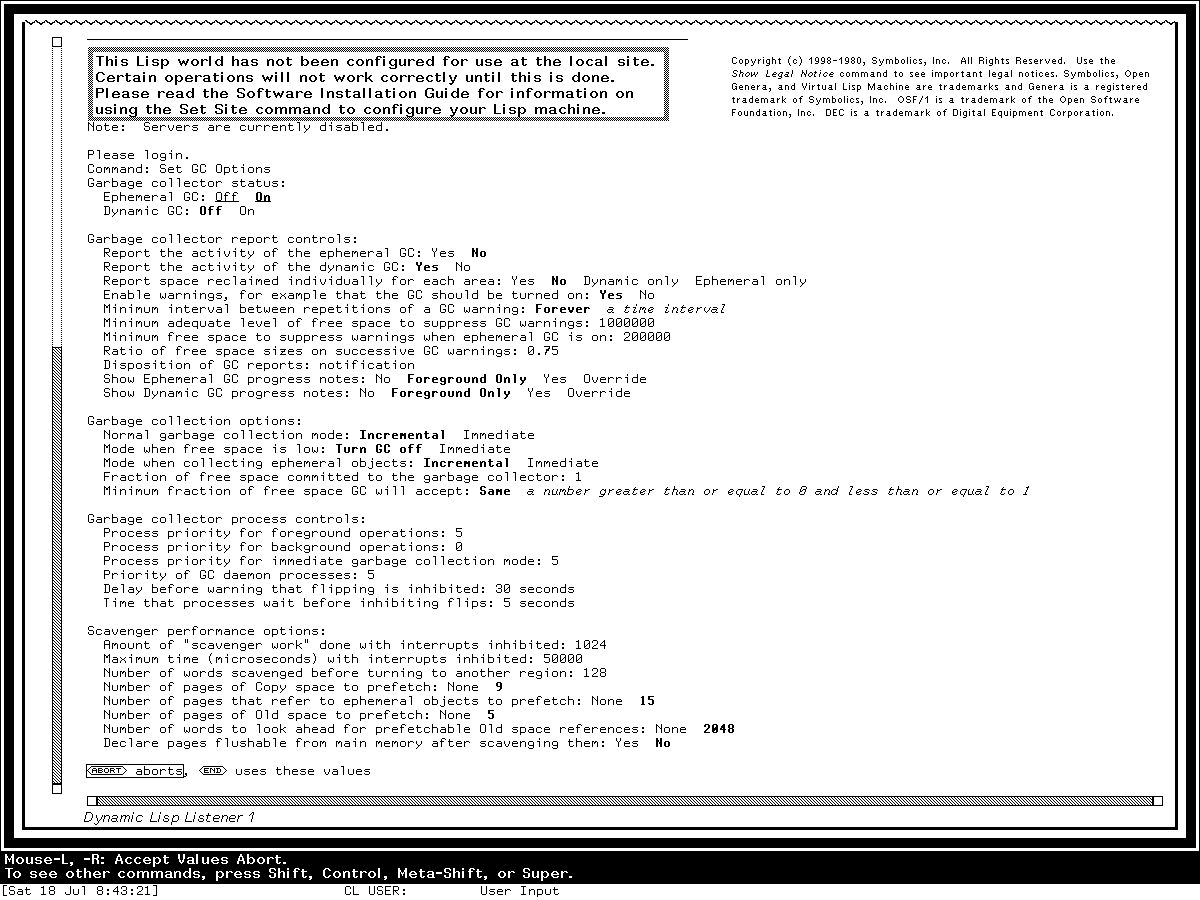
Runtime observation: the preserved Genera 8.5 world rejected an expression entered while a Boolean field owned the input context, redisplayed after correction, changed the mouse documentation over the Abort presentation, and returned without applying options after pointer selection. This bounded scholarly claim establishes typed field input and presentation-sensitive abort, not every query type. Portable provenance and the image-specific rightsholder/fair-use analysis are in the Genera screenshot asset catalog; the image is evidence, not decoration or a runtime dump.
Evidence: G85-SRC, accept-values.lisp.~244~:105-1797, plus cp/read-accelerated-command.lisp.~142~:55-831, cp/substrate-commands.lisp.~6~:99-299, dynamic-windows/dynamic-input.lisp.~498~:250-311,1160-1204, and window/mouse.lisp.~472~:631-700; G8-MAN independently documents prompt/query identity, EQUAL comparison, conditional queries, and formatted query output. Boolean correction and Abort are G85-RUN; changed-default resynchronization, every edit placement, command buttons, all 96 raw modifier/button states, zero-count choice motion, and non-Dynamic/serial fallbacks remain TODO-RUNTIME oracle obligations.
FQUERY and query-stream compatibility
FQUERY is a lower-level choice prompt, not an Accepting Values synonym. It selects or creates a query window when required, applies beep/clear/fresh-line options, renders the prompt, and loops until a legal choice, character, line, or abort outcome is obtained. Its choice objects have a presentation type and can use the completion engine. Yes/no queries are specializations of this protocol.
fquery(options, prompt, choices):
  select an existing compatible query stream or create a temporary one
  apply clear/fresh-line/beep and prompt options
  choose character-reader or line/completion-reader according to choice grammar
  loop until a typed choice, choice presentation, or permitted raw response succeeds
  unwind and release any temporary query window on Abort or nonlocal exit
A plain stream implementation MUST retain textual choice semantics without claiming pointer/menu support. A spatial implementation MUST return the semantic choice object from a presentation rather than reparsing its label. Evidence: G85-SRC, io1/fquery.lisp.~104~:55-327; public query operators are G8-MAN. A systematic FQUERY character/line/window/abort matrix is TODO-RUNTIME.
Diagnostics and introspection
A conforming D0 implementation MUST make the following state inspectable:
- canonical presentation type, arguments, expansion, and method providers;
- presentation ancestry and bounding regions under a pointer;
- active input-context stack and reductions;
- every considered handler, its effective priority, gesture, menu policy, and exact acceptance/rejection reason;
- command-table inheritance and effective commands/accelerators;
- output-history and redisplay record ancestry; and
- cache epochs and invalidation events in a debugging mode.
The historical Presentation Inspector is the behavioral model. Diagnostics MUST NOT execute a rejected handler merely to explain it.
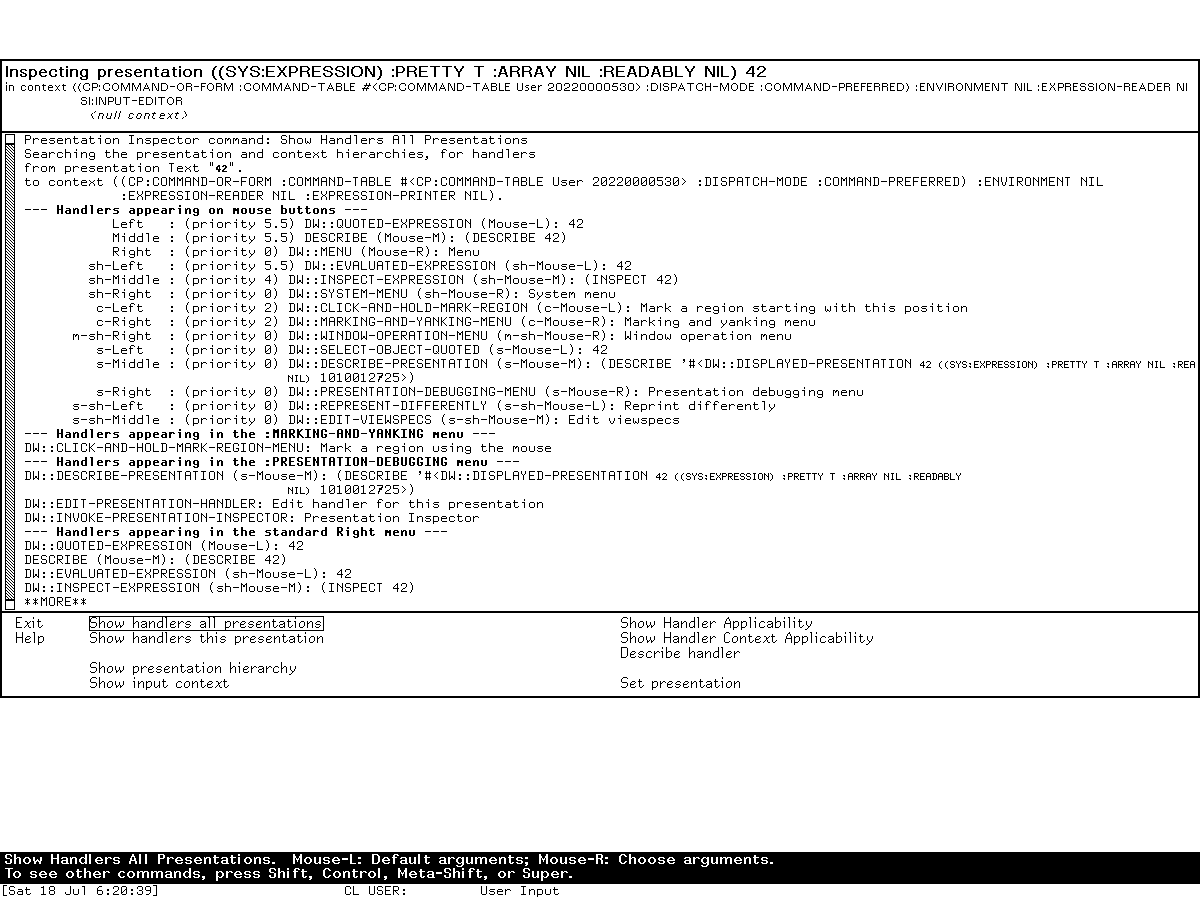
Runtime observation: the preserved inspector displayed handler categories, priorities, gestures, menus, and applicability for the selected integer. This is bounded scholarly evidence that dispatch retains inspectable semantic candidates rather than one callback attached to the text rectangle. Portable provenance and the image-specific rightsholder/fair-use analysis are in the Genera screenshot asset catalog; the image is evidence, not decoration or a runtime dump.
Error, abort, and transactional behavior
These INFERRED reconstruction invariants synthesize the source, manual, and runtime contracts and hold across all normal and recovery paths. They are not claims about Genera's internal representation:
- Every live child presentation has exactly one live parent or is a root.
- A committed presentation object satisfies its declared type.
- Pixels/output records and the semantic/spatial index commit together or the affected region is invalidated for repaint.
- Type, handler, gesture, command, and redisplay cache entries name the generations for which they are valid.
- Equal handler inputs produce deterministic candidate order.
- Input contexts and transient feedback are removed after every nonlocal exit.
- Presentation blips cannot dereference deleted records silently.
- Redisplay's display pass has the same piece identities/classes/order as collection.
- Recorded raster inputs are replay-stable.
- Program role streams refer to active-configuration panes or a documented plain stream fallback.
- Accepting Values preserves user-changed fields across resynchronization by query identity.
- Parser, printer, completion, and membership methods agree on the semantic value domain of a type.
A conforming implementation MUST report and unwind safely for:
- unknown, malformed, or cyclic presentation types; incompatible redefinitions; or use of generation-sensitive state cached under an obsolete definition;
- an object that fails its declared presentation type;
- missing printer/parser/method for a required role;
- incomplete, ambiguous, or invalid typed input;
- a handler translation whose result fails the target context;
- handler ambiguity that cannot be resolved by specified nesting, priority, dependency and menu rules plus the selected profile's dumped same-priority tie order;
- stale or invisible presentation selection;
- duplicate redisplay IDs within one matching scope;
- malformed formatted-output nesting;
- impossible pane constraints or missing pane names;
- command-table inheritance cycles or accelerator conflicts; and
- a pane/program command invoked after its owning frame was killed.
Abort is an ordinary interaction outcome, not process corruption. It MUST remove transient input editor state, contexts, highlights, menus, temporary TV windows, and uncommitted output/redisplay records. Application model mutations that span multiple steps SHOULD be protected by an explicit transaction or abort inhibition around the small critical region.
Performance requirements
The 1989 implementation reported global handler lookup and cache pressure. The following performance guidance is INFERRED; a new implementation SHOULD improve these properties while preserving results:
- index handlers by logical gesture and source-type ancestry;
- cache canonical types and type-method paths by descriptor epoch;
- cache effective command tables by table ancestry epoch;
- spatially index visible presentation regions while retaining semantic nesting;
- keep object-specific testers late in candidate evaluation;
- reconcile redisplay by stable scoped IDs rather than quadratic full-tree search;
- bound retained output history or expose an application-controlled reclamation policy; and
- provide counters for cache hits, candidate counts, full redraws, moved pieces, and stale-record rejection.
Optimization MUST NOT change which handler wins, omit Help/documentation candidates, or leave presentation indexes inconsistent with pixels.
Relationship to CLIM
CLIM inherits many ideas—presentation types, PRESENT/ACCEPT, translators, commands, output records, incremental redisplay, frames, and panes—but is a portable successor with a different API and implementation architecture. It is useful as an independent conceptual cross-check, not as evidence of a Genera 8.5 default or exact function contract.
A reconstruction MAY implement a CLIM adapter above this specification. It MUST NOT claim Dynamic Windows conformance merely because a CLIM program runs. The full release boundary and catalog audit are in How CLIM was used across the Lisp-machine software catalogs.
Clean-room reference architecture
A practical new implementation can use this decomposition:
presentation-types/
  syntax, descriptors, methods, lattice, generations, collision-safe caches

presentations/
  semantic records, nesting, regions, spatial index, output-history transactions

input/
  contexts, blips, gestures, handler selection, pointer documentation
  editor, history, rescan, completion

commands/
  tables, descriptors, command objects, accelerators/prefixes, typed reader

output/
  formatted continuations, simulation and measurement
  updating-record tree, tables, reconciliation and redraw planner

graphics/
  drawing state, transforms, primitives, raster backend, recorded operations

framework/
  panes, configurations, activities, lifecycle, program loop
  Accepting Values, FQUERY, menu and sequence clients

backend/
  Genera-TV dependency subset: sheets, streams, events, selection, raster, processes
The following clean-room architecture is INFERRED, not a claim about Genera's representation. Normalized type and handler descriptors SHOULD be immutable snapshots. Semantic output records SHOULD be backend-neutral, with pixel resources attached only by the renderer. Every history update should build a candidate tree and commit under one per-stream transaction. Start with correct full redraw; add pixel movement and caches only after generation invalidation and recovery tests pass.
This specification publishes only original behavioral analysis, witness metadata, and black-box tests intended for clean-room use. It does not publish proprietary bytes or implementation expression and does not decide downstream legal rights. Extracted Help, fonts, bulk runtime output, and the licensed source and world remain outside this specification.
Reference protocol inventory
| Protocol family | Required operations |
|---|---|
| Type definitions | define/redefine type, canonicalize, expand, query descriptor, define/invoke type method |
| Type relationships | membership, subtype/supertype, walk expansions, equivalent host type, argument-aware predicates |
| Typed output | PRESENT, scoped presentation recording, nested records, views, sensitivity, highlighting region |
| Output history | add/remove/clear records, transform/scroll, visibility, hit test, presentation ancestry |
| Typed input | ACCEPT, parser/printer, defaults, semantic blips, editor/rescan/activation, history, completion, postprocessing, compound contexts |
| Contexts | push/pop/reduce, inspect stack, match target, unwind on abort |
| Handlers | define translator/action/command/blank handler, test, prioritize, document, menu expose, invoke |
| Gestures | raw-to-logical mapping, modifier variants, current documentation |
| Commands | define command, accept arguments, construct/execute object, command loop, Help metadata |
| Command tables | define/inherit/mutate, effective lookup, accelerator and menu levels, cache invalidation |
| Formatted output | boxes, tables, cells, item lists, text blocks, graphs, measure/layout/replay |
| Redisplay | define piece, unique ID/cache, match, move/erase/redraw, nested reconcile, commit/abort |
| Dynamic streams | viewport, scrolling, output history, presentation index, input/command environment |
| Graphics | drawing state, viewport transform, clipping, primitives, ALUs/opacity, patterns/raster adapter, graphical presentations, history-only/direct modes |
| Frameworks | define program/state/panes/configurations/hooks, instantiate/select/loop/deselect/kill, register activity |
| Query/client facilities | Accepting Values query loop, FQUERY, menu program, reorder/alter sequences, branching undo framework |
| TV/backend boundary | sheets, interactive streams, events/wakeups, raster, coordinates, process ownership, activities, plain/remote degradation |
| Diagnostics | type, presentation, context, handler, command, output, redisplay, and cache inspection |
Historical source-interface and selected-module coverage
This appendix is normative about the boundary of a compatibility claim. D0-D4 cover the semantic protocols and behaviors stated in this document. They do not promise that an unmodified historical Genera program will compile. D5 is the closure level for that stronger claim. A pending entry is an explicit nonclaim, not permission to infer Genera behavior from CLIM or from a modern toolkit.
D5 public API closure
For D5, the implementation MUST publish a machine-readable manifest that gives the historical package and symbol, operator kind, complete lambda list or macro grammar, defaults, accepted options, return values, conditions and restarts, and the D0-D4 semantic operation implemented by each public entry. Public manual metadata should be the first source for public interfaces; installed-source metadata can identify System 452.22 additions or differences without publishing implementation bodies.
| Surface | D0-D4 coverage in this specification | D5 closure requirement and current state |
|---|---|---|
| Presentation-type definition and methods | Descriptor, argument classes, inheritance, method roles, generations, and invalidation | Exact defining macro/function names, package exports, lambda lists, method option grammars, redefinition values, and conditions are pending |
| Typed output, input, and contexts | PRESENT, scoped presentation recording, ACCEPT, input transactions, defaults, histories, completion, and nested contexts |
Exact operator signatures, keyword defaults, multiple values, condition/restart contracts, and context-form grammars are pending |
| Handler definitions and logical gestures | Handler kinds, applicability, ordering, menu/direct modes, gesture mapping, diagnostics, invalidation, and the complete 54-definition/66-record selected-source catalog | Exact defining forms/options, public signatures, and add/remove/redefinition interfaces are pending; installed-world identity, patches, equal-score order, remaps, and site/user additions remain runtime profile data |
| Standard presentation types | The 135 source-form calls are inventoried by family; common family invariants are normative | Per-type data and presentation lambda lists, defaults, parser/printer/view behavior, aliases, conditional population, and loaded-world identity are pending |
| Input editor, history, and completion | Buffer/blip/rescan model, complete selected base binding map and dispatch tree, numeric and staged prefixes, completion gestures/states, and semantic return values | Exact public entry points, option grammar, history protocol, resource conditions, completion auxiliary values, site mutations, and loaded-world behavioral confirmation are pending; no selected base chord is omitted |
| Command Processor | Command objects, table inheritance, typed arguments, accelerators, menus, command/form reading, and loop semantics | Exact CP packages, public symbols, macro grammars, argument-slot encodings, prefix APIs, compatibility aliases, values, conditions, and restarts are pending |
| Formatted output and redisplay | Box families, simulation, tables, capture rules, updating pieces, reconciliation, movement, and recovery | Exact combinator names/signatures/options, output-record classes, redisplay entry points, rounding rules, and callback counts are pending |
| Graphics and raster integration | Drawing state, primitive families, transforms, clipping, ALUs, opacity, recorded graphics, and output modes | Exact graphics signatures/options, pattern constructors, device auxiliary values, primitive edge rules, and public binary-graphics framing are pending |
| Dynamic streams and frameworks | Stream state, TV dependency, pane/configuration semantics, corrected lifecycle phases, activities, and role streams | Exact flavors/classes, messages/functions, pane and constraint grammars, hook signatures, creation/reuse options, values, and conditions are pending |
| Query and reusable clients | Accepting Values, FQUERY, menu, sequence, and branching-undo semantics | Exact operator signatures, query option grammars, drag thresholds, return conventions, and Abort ownership are pending |
| Diagnostics | Required semantic inspection state and safe rejection reporting | Exact inspector commands, programmatic entry points, report formats, and auxiliary values are pending |
D5 conformance MAY be claimed for a declared subset only when every public interface used by that subset has a complete manifest entry and a black-box source-compatibility test. It MUST NOT be generalized from one compiling demonstration to the complete Dynamic Windows API. Exact private binary encodings, QFASL compatibility, and Ivory object layout require separately named profiles even after D5 closes.
Selected System 452.22 module coverage
The component directory is a load-selection witness, not proof that every selected module has a separate public contract. This matrix prevents a selected module from silently disappearing from the reconstruction boundary. Normative means this page states its D0-D4 semantic contract. Partial means only the named behavior is in the base profile; the remaining public surface needs a subprofile or D5 closure. Infrastructure means no independent user-visible contract has yet been established.
| Selected component group | D0-D4 status | Unspecified or follow-up boundary |
|---|---|---|
SUBSTRATE-DEFINITIONS, TYPE-DESCRIPTOR, TYPE-METHODS, TYPE-WALK, TYPE-KEYS, DEFINE-TYPE, DEFINE-HANDLER, TYPE-PRIMITIVES, ACCEPT-SUBSTRATE |
Normative: semantic records, types, methods, lattice, definitions, typed I/O, and invalidation | Exact public operators and representation-facing auxiliary values are D5-pending |
GOOD-TABLES, MOUSE-HANDLER-TEST, HISTORY-INNER, HISTORY-SUBSTRATE, RESTRUCTURE-ARGLIST |
Infrastructure/partial: table lookup, testing, history, and argument normalization effects are consumed by normative protocols | No independent public contract is claimed; audit exports and callers before assigning a D5 surface |
CORE-TYPES, NUMBER-TYPES, SEQUENCE-TYPES, PRESENTATION-TYPES, CHARACTER-STYLE-PRESENTATIONS |
Partial: source-form name inventory and family invariants are specified | Exact per-type signatures/methods and live conditional population are D5-pending and TODO-RUNTIME |
COMPLETION, DYNAMIC-INPUT |
Normative: complete selected completion gestures, editor/blip integration, 96-state raw gesture mapping, pointer documentation, and input-context behavior | Loaded-world ambiguity, maximal/left-substring completion, modifier, and cache oracles remain TODO-RUNTIME; exact APIs are D5-pending |
BASIC-HANDLERS, HANDLER-DEBUG, selected Presentation Inspector handlers |
Normative: complete selected-source catalogs contain 42/50, 4/7, and 8/9 definitions/records respectively; ordinary Zmacs inherits the stated 47/59 subset | Exact public definition APIs remain D5-pending; installed-world identity, patches, same-score order, remaps, and site/user additions remain TODO-RUNTIME |
CP DEFS, COMTAB, COMMAND-PROCESSOR, READ-ACCELERATED-COMMAND, SUBSTRATE-COMMANDS |
Normative for command-table, typed reader, accelerator, and loop semantics; DEFS supplies shared declarations |
Exact public API, standard substrate commands, and conditions are D5-pending |
CP OLD-SYMBOL-LINKS |
Compatibility support | Historical aliases are required only for D5 and remain pending |
FORMATTED-OUTPUT, REDISPLAY, DISPLAYED-PRESENTATION, DYNAMIC-WINDOW |
Normative: layout families, recorded output, semantic regions, streams, replay, and redisplay | Exact public API and remaining layout/pixel oracles are D5-pending or TODO-RUNTIME |
FORMATTED-OUTPUT-COLD, BOX-ARITHMETIC |
Infrastructure/partial: cold-load availability and box results support the normative layout contract | Exact arithmetic, rounding, cold-load dependencies, and any public entries need source audit and runtime probes |
GRAPHICS-PATTERNS, DYNAMIC-WINDOW-FLAVORS, GRAPHICS-FLAVORS, DYNAMIC-WINDOW-MIXINS, GRAPHICS-GENERICS, RASTER-GRAPHICS-MIXIN, DEFINE-VIEWPORT-GRAPHICS-OPERATION |
Normative for drawing state, transforms, primitives, raster execution, recording, and the TV adapter; patterns and flavor/mixin surfaces are partial | Pattern constructors and exact flavor/message APIs are D5-pending; primitive raster edges remain TODO-RUNTIME |
DYNAMIC-WINDOW-COMBINATIONS |
Partial: the base profile permits embedded subwindows and composite formatted output | Exact combination constructors, ownership, layout, input routing, and destruction semantics need a dedicated source/runtime subprofile before a compatibility claim |
GRAPHER |
Partial: graph/tree output, node/edge records, layout, and presentations are required only at the family level | Exact graph data model, layout algorithm, options, interaction, and failure behavior need a dedicated source/runtime subprofile |
BINARY-GRAPHICS |
Partial: versioned typed encoding and failure on unsupported values are specified | Byte-exact framing/opcodes are outside D0-D4 and remain separately pending after D5 unless explicitly included |
WINDOW;ACTIVITIES |
Normative dependency: registration, compatibility, selection, reuse, and state distinctions | Exact TV activity API belongs to the Genera-TV backend/D5 manifest |
WINDOW;BACKGROUND-STREAM |
Partial dependency: capability-tested textual degradation is normative | Exact queueing, process, remote, failure, and lifecycle behavior remains TODO-RUNTIME and D5-pending |
Dynamic Windows COMETH |
Unclassified selected component | Its independent purpose and public contract are not established here; do not infer either. Source/caller analysis is required before D5 closure |
PROGRAM-FRAMEWORK-PANES, DEFINE-PROGRAM-FRAMEWORK, ACCEPT-VALUES, IO1;FQUERY, REORDER-SEQUENCE |
Normative for pane families, lifecycle, typed forms/queries, complete Accepting Values base bindings, menus, and sequence clients | Exact public grammars, options, values, site/owning-program overlays, and remaining interaction oracles are D5-pending |
GRAPHICS-TESTS, FORMATTED-OUTPUT-TESTS |
Test-only in the selected directory: not selected as normal loaded components | They are candidate oracle cases and evidence, not automatically normative production APIs |
Coverage evidence: G85-SRC component selection at patch/system-452/system-452.component-dir.~10~:370-457. This matrix describes coverage status only; it does not reproduce or characterize an uninspected module by its name alone.
Conformance test suite
Each test records the implementation version, DW-G85 profile, TV backend, logical event trace, semantic objects/results, record tree, and final framebuffer region. A comparison against the preserved world additionally records the complete harness provenance described below.
D0 substrate tests
| ID | Test | Pass condition |
|---|---|---|
DW-T01 |
Type argument separation | Data arguments affect membership/subtyping; presentation arguments affect rendering/input without accidental membership change |
DW-T02 |
Type expansion | Methods and relationships follow expansion; a cycle is diagnosed |
DW-T03 |
Redefinition invalidation | Old type/method/handler cache entries cannot affect the redefined descriptor |
DW-T04 |
Semantic versus host type | Two types over the same host class remain distinguishable in contexts and printers |
DW-T05 |
Nested presentation recording | Exact objects, types, parentage, regions, and sensitivity survive output |
DW-T06 |
Presentation unwind | An aborted output scope leaves no selectable incomplete record |
DW-T07 |
Visibility and scrolling | Off-viewport history persists but cannot be selected until visible |
DW-T08 |
Typed parser correction | Invalid input reports locally and remains editable; corrected input returns the typed object |
DW-T09 |
Default and edit-default | Selecting and editing a default take the correct distinct paths |
DW-T10 |
Completion states | Incomplete, ambiguous, unique, and invalid input remain distinct |
DW-T11 |
Compound acceptance | Inner pointer/typed input satisfies one component and outer parser resumes correctly |
DW-T12 |
History validation | Recalled object is checked against current arguments and predicate |
DW-T13 |
Four-state subtyping | True, false, unknown, and conditional parameter relationship remain distinguishable internally |
DW-T14 |
Type-key collision | Compact/canonical cache collision cannot change membership, methods, subtype, or handlers |
DW-T15 |
Semantic blip rescan | Placeholder is visible, but parser receives the original atomic blip/object after editing |
DW-T16 |
Dead blip | Deleting its presentation produces controlled correction, never stale dereference |
DW-T17 |
Kill/history separation | Consecutive kills coalesce, yank rotates only after yank, and stream history remains separate |
DW-T18 |
Numeric editor argument | Every nonzero-bit modified digit/minus and repeated C-U follows the exact state grammar; character/line/word/case/whitespace/history/scroll consumers use it as specified, while expression and other nonconsumers ignore then reset it |
DW-T19 |
Completion policy | No-match, ambiguity, left-substring, unique and exact states; closed types reject forced arbitrary input |
DW-T20 |
Complete base Input Editor map | Every listed key and alias reaches exactly one source command; End and every unlisted nongraphic character take the context activation or unbound-beep branch rather than an invented binding |
DW-T21 |
Input dispatch precedence | Activation/rescan/command/blip/pass-through and per-call editor overlays shadow the base map in the stated order; mutation updates effective Help and dispatch immediately |
DW-T22 |
Input multi-stage leaves | C-Q literal/error branches and C-M-S/C-M-R character-register reads terminate, fail, and reset numeric state exactly as specified |
Handler tests
| ID | Test | Pass condition |
|---|---|---|
DW-H01 |
Direct subtype match | A subtype presentation directly satisfies a supertype context |
DW-H02 |
Translator match | Source subtype, target context, tester, and gesture produce the translated object |
DW-H03 |
Rejected result | A translated object failing target predicate is not accepted |
DW-H04 |
Nested contexts | Innermost applicable context wins; outer context remains available if inner has no candidate |
DW-H05 |
Nested presentations | Innermost eligible presentation wins subject to explicit priority and sensitivity policy |
DW-H06 |
Priority and same-priority tie | Priority is exact; the selected loaded profile's effective same-priority order is dumped and diagnostics expose it rather than assuming intended stable-name behavior |
DW-H07 |
Action continuation | Action runs and original accept continues without a spurious value |
DW-H08 |
Presentation-to-command | Result is a typed command object with selected operand, not immediate callback-only execution |
DW-H09 |
Blank-area fallback | Applies only when no more specific candidate owns the gesture/context |
DW-H10 |
Documentation parity | Highlight/mouse documentation names exactly the dispatchable handlers under each modifier |
DW-H11 |
Handler mutation | Add/remove/redefine invalidates caches and changes dispatch immediately |
DW-H12 |
Inspector safety | Candidate reasons are visible without executing handler bodies |
DW-H13 |
Menu/direct separation | Menu-only and gesture-only handlers appear only in the applicable mode |
DW-H14 |
Context dependency and exclusion | Context-dependent tie and exclude-other-handlers follow selected ordering |
DW-H15 |
Gesture remap | Remapping physical chord updates dispatch and pointer documentation immediately |
DW-H16 |
Complete raw gesture matrix | All 32 modifier states by three buttons have distinct primary gestures and only the listed aliases; direct injection is separate from physical simultaneous/down-transition, timeout/NIL-off, keyboard-pending, Shift/double, no-triple, and Essential Mouse tests; found-handler semantic dead and true no-match signal/beep remain distinct rather than falling back to an unmodified gesture |
DW-H17 |
Selected-source registry census | A block-comment-aware source reader enumerates exactly 42/50 Basic, 4/7 Handler Debug, and 8/9 Presentation Inspector definitions/records and compares every name, source/target type, gesture, menu/blank/composition flag, tester, and priority with the catalog |
DW-H18 |
Zmacs inherited-context matrix | All 96 raw characters over BP, blank no-type, expression, pathname, history-element, and presentation-type fixtures in ordinary Zmacs, Input Editor, Form, CP Command, and In-Band Menu contexts produce the exact ordered candidates and winner; ordinary Zmacs's selected-source inherited denominator is 47/59 |
DW-H19 |
Application-before-inherited precedence | A raw event with a successful Zmacs compatible-comtab leaf takes that leaf; removing only that fixed cell falls through to the named Dynamic Windows handler |
DW-H20 |
Specificity and menus | BP-to-raw-text expansion selects Editor Yank versus generic Yank Word by type/priority, and Op/Blank/MY/PD menus preserve category isolation, styled-last ordering, duplicate removal, remembered defaults, empty behavior, and dismiss behavior |
DW-H21 |
No modifier fallback and mutation | A fully modified raw state with no mapped alias does not strip modifiers; add/remove/redefine invalidates candidate caches; equal-score live-world order is recorded as runtime profile data rather than selected-source conformance |
D1 command tests
| ID | Test | Pass condition |
|---|---|---|
DW-C01 |
Mixed argument sources | One command accepts typed, completed, and pointed operands in sequence |
DW-C02 |
Entry-path equivalence | Typed name, menu, accelerator, and translator build equivalent command objects |
DW-C03 |
Table inheritance | Commands, menus, handlers, and accelerators resolve deterministically; cycles fail |
DW-C04 |
Table mutation | Descendant effective caches and Help update after change |
DW-C05 |
Accelerator conflict | Profile rule resolves or reports conflict; it never silently invokes an arbitrary command |
DW-C06 |
Abort command read | Partial argument contexts/editor/highlights unwind and command body does not run |
DW-C07 |
Post-command lifecycle | Hooks and configured redisplays occur exactly once after a successful command |
DW-C08 |
Noun-verb versus verb-noun | Equivalent semantic command and result for both interaction orders |
DW-C09 |
Unread versus NIL | Conditional/optional unread slot stays distinct from an explicitly supplied NIL |
DW-C10 |
Depth-first inheritance | First command/accelerator found in declared depth-first parent order wins |
DW-C11 |
Prefix Help and activation | Prefix state lists legal continuations and cannot execute before completion |
DW-C12 |
Numeric accelerator argument | Prefix argument reaches the same semantic command body exactly once |
DW-C13 |
Command/form correction | Failed command input remains editable and cannot become an unintended evaluated form |
D2 output and redisplay tests
| ID | Test | Pass condition |
|---|---|---|
DW-O01 |
Table alignment | Cell edges align across rows and nested presentations retain correct transformed regions |
DW-O02 |
Item-list reflow | Width change alters row/column layout without changing object identity or order |
DW-O03 |
Deferred state | Snapshotted and explicitly shared variables replay according to declaration |
DW-O04 |
Stable redisplay ID | Equal cache and geometry retains pixels/record identity without executing changed renderer |
DW-O05 |
Changed cache | Old full region erases and new output/presentations replace it |
DW-O06 |
Move-only piece | Pixels may move, but nested semantic regions and clipping update exactly |
DW-O07 |
Insert/delete/reorder | Final pixels/order equal a full redraw; no stale presentation is selectable |
DW-O08 |
Duplicate ID | Diagnosed or deterministically scoped; never randomly matched |
DW-O09 |
Redisplay abort | Old coherent tree or complete redraw remains; no mixed record index |
DW-O10 |
Output-history clear | Removes visible/hidden presentations and redisplay associations |
DW-O11 |
Overlapping moved pieces | Final stacking and exposed backgrounds equal a full redraw |
DW-O12 |
Highlight during redisplay | Transient feedback is removed/recomputed and never becomes application output |
DW-O13 |
Collection/display identity | Changing piece sequence/class/order between passes signals and forces coherent redraw |
DW-O14 |
Callback count | Cache hit/miss and changed-piece paths execute collection/display continuations as specified |
DW-O15 |
Flow-dependent child | Unsafe independent redisplay escalates to the nearest layout-safe ancestor |
DW-O16 |
History-only/direct output | Record-without-draw and draw-without-record remain distinct for text and graphics |
DW-O17 |
Mutable recorded raster | Replay uses the recorded snapshot, not later-mutated source bytes |
D3 framework tests
| ID | Test | Pass condition |
|---|---|---|
DW-F01 |
Definition validation | Bad pane names/configuration/table cycles fail before registration |
DW-F02 |
Lifecycle phase order | Definition-time activity registration, instance/state initialization, TV pane construction, activation/selection hooks, stream binding and top-level execution, reuse/reset, deexposure, and kill follow the specified phases; frame creation neither re-registers the activity nor invokes a nonexistent generic initialization hook |
DW-F03 |
Nonselectable framework | Usable internally but absent from activity/System Menu/Select registries |
DW-F04 |
Pane registry extension | New pane type appears to design/introspection tools without modifying their fixed code |
DW-F05 |
Command menu unity | Menu item invokes the same command object and hooks as typed interaction |
DW-F06 |
Display incremental policy | Only configured panes redisplay, with full versus incremental behavior respected |
DW-F07 |
Configuration switch | Pane exposure, geometry, selected and terminal-I/O panes, and presentation transforms stay coherent |
DW-F08 |
TV cover/deexpose | Dynamic output history remains semantic and redraws/restores correctly through TV lifecycle |
DW-F09 |
Graphics transform | Application, viewport, history, sheet, and device coordinates round-trip within integer policy |
DW-F10 |
Graphical presentation | Arbitrary drawing returns the exact recorded object through a gesture |
DW-F11 |
Default pane configuration | Omitted configuration places every declared pane in a vertical column and binds inferred role streams |
DW-F12 |
Activity reuse | Compatible existing frame is selected without destructive reinitialization |
DW-F13 |
Remote/plain stream | Typed input/query semantics degrade textually without fabricated spatial facilities |
DW-F14 |
Ragged margin state | Synthetic vertical and horizontal extents exercise all 16 four-edge predicate combinations allowed without a secondary viewport, both forced horizontal edges with a secondary viewport, the top/bottom-only option, straight-to-ragged and ragged-to-straight redraws, ten-pixel phase anchoring, and absence of presentation/output-history records from margin drawing |
D4 client tests
| ID | Test | Pass condition |
|---|---|---|
DW-A01 |
Accepting Values query stability | Query IDs preserve values/history across iterations and dependent redisplay is selective |
DW-A02 |
Type rejection/correction | Wrong typed value does not commit; corrected value redisplays and can commit |
DW-A03 |
Done versus Abort | Done validates/returns; Abort leaves caller state unchanged |
DW-A04 |
Samples and buttons | Compatible sample copies value; command continuation runs then form resynchronizes |
DW-A05 |
Pane ownership | Accept Values pane commands route through owning framework and state |
DW-M01 |
Menu prefix | Case-insensitive prefix, highlight navigation, End, Rubout, Clear, Help, and Abort remain synchronized |
DW-R01 |
Reorder drag | Each threshold crossing moves one item; Done returns order; Abort discards working state |
DW-R02 |
Cross-sequence abort | Element exists exactly once before and after an abort at every mutation boundary |
DW-Q01 |
FQUERY choice parity | Character, line/completion, and pointer choice return the same semantic choice object |
DW-Q02 |
FQUERY cleanup | Temporary query window and editor/context state unwind on every Abort boundary |
DW-A06 |
Query resynchronization | Conditional removal/reappearance preserves explicit-ID changed value under selected policy |
DW-A07 |
Complete idle accelerator tree | Every local and inherited standalone key, alias, numeric/infinity sequence, argument-disallowed leaf, colon, and unknown character matches the normative tree and diagnostic outcome |
DW-A08 |
Cursor navigation edges | Positive, negative, zero, first, and beyond-end counts for all four query/choice motions match no-wrap, beep, preservation, and zero-choice call-path semantics |
DW-A09 |
Complete pointer tree | Direct injection of all 96 named raw modifier/button states over values, choices, samples, buttons, exit presentations, and blank area selects the exact direct/menu/dead-blip path; separate physical tests cover simultaneous-button precedence, release/repress timeout and NIL-disabled mode, keyboard-pending suppression, Shift/double equivalence, no triple encoding, and pre-Dynamic-Windows Shift-Right interception |
DW-A10 |
Field-editor handoff | Entering replace/edit leaves idle accelerators for the context-shadowed Input Editor tree; activation, correction, full rubout, and successful typed commit return to the correct query state |
DW-A11 |
Pane binding profile | Base pane supplies no accelerator; optional keyboard pane supplies exactly seven direct keys, and only explicit owning-table inheritance adds scrolling, argument, Help, Done, or Abort behavior |
DW-A12 |
Pointer routing and semantic-dead split | Selected/unselected clicked windows with and without presentation-input-blip handling prove which context/table owns translation; blank Left alias tester, three-sibling-button highlight selection, Operation-menu sort/default/dismiss/empty behavior, and found-handler dead versus true no-match signal/beep all match the selected profile |
DW-U01 |
Branching undo | Undo then new action preserves both redo branches; branch choice reaches the selected operation |
DW-U02 |
Clear history index | Clear empties first/last/current while later operation indices remain monotonic |
Source, compiled-world, and oracle disagreement rules
System 452.22's component directory establishes which source modules were selected; it does not prove that the saved Genera 8.5 world contains those exact definitions. The world can include patches, conditionals, architecture-specific compiled code, runtime redefinitions, or definitions with no readable selected source witness.
Apply these rules:
- For the
DW-G85behavioral profile, a reproducibleG85-RUNobservation of the identified world outranks a conflicting source-only prediction for that exact interaction. G85-SRCremains authoritative evidence for the selected source interface and algorithm; do not rewrite it to pretend it agreed with the world.G85-WORLDintrospection can establish that a definition, type, table, activity, or compiled method is resident, but not every hidden branch's behavior.G8-MANestablishes intended public behavior. A manual/source/world conflict is recorded as a three-way conflict, not resolved by choosing the most convenient text.UIST89establishes chronology and the paper-era design, not a later 8.5 defect.- A screenshot proves only its bounded visible state and recorded input path. It cannot alone prove hidden object identity, cache behavior, or method provenance.
- Until a harmless synthetic oracle reaches a branch, retain
TODO-RUNTIMEand implement the source-established rule behind a compatibility switch if needed.
Each future oracle should ask the running system for loaded definition/patch identity where possible and attach it to the harness record. If compiled behavior differs, add a conformance variant with both expectations rather than silently blending them.
Known compiled/wire gaps include the exact binary-graphics byte encoding, conditional standard-type population, architecture-specific compact type-key limits, and any patched definitions whose readable source origin the world cannot report.
Preserved-world comparison procedure
Use a fresh named run through the Genera computer-use harness. A comparison record for this profile begins from the 54,804,480-byte Genera-8-5.vlod, SHA-256 a8ee5e86cc7e322f7385af3e0cd579d7650d4dcfc3ce328acbf8b25515dd0672. It MUST record whether the private copy matched that base at start and how it differed at stop; a matching world hash still does not establish which source version produced every compiled definition. The comparison record MUST retain the base/private VLOD, debugger and VLM hashes, compatibility preloads, time responder and configuration, namespace/isolation state, X window identity, ordered input intents and outcomes, screenshots and pixel hashes, private-world hash change, and every shutdown stage. A forced host cleanup after Genera's known shutdown stall is not an orderly guest exit and must be labeled separately.
Prefer researcher-owned synthetic values, frames, types, handlers, and commands created in unsaved memory. Do not publish licensed output payloads or source. A reviewed screenshot may document only the visible state needed by a substantive claim.
Known unknowns and required follow-up
TODO-RUNTIME: dump resident/redefined identity for the complete 54/66 selected-source handler denominator, then use a small synthetic type lattice to measure exact live priority, context-dependency, equal-score order, nested contexts, and nested presentations. Patches, gesture remaps, and site/user additions remain overlays rather than omissions from the source catalog.TODO-RUNTIME: exercise handler add/remove/redefinition and observe cache invalidation in the preserved 8.5 world.TODO-RUNTIME: compare all logical gesture/modifier mappings and mouse documentation for a synthetic handler set.TODO-RUNTIME: execute the now-complete source-defined Input Editor map over text, styles, presentation blips, context shadowing, site mutation, failed register reads, kill/history/search/selection, and rescan boundaries in the preserved world.TODO-RUNTIME: measure every completion state, maximal completion, left-substring termination, quoting, and forced-invalid policy.TODO-RUNTIME: test command-table parent conflicts, accelerator prefix Help, numeric arguments, unread conditional arguments, and command/form fallback.TODO-RUNTIME: exhaust the standalone and optional-pane Accepting Values binding trees, including every local/inherited accelerator, argument-error leaf, all 96 raw pointer states, multi-button/double-click encoding, no-wrap cursor edges, and the zero-count choice call path.TODO-RUNTIME: run a synthetic formatted table/item list through width changes and record exact rounding and conditional-break results.TODO-RUNTIME: exercise redisplay insert, delete, move, reorder, duplicate ID, abort, and mutable lexical capture in one harmless framework.TODO-RUNTIME: exercise standalonemenu-program,reorder-sequence,alter-sequences,FQUERY, and the branching undo framework with synthetic data.TODO-RUNTIME: exercise all seven standard pane types, default-column role inference, measured pane sizing, activity reuse, and redisplayer error restarts.TODO-RUNTIME: exercise serial/plain/background/remote stream degradation without assuming spatial Dynamic Window operations.TODO-RUNTIME: compare graphics transforms, raster edge rules, clipping, history-only/direct modes, mutable raster replay, and binary-graphics framing.TODO-RUNTIME: create a synthetic horizontally oversized Dynamic Window and capture right-only, left-and-right, and left-only ragged side states with exact viewport coordinates and margin configuration; then exercise a secondary viewport to confirm the source-defined forced top-and-bottom state.TODO-RUNTIME: measure output-history reclamation and global handler-cache behavior to determine whichUIST89limitations remain in System 452.22.- The D5 public API manifest and all
pendingselected-module entries in the coverage appendix remain closure tasks. Use the public dictionaries for public interfaces first and local installed-source metadata only to identify release-specific facts; do not publish proprietary implementation bodies. - No claim is made that CLIM's unspecified corner behavior fills a Dynamic Windows gap. Unverified differences stay TODOs.
Artifact identities
The following are metadata for licensed local evidence; the files remain untracked.
| File | Bytes | SHA-256 | Role |
|---|---|---|---|
Base Genera-8-5.vlod world |
54,804,480 | a8ee5e86cc7e322f7385af3e0cd579d7650d4dcfc3ce328acbf8b25515dd0672 |
G85-WORLD identity used by the reviewed runs; not proof of source-definition identity |
sys.sct/patch/system-452/system-452.component-dir.~10~ |
70,420 | 65223d62d539dc78e57ee3671f292686bb2e8d388314474d866fd1115d35bcf7 |
Selected module order |
sys.sct/sys/sysdcl.lisp.~1059~ |
39,497 | 3bb5fad39feb2d174c53b94ea7b726a6f3fa3de1ec18a1293352bb68027c1584 |
Subsystem order and module composition |
sys.sct/dynamic-windows/substrate-definitions.lisp.~44~ |
47,954 | d9692d71c5e0237944a32330f2b02ba9cafdee23f6f34b2f586edd706fdf8e3e |
Presentation substrate structures/protocols |
sys.sct/dynamic-windows/type-descriptor.lisp.~12~ |
41,401 | b891b5326b00307fb36512f7680114388ab7fe6913237fd5b3dc3ab860a4bae1 |
Descriptor protocol |
sys.sct/dynamic-windows/type-methods.lisp.~6~ |
32,708 | c759735e87f996be7ae9eb5efb2afb10c523ec425b134be927a2e53cb2879aed |
Type-method lookup/inheritance |
sys.sct/dynamic-windows/type-primitives.lisp.~11~ |
14,636 | bb59437df0373786f97d2ac08c926722df5d9776814639cd97f783ebd2861ce7 |
Membership/subtype primitives |
sys.sct/dynamic-windows/type-walk.lisp.~17~ |
36,581 | 4cd810e5e96286d74934d04ae610dc25bbfe8fa206506e44ab4e6f1ad94dee9b |
Type-lattice traversal and host bridges |
sys.sct/dynamic-windows/type-keys.lisp.~3~ |
23,515 | 9b847c448bfe07450e3ad5f30162d39b226bf0b4ffb7c853d72a701007452116 |
Canonical/cache keys |
sys.sct/dynamic-windows/define-type.lisp.~8~ |
43,218 | f7505ed64460c90361b2cdfc09e2a96667dc1381a76270301233aa88573e4046 |
Type-definition interface |
sys.sct/dynamic-windows/define-handler.lisp.~12~ |
25,689 | 00d7c33ea97a342ff53877b8c33106f2b1730bb0fd86963d1a086e4bac883ab0 |
Handler-definition interface |
sys.sct/dynamic-windows/dynamic-input.lisp.~498~ |
55,058 | a79805ece6844ccb568ecf97e2d818a0c6095e539e51fbf74423944a32b6dd8f |
Input contexts and typed interaction |
sys.sct/dynamic-windows/dynamic-window-mixins.lisp.~204~ |
139,058 | d1c9db01f37982f10efdd5f7f21dff938a437c4b1f80633c04054158be87a482 |
Selected-window-sensitive presentation click routing; ragged-margin rendering, allocation, state change, and presets |
sys.sct/dynamic-windows/basic-handlers.lisp.~30~ |
58,716 | 3a85f039dbeb76b65401c0f88f1b1712cf9961645aee6f82c5bfb04c14c4303d |
Generic presentation, menu, marking, window-operation, and System Menu handlers |
sys.sct/dynamic-windows/handler-debug.lisp.~33~ |
13,058 | ff2081af4ac6b0c4c41446b2f12de971e6f16b8197cd8005a204bfca5c04007a |
Presentation-debugging gesture and menu handlers |
sys.sct/dynamic-windows/presentation-inspector.lisp.~4053~ |
45,825 | 9f20e13acd39201e73fee30d6890275aaf9d0b745f6b2089dfad0e05869f494d |
Eight selected handler definitions/nine records plus local inspector commands; runtime screenshot proves only the exercised inspector path |
sys.sct/dynamic-windows/mouse-handler-lookup.lisp.~33~ |
99,828 | 601385c017301e7158599b8dfe235650a1f5dee06a7944fc701ce8a4a491d716 |
Handler lookup and caches |
sys.sct/dynamic-windows/accept-substrate.lisp.~19~ |
53,779 | 3cc5c405bac3dc98d321cef309d51e4f9b1ec77369c3a82019e0fbd983376a33 |
PRESENT, ACCEPT, tokens/history |
sys.sct/dynamic-windows/core-types.lisp.~34~ |
83,350 | 3ff0511b6fcfd6b8d5583b6f5dd96bc7e651ac5ee49147ea50cb5126fbd2f927 |
Core standard presentation types |
sys.sct/dynamic-windows/number-types.lisp.~5~ |
34,144 | 7db2b506d918daed44731466a5bbb1504d198be7d7aed785a7778acf34353fa1 |
Numeric standard presentation types |
sys.sct/dynamic-windows/sequence-types.lisp.~28~ |
86,023 | 2486d359cd77f76ae8488a7ba87823654696807d6808b081d20d884038d8a163 |
Sequence and membership presentation types |
sys.sct/dynamic-windows/presentation-types.lisp.~722~ |
69,051 | cbe5cc7b320896ca7c835ffb40c2835ed4fd78cb4496c965fcf91290fd541a38 |
General system presentation types |
sys.sct/sys2/character-style-presentations.lisp.~64~ |
45,871 | 0649ab332ccd23954b660d31f21766c5cc18e388372f799c4152ea0113630aed |
Character-style presentation types |
sys.sct/dynamic-windows/completion.lisp.~206~ |
103,114 | 1af865c9149920a4a47090e2aea50d2db70ebf05550e2ed9a1c1e7fe6c62b07f |
Completion state machine |
sys.sct/io/input-editor.lisp.~332~ |
110,515 | 856548d945403aa4f5fa3036bd2e8b936890b07b231673c9e2cab5f9e42707b3 |
Input editing, blips, rescan, commands |
sys.sct/io/readers.lisp.~251~ |
89,420 | 234f313926a322f3d61e7d750c96bd3a1f4408b8eaf9eb8afffb294a28667491 |
Standard intercepted-character sets and reader behavior |
sys.sct/io/format.lisp.~369~ |
91,024 | ae5135cf2be3af4741093ea7f8e885259927d9aaa32555c7fa292553eb112249 |
Historical modifier-name formatter for the 96 primary pointer gestures |
sys.sct/cp/comtab.lisp.~103~ |
36,295 | f60724c8e2526950000f090f2dae4745b3394079713b3601606be865c23b98e1 |
Command tables/inheritance |
sys.sct/cp/command-processor.lisp.~318~ |
131,639 | 248550a755130c40322b3a12c608cfa7a18213b504d18f36d5fcf3399dc4bca6 |
Command definitions and typed reader |
sys.sct/clcp/iofns.lisp.~273~ |
100,273 | 21b171f5c23054894b7d11a3001226dabc6109790a1badb19a1f8ebbea84212d |
Command-reading wrapper and outer Input Editor presentation context |
sys.sct/cp/read-accelerated-command.lisp.~142~ |
37,639 | 8107cf4e993068344e624ec924c8d0cf0327158a927c1962666d22eb81494388 |
Accelerator/prefix reader |
sys.sct/cp/substrate-commands.lisp.~6~ |
14,731 | 558f085cc3953de3f831e4e9e195104303e9e6331861a9ed629b550870fb4f44 |
Standard scrolling accelerators and semantic commands |
sys.sct/window/mouse.lisp.~472~ |
119,392 | 9375d99e127c097e22852dc0ea7f6cd496101f01946a42eb0c6bf58051d4a3b6 |
Mouse transition, multi-button, and double-click encoding |
sys.sct/dynamic-windows/displayed-presentation.lisp.~47~ |
47,909 | b0d4dc75d13fef088bec77bc228af3b87b51f59ab2d1334e7051f93cc9ebc4c0 |
Spatial records and hit testing |
sys.sct/dynamic-windows/formatted-output.lisp.~397~ |
108,448 | 7317eee2b94d185f6f3ca51feed57a4adec7594760a81c17f7b55b043bb67de0 |
Formatted output |
sys.sct/dynamic-windows/redisplay.lisp.~185~ |
113,947 | 61134f02a3491966b3f45199af264e622b2004feccc3c2e3263e9866a99b699e |
Incremental redisplay |
sys.sct/dynamic-windows/dynamic-window.lisp.~625~ |
177,680 | 92e9322d4e04020d014055ab452036ff7df2adfe13570eb8c99c02e369de55ca |
Dynamic Window stream/output history |
sys.sct/dynamic-windows/dynamic-window-flavors.lisp.~29~ |
7,154 | 50fd3a8d734f63cdac289bac286056ade066a594039fe9dfd15402eefd7d1279 |
Default Dynamic Window margin composition |
sys.sct/dynamic-windows/graphics-flavors.lisp.~21~ |
6,763 | afc6cdf307fd60d2df8f66fe498faa876a19720b0afd80a1854350c58a7036ae |
Drawing state |
sys.sct/dynamic-windows/graphics-generics.lisp.~246~ |
182,943 | 76d11cb53809b2b96a07ed654fa57a63f52676a789978396e05a2b03d69576cd |
Graphics protocol/transforms/primitives |
sys.sct/dynamic-windows/raster-graphics-mixin.lisp.~157~ |
118,783 | c78ca3292c788f46a0fefdcd5f2f86357498dc48b7b583eef717831728024c09 |
Raster execution and clipping |
sys.sct/dynamic-windows/define-viewport-graphics-operation.lisp.~62~ |
59,210 | 9b4febea27966248fc8206e47252aa46a1700d0d252ce558ec95b27a6141a7bf |
Recorded graphics presentations |
sys.sct/dynamic-windows/binary-graphics.lisp.~43~ |
45,292 | 0d818dc79eef99f04ca709e76ac33c4a6d4220daca5aef2272de4ac751bab65e |
Versioned binary graphics |
sys.sct/dynamic-windows/program-framework-panes.lisp.~32~ |
18,999 | 4ebc7fac734b83b7f9c2be4e81fb47b6443157460c0fcdbbb864dd242eeb27ea |
Pane registry/standard panes |
sys.sct/dynamic-windows/define-program-framework.lisp.~332~ |
132,692 | e4fde854b9a36492bf4d23eec0a812bd36c7d42e7d32c649c7aaa5786cd30128 |
Framework generator and lifecycle |
sys.sct/dynamic-windows/accept-values.lisp.~244~ |
82,063 | 1c430c59e77f488fe3b85475bd89c704e2250e343243f7399ab9c0c5896de0d5 |
Standalone/pane typed forms |
sys.sct/io1/fquery.lisp.~104~ |
13,320 | 022823ae8dddbf64c598ab59bde00945c9b5e621191617b1374a84f020730e0f |
FQUERY and yes/no queries |
sys.sct/window/activities.lisp.~35~ |
22,385 | 8965c6ae99c41efbab9cf10896d0bca253f99dd7a85ad76c30b3e86b7df91089 |
Activity registry/reuse |
sys.sct/dynamic-windows/reorder-sequence.lisp.~10~ |
31,603 | d84c935cd8f2b7540e00464ab2a0e58aa98c4975316ea9e375c97665cfaa5a0f |
Reorder/alter client source |
sys.sct/graphic-editor/undo.lisp.~16~ |
12,680 | ce9e4a764cda0615c0771a55b3430e0a2c96d4e74cd8d0d910b50f61efaf7e9f |
Branching reusable undo framework |
The purchased Genera archive, VLOD, extracted source, and runtime session files remain ignored. The harness and linked dossiers carry portable world and screenshot provenance without exposing machine-specific paths.
Sources
- Scott McKay, William York, and Michael McMahon, “A Presentation Manager Based on Application Semantics”, Proceedings of UIST 1989, for the designers' semantic model, interaction goals, chronology, application experience, and then-current limitations.
- Symbolics, Programming the User Interface, Genera 8, for presentations, input contexts, handlers, commands, formatted output, redisplay, panes, frameworks, and Accepting Values.
- Symbolics, User Interface Dictionary, Genera 8, for the public interface reference.
- Licensed local Genera 8.5/System 452.22 source and preserved world, identified above and inspected 2026-07-18; only metadata and original analysis are published.
- Repository studies, Dynamic Windows and presentation-based interaction, Presentation Inspector, Screen Editor and Frame-Up, and Genera computer-use harness.
Last verified: 2026-07-26.