Emergency Break and the cold-load stream
Emergency Break is a live recovery console, not a reset, reboot, load-band restoration, or virtual-machine snapshot. On both the MIT CADR lineage and Symbolics Genera it enters a primitive Lisp break loop using a deliberately primitive stream that does not depend on the ordinary window system. Evaluation errors or an explicit debugger key can then transition into a Lisp debugger. An operator can inspect or change the running Lisp world while normal windows are unusable, then attempt to return to it. That power is also why both implementations label the path for experienced users and why museum runtime work uses a disposable private world.
The implementations are related but not identical. System 46 has a compact direct break loop. The maintained LM-3 System 303 implementation saves and restores the screen, arbitrates keyboard ownership, and can divert an error whose window is locked. Genera retains the same architectural escape hatch but adds a front-end processor-backed console, a more capable input editor, explicit cleanup, and platform-dependent availability.
The implementation-ready contract, including every source-visible entry prefix, cold-reader key, pagination branch, breakpoint leaf, debugger transition, recovery query, pointer route and multi-stage key sequence, is the Emergency Break and degraded interaction paths reimplementation specification.
Evidence and release boundaries
Public CADR material
The early evidence is the museum's public MIT CADR System 46 snapshot at revision 8e978d7. The relevant source files are the 37,385-byte lmwin/basstr.163, SHA-256 19e0771ff876d5325f18b97a2ccbf392f7d5950d3a89751d633d27d7cbe01e72, and the 28,436-byte lmwin/sysmen.105, SHA-256 c203bc08b5550edefb1928349179fc54c483655d273077294211eb778daff6f1. The 10,000-byte window-debugging manual source lmwind/wdebug.6, SHA-256 b1ea2f91d6900369c47b9bda823e943b501371372e74e544915e46bd45f4b51a, explains its intended recovery role. Links and local identities were verified on 2026-07-18.
The later public implementation and runtime observation use the maintained LM-3 System repository at Fossil check-in 4df393c, tag system-303. This tree is maintained preservation work, not silently treated as an unmodified 1980s distribution. The active window/basstr.lisp is 81,846 bytes with SHA-256 8ba3a16e726ed043e6585c7a68b7096bb2dcc5d6f05476afd89f84a48dff2645; window/sysmen.lisp is 43,408 bytes with SHA-256 b53b7c3d5a59040f3180d5be0d2072b2a334bb386fa5e19dd6abbd945148b40c.
Licensed Genera material
The Genera analysis uses the locally purchased Open Genera 2.0 release and the Genera 8.5 world it supplies. The source inputs remain ignored and are not linked or redistributed. The complete specification records the exact locally inspected source artifacts needed for its contracts. The core stream and entry files are:
| Release pathname | Bytes | SHA-256 | Evidence supplied |
|---|---|---|---|
sys.sct/window/sysmen.lisp.~250~ |
52,798 | 2f54fdb15335fc7f9f9f5c47a03f1ad2a5803d86787267949825f23853363f4c |
System Menu registration |
sys.sct/window/basstr.lisp.~645~ |
65,555 | 112245299c0d46cf81a67f2cc8de714c766711653be215467ef41bb2c6778021 |
function-key entry, selection, cleanup, and availability logic |
sys.sct/sys/cold-load-stream.lisp.~6~ |
15,225 | a6ba54d93b4d8b5852653686b183e9e7ba70763da48fe276e842f591f60ff27c |
front-end console stream and input editing |
sys.sct/sys/ifepio.lisp.~239~ |
17,345 | 2ea2530f775e4653891e49ea59c2dc05fe16b8155a91bdb8c30521aa2c61ac78 |
low-level special-character interception, output, and **MORE** |
sys.sct/debugger/debugger.lisp.~784~ |
99,026 | 0f12aed40337a76298f42ba16fe3e23723ac005e34a63927c0dbff8b6c91e600 |
cold takeover, saved-screen ownership, cleanup, and recursive degradation |
sys.sct/sys/ltop.lisp.~754~ |
25,132 | 18f1cc03e5a5aefc06b97eaa5649cffdf2717b824f994422d8ea2111f1db6ebb |
distinct minimal emergency evaluator and warm-reinitialization boundary |
These are local artifact observations verified through 2026-07-19. They support original technical description here, not publication of the proprietary files.
Entry points and visible contract
| System boundary | Entry point | What the source advertises |
|---|---|---|
| System 46 | Terminal Call |
get to the cold-load stream |
| System 46 | Emergency Break in the System Menu's Other column | equivalent recovery path when the keyboard or window system is suspect |
| LM-3 System 303 | Terminal Call and Emergency Break in the Programs column |
evaluate Lisp forms without using the window system, with an explicit caution |
| Genera 8.5 | Function Suspend |
get to the cold-load stream, with caution |
| Genera 8.5 | Emergency Break in the System Menu | start a high-priority process that enters the same stream with that reason label |
The menu item and keyboard prefix are not different breakpoint implementations. In each inspected release they start a process that calls the same keyboard recovery function. The menu exists partly because a mouse may still work when the relevant keyboard path does not; a System 46 change note says this explicitly. After the cold stream is selected, however, it has no pointer or presentation bindings.
Why it survives window-system failure
The cold-load stream is part of the small I/O environment available during and below ordinary system startup. It can draw characters and read keyboard input without acquiring an application window, redisplaying a pane, consulting a command table, or selecting an editor buffer. “Cold-load” names that implementation layer; entering Emergency Break does not reload the cold load or replace memory with an older image.
This separation matters in failure cases such as:
- a sheet or superior locked by another process;
- the selected process waiting in
Output Holdor on a window-system lock; - the error handler being unable to obtain a usable error window;
- the scheduler discovering an invalid inhibit-scheduling state; or
- a screen that cannot be exposed on the available hardware.
The ordinary debugger can be the thing that cannot display. The cold-load path changes the I/O dependency first, then runs Lisp and debugger machinery over that minimal stream.
System 46: a compact independent breakpoint
KBD-USE-COLD-LOAD-STREAM first moves the cold-load cursor home and clears the rest of the line. It establishes a top-level catch, enables scheduling for the break, binds TERMINAL-IO to the cold-load stream, prints the current package, and calls BREAK on that stream. The operator receives a Lisp break loop drawn directly over the display rather than a new window.
The contemporary window-debugging documentation gives the intended operating sequence: enter through Terminal Call or the menu, inspect process or window state, optionally redirect error-handler output to the cold-load stream, continue, and then force the affected process into the normal error handler. It also suggests the cold-load stream for trace output when tracing the ordinary window interface itself. That is a narrow diagnostic purpose, not a recommendation to use this console as the normal listener.
System 303: screen preservation and error-window recovery
The maintained implementation adds several layers around the same idea:
- a global ownership flag prevents the normal keyboard process from consuming characters while the cold-load stream owns the keyboard;
- the current screen is saved before the breakpoint and restored in an unwind cleanup;
- any error windows recorded as locked are offered one at a time for handling over the cold-load stream;
- standard terminal I/O is rebound to the cold-load stream and the current package is displayed;
BREAKruns under an explicit abort/error restart; and- screen restoration runs even when the breakpoint exits abnormally.
This is a useful code-only finding beyond the short menu label: Emergency Break can be the dispatch point for an already-waiting error whose graphical debugger window could not be used. It does not merely create an unrelated REPL.
The source also contains degraded recovery neighbors: clearing temporary windows, clearing window-system locks, attempting a lock-aware redisplay, and forcing or redirecting output. These are separate operations. Emergency Break gives the operator a place to reason about them; it does not automatically clear every lock or repair every process.
Genera 8.5: front-end console and explicit cleanup
Genera's WITH-COLD-LOAD-STREAM wrapper saves the selected window and original terminal stream, redirects query, debug, error, standard input, and standard output through synthetic terminal streams, marks the cold-load stream selected, and asks the debugger substrate to take over the console. An unwind cleanup calls the debugger's cold-load recovery function. The actual Emergency Break path clears the selected-window binding, prints the current package, and invokes BREAK over the cold-load stream.
That user-facing path is distinct from the function named SI:EMERGENCY-BREAK. When recursive debugger depth reaches 25, Genera bypasses the ordinary debugger command surface and enters that smaller read/evaluate/print loop; at depth 30 it halts into the auxiliary FEP/VLM layer. The menu label therefore must not be used as evidence that the menu directly invokes the minimal evaluator.
The underlying Genera stream is not just a character-output primitive. The inspected source maintains cursor geometry, a rubout-handler buffer, prompt and “noise string” state, activator and unread-character cells, single-character Rubout, whole-buffer Clear Input, screen refresh, Help, activation, and **MORE** behavior. It does not provide the ordinary Input Editor's cursor-motion, word-motion, kill/yank, or completion maps. Its lowest-level display and keyboard operations go through the front-end processor interface. This explains how the console can offer a usable reader while avoiding Dynamic Windows.
The exact source tree is context-sensitive. Before rubout editing, Control-Suspend recursively enters BREAK, Control-Meta-Suspend enters the ordinary Debugger, and Control-Abort signals Abort. Within the editor, Refresh redraws the prompt and buffer, Control-Refresh redraws after a fresh line, Help chooses the first available configured help mode, and any otherwise unhandled modified character beeps. The Lisp reader uses End as its activation character. There is no cold-stream pointer command or multi-stage editor prefix.
The ordinary Break loop then gives the first nonwhitespace character another context: Resume returns; Abort and Control-Z take the abort path; Suspend enters a nested Break; Meta-Suspend enters the ordinary Debugger; and (RETURN expression) returns all values of the expression. Once text has begun, intercepted characters again follow their ordinary asynchronous behavior. This command-loop layer is distinct from both the lower cold-stream intercept and the depth-25 minimal evaluator.
Availability is platform-sensitive:
- on 3600-family builds the source enters the console directly;
- on Ivory-machine builds it checks the applicable system case, including a Domino debug switch;
- if the stream is unavailable and the caller did not require it, the user receives a notification; and
- a caller that requires a debugger instead signals the stated reason, allowing a stack trace and warm-boot path rather than silently pretending the console exists.
This conditional is a high-confidence source fact. Whether the purchased Open Genera VLM world takes each branch remains a runtime question; the museum has not forced a failure merely to discover it.
Capabilities and limits
What an operator can do
- read and evaluate Lisp forms in the live world;
- inspect packages, variables, functions, processes, windows, locks, and debugger state using callable Lisp facilities;
- change live state to redirect diagnostics or repair a known problem;
- enter debugger commands and restarts supplied by the running error system; and
- attempt to recover to the saved screen and process state.
What the path does not provide
- an isolated address space or rollback point;
- automatic repair, transactional undo, or protection from a mistaken mutation;
- the ordinary window debugger's panes, mouse-sensitive stack frames, source links, or presentation menus;
- proof that every scheduler, device, or memory failure leaves enough machine alive to run Lisp; or
- a substitute for saving a world, rebuilding a band, or restarting the emulator.
“Independent of the window system” is therefore a dependency claim, not a promise that the rest of the machine is healthy.
Runtime observation on LM-3 System 303
Disposable harness session emergency-break-20260718, generation 1, booted load band System 303-0 as Experimental System 303.0, ZWEI 129.0, microcode 323. After dismissing the date question, the researcher opened the System Menu and confirmed the visible Emergency Break item. The exact menu click did not expose the breakpoint in that attempt, so the listener evaluated the menu target directly as (tv:kbd-use-cold-load-stream).
The observed display then:
- identified package
USER; - announced a breakpoint using the cold-load stream;
- said Resume would continue and Abort would quit;
- accepted the researcher-entered form
(+ 40 2); and - printed
42on the cold-load display while the original Lisp Listener remained visible underneath.
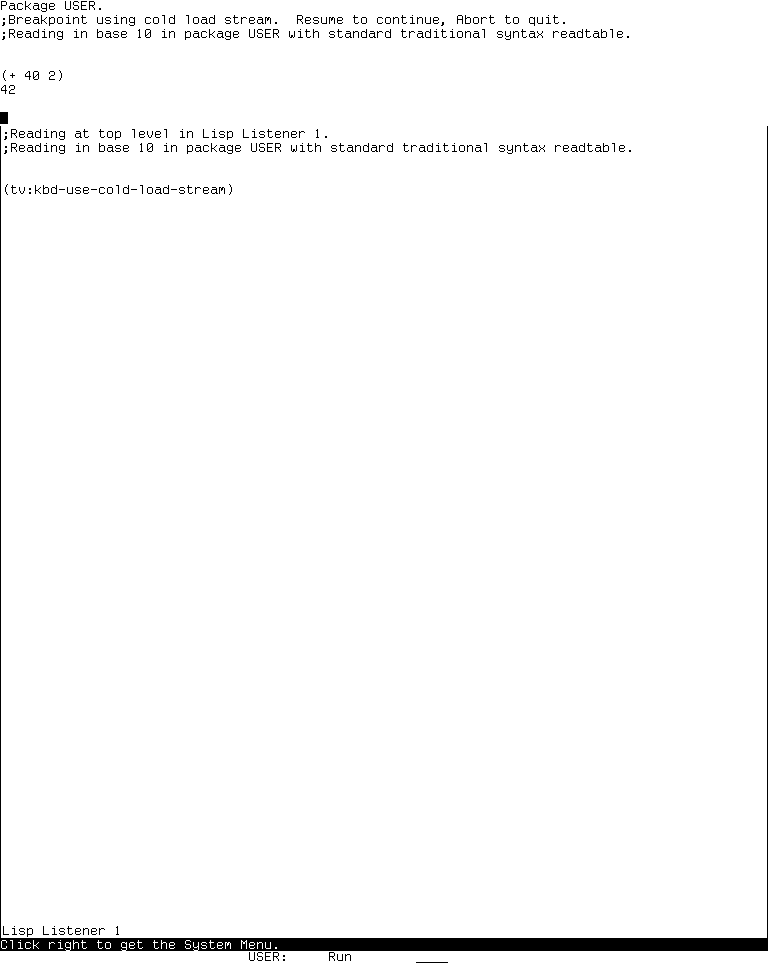
Runtime observation: LM-3 System 303 Emergency Break after evaluating a synthetic arithmetic form, captured 2026-07-18. Underlying software and display material remain the property of their respective rightsholders; reproduced for criticism, scholarship, and historical documentation under 17 U.S.C. section 107. No affiliation or endorsement is implied.
The harness's F11 event did not act as Resume in this context; Page Down inserted a visible Resume character into the cold-load reader, and submitting it produced an unbound-variable error. That is evidence about the present host-to-CADR key mapping, not evidence that a physical CADR Resume key failed. The session was therefore stopped through the harness instead of claiming a verified in-guest return path.
| Runtime item | Recorded value |
|---|---|
| Session interval | 2026-07-18 04:14:52–04:19:47 EDT |
| Disk | public base and private start SHA-256 bb16e46ad81decfe1efe691d36b6aa4ce3fd4ffb82474365de3520989d397cb5 |
| Source | public System check-in 4df393c68d7f083ce42d5c377039d26043cc18a9031ace28258dc97f4137eb91; unchanged private tree SHA-256 21f5215de973aa6ccbddb817f2d64edd95ee1014c3028a9b0711ea7c741b807e |
| Emulator | start and execution SHA-256 707a77d23e28ea1c45ae0eb0145dc181fa7ba649b9defc30044d4f847ac2c5be |
| Selected screenshot | 768 by 963; PNG SHA-256 e9af453164e75dccc90a4fe12a12b231e3308af9212b9c3b005a927e09f919ce; decoded-pixel SHA-256 f3e531869cdc3255270cde0ce5f808ae738298fe14573673b609a62f56e4e161 |
| Run record | 6,872 bytes; SHA-256 77bc6037b5f1fcdafdd253c7e32e33e0ad71e9989f9135508e5f9a79f4d0966a |
| Shutdown | clean: forced_stop=false, state_may_be_incomplete=false, usim and Xvfb exit status 0, public base disk unchanged |
The selected screenshot contains only a functional recovery display, short system labels, and researcher-entered arithmetic. Its use is reviewed in the runtime screenshot publication policy and recorded in the curated CADR screenshot catalog. It is not a source, manual, font, or decorative screenshot gallery.
Runtime observation on Genera 8.5
Disposable isolated session d04-emergency-break-publication-20260719, generation 1, used the exact identified Open Genera archive, VLM, debugger, and base world. The harness explicitly targeted either the main or Cold Load X client and failed closed if that kind was absent or ambiguous.
The positive action sequence was:
- hold Shift and the rightmost mouse button to display the System Menu;
- move to and visibly highlight Emergency Break;
- release the momentary-menu button and select the still-displayed item with Left;
- observe the separate Cold Load client announce “Emergency Break, using the cold load stream,” proving the actual menu dispatch rather than a direct substitute;
- type the synthetic form
(+ 40 2); - send the source-defined
Endcharacter through hostKP_End; - observe the value
42and a newCommand:prompt; and - send
Resumethrough hostF5, then observe the saved main Listener display restored.
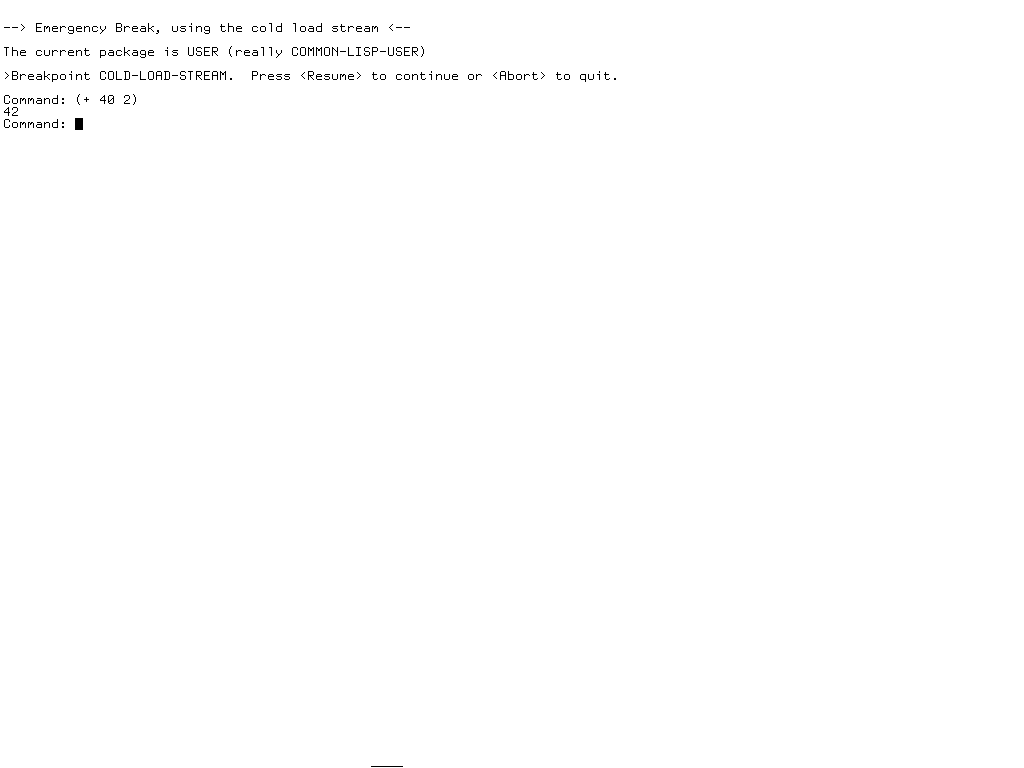
Runtime observation: Open Genera Emergency Break after actual System Menu entry, captured 2026-07-19. Underlying software and display material remain the property of their respective rightsholders; reproduced for criticism, scholarship, and historical documentation under 17 U.S.C. section 107. No affiliation or endorsement is implied. The image is excluded from the repository's project license.
| Runtime item | Recorded value |
|---|---|
| Session interval | 2026-07-19 08:13:46–08:16:36 EDT |
| Archive | 206,213,430 bytes; SHA-256 89fb3e76b91d612834f565834dea950b603acf8f9dbacacdd0b1c3c284a2d36e |
| World | 54,804,480 bytes; SHA-256 a8ee5e86cc7e322f7385af3e0cd579d7650d4dcfc3ce328acbf8b25515dd0672 |
| VLM / debugger | SHA-256 9f5e18d5770f973879716182b6856ef5a8ee9d3b2bb907476ea0cf35986aa4c7 / 2db918cfe8f35f52c7ff4b7695b0ecd3bb85e41a3327ea5a94874edf05edb54a |
| Harness | Python source SHA-256 6f8c65bdc2f814a8408f92eb05d3fac68eafefefe889bd02e570059694145497 |
| Selected screenshot | 1024 by 768; PNG SHA-256 b7edcce3ba94e9601335ac280438988d5ae40451c1f2235f2b5fe786f8736eb6; decoded-pixel SHA-256 219c9bce8d7771553141df4873aced28255317f6e7b1cd9700c61ef5ac834445 |
| Final action log | 42 records; SHA-256 0e3563bb5af99754dd00e08f294cdfc235e9bc2988b019c418342073f794bcdd |
| Recovery | Resume visibly restored the 1200 by 900 main client; restored capture PNG SHA-256 641dcef54b379e67a74e5e7bd19bbb5838ae42d01d5b63f8536c8fd2695bb35d |
| Persistence and stop | base/private world unchanged; save_world_invoked_by_harness=false; process_checkpoint_created_by_harness=false; in-guest save/checkpoint fields unknown; unsaved state recorded discarded/non-resumable; confirmation and cleanup progress observed; known forced VLM mutex-stall cleanup, so state_may_be_incomplete=true |
Two earlier menu gestures in this same session changed global input status without displaying or selecting the item. They remain negative timing/focus evidence, not successful entries. The third observed menu, highlight, exact reason banner, value, and restored display form the positive claim chain.
Preservation and safety guidance
- Always use a disposable private disk or world. A valid Lisp form can mutate the live machine as completely as code evaluated in an ordinary listener.
- Record the exact source/world boundary before testing. The recovery path changed substantially between System 46, System 303, and Genera.
- Test with synthetic, side-effect-free forms first. Do not manufacture a disk, scheduler, or network failure simply to obtain a dramatic screen.
- Distinguish an in-guest Resume/Abort result from an emulator stop. The latter proves containment, not guest recovery.
- Keep raw captures and all Genera inputs ignored. Curate only the minimum screenshot required to establish a specific historical claim.
Open questions
- Which exact physical-key sequence is appropriate for returning from this System 303 breakpoint through the present
usimSpace Cadet mapping? The source and display name Resume, but the current harness delivery was not verified. - Which actual platform/availability branches besides the now-verified base-world menu entry are reachable on 3600, Ivory, and Domino configurations?
- Does
Function Suspendin the purchased world follow the same complete lifecycle, including ignored numeric argument and typeahead release, as the source? - Which Genera debugger commands remain usable when invoked through the primitive stream, and which assume Dynamic Windows despite the stream redirection?
- Can a controlled locked-error-window fixture demonstrate the System 303 diversion path without risking unrelated state?
- Can equivalent Genera locked-window and Output Hold fixtures cover the cold yes/no/debugger choices without manufacturing destructive failure?