Converse, direct messages, and notifications on CADR and Genera
The Lisp machines did not have one undifferentiated “chat” facility. They had a small family of mechanisms with different histories and user interfaces:
| Mechanism | Purpose | Durable history in the running world |
|---|---|---|
SEND-MSG / QSend |
Send one interactive message to a user or machine, optionally prompting for its body | System 46 saves received messages only; later implementations also feed sent-message status into Converse |
| Converse | Edit, send, receive, and revisit direct messages in a Zwei-derived conversation buffer | Memory-resident received and sent/failure records; the selected System 303 source has no explicit OLDMSGS reset, while Genera deletes conversations before cold; explicit commands can export the display to a file |
SHOUT |
Fan one message out to every Lisp Machine in a site inventory | No separate conversation or delivery log beyond what receiving facilities retain |
network NOTIFY |
Send a brief host-level notice that the receiver submits to its notification system | The receiver's notification history, not Converse |
| Genera Notifications | Deliver and retain asynchronous messages from programs and network services | All notifications since the last cold boot, in a central history independent of Converse |
“Saved sends” is historical naming, not an outgoing queue: in the implementations inspected here it means a memory-resident record of received direct messages. Likewise, Converse is “interactive” because it supports quick person-to-person exchanges and replies; each message is still a separate network transaction rather than a continuously connected chat session.
The family also changed sharply across releases. The public MIT System 46 snapshot contains QSend and a pop-up receiver but no full Converse application. The maintained LM-3 System 303 tree adds a complete Zwei application, SHOUT, and network notifications. Genera keeps the conversation editor, adds richer addressing and a new Converse protocol, and integrates incoming notices with a central notification delivery service and a separate Notifications activity.
The D09 reimplementation specification turns this evidence into release-selectable reconstruction contracts. Its normative System 46 and System 303 companion and Genera 8.5 companion close the application-owned input trees, inherited-editor boundaries, transient reply and prompt contexts, command effects, network adapters, and failure behavior.
Evidence and release boundaries
| Boundary | Evidence used | What it does not establish |
|---|---|---|
| MIT CADR System 46 | Public source snapshot at commit 8e978d7d1704096a63edd4386a3b8326a2e584af |
Absence from this snapshot does not prove absence from every MIT band or later CADR release |
| LM-3 System 303 | Maintained Fossil tree at check-in 4df393c68d7f083ce42d5c377039d26043cc18a9031ace28258dc97f4137eb91, release notes, and a fresh isolated System 303 run |
The maintained restoration tree and the loaded world are distinct historical artifacts; source presence does not prove that a subsystem is already loaded |
| Symbolics source and Genera 8.5 world | Licensed local System 452.1 / Zmail 442.0 source; Genera 8 manuals and installed Sage help; and the separately identified Genera 8.5 System 452.22 world | The selected source and compiled world are not proven load-identical; licensed source and extracted documentation remain untracked, and no peer-to-peer exchange was attempted in the isolated museum network |
The command inventories below include every command installed directly in each specialized command table. Ordinary inherited Zwei/Zmacs editing, numeric arguments, and Command Processor common keywords are identified but not duplicated; their complete global surfaces are documented in the cross-system editor history, System 303 key inventory, and Genera key inventory.
MIT System 46: QSend before Converse
The whole visible facility is a pop-up receiver
The System 46 lmio/chsaux.113 source defines the direct-message substrate but not the later conversation editor. QSEND is a macro that quotes its destination and optional message and expands to SEND-MSG; the arguments therefore are not ordinary evaluated function arguments. SEND-MSG forces a user login, opens the Chaosnet SEND contact, writes a sender-and-time header followed by the body, and returns NIL on success or an error string on failure.
A destination containing @ is split at the last at-sign. Its person part is uppercased and its host part is parsed as the remote machine. A destination without an at-sign is treated as a host and addressed to anyone. If no message argument is given, an input editor reads the body until End, either encoded Control-C form, or end of input.
The receiver listens on the same SEND contact. It accepts an explicitly named recipient from the request or uses anyone, appends its local heading, then copies the remote first line and body directly into the extensible string SAVED-SENDS. It closes the transport only after the copy and then appends two returns. A read failure can therefore leave partial history and an open registered connection; history is not a commit-at-EOF transaction. Completed messages are retained in arrival order. PRINT-SENDS writes the entire string and returns true.
The user sees a reusable pop-up text window named QSend, 400 pixels high—described in source as about seventeen lines. It beeps twice by default, displays the new message, and asks whether to reply. A yes answer invokes SEND-MSG back to the derived sender; a no answer dismisses the window. A global lock admits only one message interaction at a time. Only a waiter's first failed lock attempt can report to the current notification stream, and only when the shared pop-up is not already selected. On normal completion the owner clears the lock and yields; it deselects and deactivates only if no successor acquired the lock during that scheduling opportunity. The closed connection is removed from the active registry after the message slice displays and before the reply query, so display and reply failures have different cleanup states.
This is the complete System 46 source-visible user surface:
| Entry | Effect |
|---|---|
(QSEND destination) |
Prompt for a body and send it; destination is quoted by the macro |
(QSEND destination message) |
Send the quoted body without prompting |
(SEND-MSG destination [message]) |
Function form used by QSend and replies; returns an error string or NIL |
(PRINT-SENDS [stream]) |
Print every received message retained in SAVED-SENDS |
Incoming QSend pop-up |
Y replies through the yes/no query; N declines; ordinary yes/no aliases come from the shared query reader |
The file contains no cold-initialization reset and no file writer for SAVED-SENDS. It is therefore safe to call the history memory-resident; it is not safe to infer the exact lifetime of the object across every kind of world save from this file alone.
A release-bounded absence
A full-text audit of the pinned System 46 source found no Converse frame, Converse command table, SHOUT, NOTIFY, or NOTIFY-ALL-LMS implementation. This is an important version boundary: the direct-message protocol and received-message buffer predate the editor that later organized those messages into conversations. The absence claim is limited to this public snapshot and is not a claim about all MIT Lisp Machine software ever produced.
LM-3 System 303: the Converse editor
A structured Zwei buffer, not a transcript window
The maintained System 303 io1/conver.lisp identifies Converse as a network message facility written by Cliff Lasser in 1982. It runs a CONVERSE-FRAME containing a single Zwei pane. The visible buffer begins with a headerless To: composer. Each established peer has another To: template, messages are separated by thin black diagram lines, and conversations are separated by thick ones.
The black lines are structural objects. Each conversation retains its own first and last lines, active To: boundary, peer identity, insertion mode, and OLDMSGS history. Commands recover the conversation from line ownership rather than reparsing the visible heading. Editing across a divider can invalidate those relationships; Regenerate Buffer rebuilds them from recorded messages but discards unsent edits.
System 303 groups a conversation by exact user@host. Sending to several comma- separated recipients creates a separate message copy and a separate conversation record for each recipient. A bare user name causes Converse to search logged-in Lisp Machines plus *CONVERSE-EXTRA-HOSTS-TO-CHECK*; one match is selected directly and several matches open a host-choice menu.
Incoming network work does not edit the Zwei buffer from the network process. Requests are queued on the frame and drained by its command loop and post-command hook. This source-visible boundary explains how a message can arrive while the user is editing or stopped in a break loop without letting the receiver mutate editor state concurrently.
Complete System 303 direct bindings
| Binding | Operation |
|---|---|
End |
Send and remain in Converse by default; send and exit when *CONVERSE-END-EXITS* is true |
Control-End |
Complement End: send and exit by default, or send and remain when the option is true |
Control-Z |
Dispatch to COM-CONVERSE-SEND-WITH-EXIT; that command symbol has no definition in the complete selected public tree, although the differently named ordinary function CONVERSE-SEND-WITH-EXIT implements the apparent intended operation |
Abort |
Deselect and bury Converse without sending the unfinished message |
Meta-{ |
Move to the preceding conversation or its active To: line |
Meta-} |
Move to the next conversation or its active To: line |
Control-M |
Mail the current message instead of sending it interactively |
Control-Meta-Y |
Insert the body of the last received message |
Help, then M |
Display Converse's specialized Help text through the ordinary Zwei Help dispatcher |
The table inherits the standard Zwei command table, so normal motion, killing, yanking, filling, and searching remain available when they do not damage the structural lines. No Converse-specific mouse command table is installed. The only source-defined menus in this path are the ambiguous-destination chooser and the choices in the incoming-message pop-up.
Complete System 303 named commands
| Extended command | Operation |
|---|---|
Regenerate Buffer |
Rebuild the structural buffer from retained conversation messages; discard unsent edits |
Delete Conversation |
Remove the conversation at point from the visible buffer and in-memory conversation list |
Write Buffer |
Write every conversation to a newly selected file |
Write Conversation |
Write only the conversation at point |
Append Buffer |
Append every conversation to a file, preserving existing contents |
Append Conversation |
Append only the conversation at point |
Disable Converse |
Reject incoming messages |
Enable Converse |
Accept incoming messages |
Gag Converse |
Toggle enabled state; a numeric argument of 2 or greater forces disable |
Write and Append are the only persistence operations in this application source. There is no automatic transcript file.
Delete Conversation also has a strict source-profile edge defect. The command calls DELQ without assigning its returned list head. Deleting a non-head conversation can splice the list in place, but deleting the initial headerless composer leaves the old head in *CONVERSE-LIST* and then deletes that conversation's interval. A safe reimplementation can prohibit deletion of the composer or store the returned head, but either choice is an explicit correction rather than maintained-source identity.
Receiving modes and options
| Variable | Default | Effect |
|---|---|---|
*CONVERSE-RECEIVE-MODE* |
:NOTIFY-WITH-MESSAGE |
Controls what happens when Converse is not exposed |
*CONVERSE-APPEND-P* |
NIL |
Prepend new messages inside a conversation; true appends them |
*CONVERSE-END-EXITS* |
NIL |
Makes End stay and Control-End exit; true swaps them |
*CONVERSE-BEEP-COUNT* |
2 | Number of arrival beeps |
*CONVERSE-EXTRA-HOSTS-TO-CHECK* |
NIL |
Extra hosts searched for a bare user name |
*CONVERSE-WAIT-P* |
true | Whether listener-level QSend waits for delivery status |
*CONVERSE-GAGGED* |
NIL |
NIL accepts; true rejects; a string rejects with that response |
The documented receive modes are:
| Mode | Behavior when Converse is hidden |
|---|---|
:AUTO |
Select Converse and insert the message |
:NOTIFY |
Issue a short notification naming the sender |
:NOTIFY-WITH-MESSAGE |
Issue a notification that also contains the message |
:SIMPLE |
Open the small incoming-message reply window |
The receiver also accepts :POP-UP as an alias for :SIMPLE, but the option's own documentation lists only the four values above. This is a source-visible extension, not an additional documented System 303 choice.
There is a second, less benign discrepancy. The :NOTIFY-WITH-MESSAGE branch passes the message body as the only argument to a format string whose visible wording says “received from”. The documented behavior says the notification includes both sender and body, but the pinned implementation omits the sender and places the body after “from”. This probable formatting defect has not been exercised against a peer.
The simple window is 400 pixels high and labeled Incoming Message. Its full local choice set is:
| Choice | Keys or gesture |
|---|---|
| Reply | Y, R, T, Space, or hand-up |
| Nothing | N, Rubout, or hand-down |
| Enter Converse | C, mouse-left, or the who-line L choice |
| Dismiss | Mouse-middle or the who-line M choice |
One-shot QSend, replies, and saved sends
(QSEND) selects the Converse frame. With a destination but no message it opens an input editor; End and Control-Z finish, Abort quits, Control-Meta-Y yanks the last received body, and Control-Meta-E transfers the unfinished text to Converse. With WAIT-P false, QSend starts a background sender and immediately returns NIL; with it true, it waits and returns the successfully reached recipients.
Unlike raw SEND-MSG, QSend records outgoing success or failure in the appropriate Converse conversation. (REPLY) uses the most recent sender. QSENDS-OFF and QSENDS-ON control whether the inbound server accepts further messages.
Ordering differs by entry path. An in-frame multi-recipient send attempts and records in comma-input order, but each new peer block is inserted immediately after the headerless composer, so all-new blocks appear in reverse creation order. Out-of-frame QSend pushes resolved recipients: its wire attempts and delayed record requests run in reverse input order, while pushing successes again restores their original relative order in the synchronous return. Zero-argument REPLY with no last sender delegates to destinationless QSend and merely selects Converse. In the mail path, a failure reason from an unresolved recipient can remain attached to a later successful mail record because the per-recipient local is not cleared.
System 303 still retains the compatibility *SAVED-SENDS* history separately from the full editor. Incoming messages are prepended to that string, so PRINT-SENDS prints the newest received message first—the reverse of System 46. The initial source binding is an empty extensible string, but before-cold stores NIL. The first receive after that reset coerces the old value to the literal suffix NIL, and an immediate post-reset PRINT-SENDS passes non-string NIL to the stream; the latter result remains a runtime oracle. Before any receive, direct editor Control-Meta-Y likewise inserts literal NIL, whereas the transient QSend reader inserts no bytes. The yank text comes from *SAVED-SENDS*, whereas *LAST-CONVERSE-SENDER* supplies only the default reply destination. The selected before-cold initializer does not assign that sender register, so invoking that operation retains its prior value; this does not establish persistence through every possible cold-boot or world-loading mechanism.
System 303 does not have one aggregate “cold reset” here. Cold initialization alone clears gag state; one before-cold action clears saved sends; another calls the frame finder (creating a missing frame and ensuring its process has a run reason) before clearing the request queue; and :ONCE constructs/activates the comtab and frame. None of these selected operations resets receive mode.
Help and command-table mismatches in the maintained source
The executable End and Control-End handlers, the dynamic mode-line text, and the System 94 release note agree: with the default option, End sends and remains while Control-End sends and exits. The hard-coded COM-CONVERSE-HELP prose says the opposite. It is stale documentation inside the application itself.
The same Help text omits the direct Control-Z cell. More importantly, that cell names COM-CONVERSE-SEND-WITH-EXIT, while the selected System 303 source tree defines only the ordinary function CONVERSE-SEND-WITH-EXIT; a whole-tree search found no command definition or alias for the installed target. Its name reveals the intended operation, but its effective runtime result remains an exact oracle rather than a claimed working send path. These are release-source findings, not inferences from a modern keyboard mapping.
System 303 SHOUT and network NOTIFY
These functions live beside Chaosnet support, outside the Converse editor.
SHOUT is intended to read one body, prefix it as a message to everybody, and independently open a SEND connection on every host in SI:MACHINE-LOCATION-ALIST. Connection failures are skipped. This is fan-out, not a multi-party Converse conversation: there is no shared recipient object, room, membership, or SHOUT history.
The pinned source appears to contain a long-lived parenthesis or assignment defect. Its local PERSON is never assigned. Instead, PERSON and the literal "anyone" are arguments to STRING-APPEND, so the same tree's symbol-to-string coercion would append NILanyone to the body; the contact name is then constructed from "SEND " and the still-NIL person, producing SEND NIL. Versions .350 through .367 in the maintained tree retain the same form. The docstring establishes intended broadcast purpose, but actual recipient behavior is a runtime TODO, not silently corrected to the apparent intention here.
The maintained NOTIFY server takes a brief message from the Chaos request, reports it through TV:NOTIFY, and answers Done. It suppresses a case-insensitive match to the immediately preceding notification string, even when the case, source host, or elapsed time differs. NOTIFY sends to one host. NOTIFY-ALL-LMS opens parseable hosts in source-list order, stores their connections at the front of a work list, waits up to five seconds, and reports and cleans them in reverse parseable-host order; an unparseable host has no report entry. When the message argument is omitted, strict selected source passes an explicit NIL stream to the common reader and fails before its documented prompt unless a loaded patch repairs it. With a supplied message, no prompt is needed.
| Function | Scope | Recipient UI | History |
|---|---|---|---|
SHOUT |
Every entry in the Lisp Machine location alist | Normal direct-message receiver | Whatever each receiver's direct-message facility records |
NOTIFY |
One host | Notification delivery | Receiver's notification history |
NOTIFY-ALL-LMS |
All known Lisp Machines | Notification delivery | Receiver histories; sender prints per-host results but creates no transcript |
System 303 TV notification history and pop-ups
The receiver-side TV:NOTIFY named above belongs to an older window-system notification facility, not to Genera's later central delivery process. The selected System 303 source pushes (time, message) records onto a newest-first history before it attempts display. A notification can identify a window of interest. Depending on the selected stream and its mixins, it is printed immediately, queued as pending or deferred, or shown in a temporary pop-up. Careful notification may give up on display without undoing the history insertion. A before-cold initializer clears the retained history.
Terminal-N is the exact history/pending entry point. With no argument it displays pending records and reports an empty set; with programmatic argument T it opens only when pending/deferred records exist and then also prints residual old history, despite its narrower docstring; argument 1 includes all retained history; argument 2 moves pending records to the deferred queue without displaying them. Every other argument detaches and drops the pending/deferred lists without display or requeue. The physical Terminal-prefix reader produces only NIL or integers. Every branch detaches the two queues without interrupts before deciding whether to select the temporary window.
The temporary window is labeled most-recent-first and absorbs notifications that arrive while it is open. Its prompt asks for Space to flush, but the executable loop accepts any available character when no new item is pending; loss of selection also returns. This is a source-visible prompt/behavior mismatch. The separate fallback notification window similarly accepts any typed input after protecting three seconds of preexisting typeahead. A left click deexposes that window and selects its recorded window of interest; no other pointer button has a local method. These input contexts and the global Terminal-prefix parent are closed normatively in the CADR D09 companion.
Genera 8.5 Converse
Entry points and the display model
Genera registers Converse both as an activity and as Select C. It can also be entered from the System menu, by invoking the activity, by calling (ZL:QSEND) with no destination, or by choosing C in an incoming-message pop-up.
The visible model remains recognizably descended from the System 303 editor:
- a blank headerless
To:composer is kept at the top; - thick diagram lines separate conversations and thin lines separate messages;
- normal Zmacs editing is available within message text;
- outgoing, incoming, and failed-send records are retained since cold boot; and
Regenerate Bufferreconstructs the structure from those records while losing unsent edits.
The grouping rule is broader than System 303. A Genera conversation can own a recipient list treated as a set, with Also-to: metadata and a message identity. The strict comparator first requires equal lengths and then checks whether every candidate address matches some existing address, without consuming matches. It is therefore order-independent but not true multiset equality: [A,A] can compare equal to [A,B]. A corrected recreation must label a consuming multiset comparator as a deviation. Group sends can otherwise remain one multi-recipient conversation rather than being copied into one conversation per recipient. Addresses are canonicalized through the namespace system. Giving name@host avoids the bare-name search; an unqualified name can require a host choice.
The default divider heights are three quarters of a text line for the thick conversation header and one quarter for a message divider. These are configurable source values, not estimates from a screenshot.
Complete Genera Converse direct bindings
| Binding | Operation |
|---|---|
End |
Send and remain by default; send and bury Converse when *CONVERSE-END-EXITS* is true |
Control-End |
Complement End: send and bury by default, or send and remain when the option is true |
Abort |
Bury Converse without sending the unfinished text |
Help |
Display Converse's local explanation directly |
Control-Meta-[ |
Move to the preceding conversation |
Control-Meta-] |
Move to the next conversation |
Control-M |
Mail the current message rather than use interactive delivery |
Meta-Q |
Fill the current or next paragraph without merging To: or Also-to: header lines into body text |
Control-X |
Enter the Converse-specific window prefix table |
Control-Z, Meta-Z, Control-Meta-Z |
Explicitly undefined in this mode |
The complete local Control-X subtable is:
| Binding | Operation |
|---|---|
Control-X 1 |
One window |
Control-X 2 |
Two windows |
Control-X 3 |
View in two windows |
Control-X ^ |
Grow the selected window |
Control-X O |
Select the other window |
Both tables inherit their standard Zmacs counterparts. No Converse-specific mouse menu is installed in the inspected source; ordinary inherited editor gestures still apply.
Complete Genera Converse named commands
| Extended command | Operation |
|---|---|
Regenerate Buffer |
Rebuild conversations from retained records and discard unsent edits |
Delete Conversation |
Delete the conversation at point |
Write Buffer |
Write the whole Converse buffer to a file |
Write Conversation |
Write the current conversation |
Append Buffer |
Append the whole buffer to a file |
Append Conversation |
Append the current conversation |
Compile File |
Invoke the Zmail-derived file compiler command in this editor |
Load File |
Invoke the Zmail-derived file loader command |
Hardcopy Buffer |
Submit the whole Converse interval for hardcopy |
Bug, Report Bug |
Prompt for a system and start the bug-report mail path; both names invoke the same command |
Commented encryption command cells are not commands. They are intentionally excluded from this available-surface inventory.
The built-in Help describes the send/exit keys dynamically and correctly, but it is not a complete command census. It omits Meta-Q, all five local Control-X window commands, the three explicitly undefined Z chords, and the Compile, Load, Hardcopy, Bug, and Report Bug extended commands. This is precisely why the command table must be audited in addition to the manual.
Sending, delivery feedback, and incoming choices
Genera sends from Converse in a background process. The editor first inserts a temporary “being sent” or “being mailed” record, then replaces that header with the success or failure result. If the frame is hidden, delivery failures become notifications. The failed attempt remains part of the conversation history. Mailing from Control-M uses the subject [Failing Converse message].
Before sending, the code checks canonical recipients, local service state, the receiver's availability, and whether styled or non-thin text requires protocol support. If interactive receiving or the relevant services are disabled, the user can decline, send anyway, or enable service as applicable. This validation and the transient status record are source-visible behaviors that the concise Help does not fully expose.
Listener-level QSend uses the Command Processor input editor and a dedicated message-string history so large bodies do not pollute ordinary string completion. Both End and Control-End activate the body. QREPLY snapshots the most recent recipient set and message identity before sending, preventing a newly arriving message from retargeting a reply halfway through the operation. The public QSend entry remains a macro that quotes its optional destination and message, preserving the historical “arguments are not evaluated” calling convention.
The ordinary incoming pop-up is 400 pixels high and labeled Incoming Message:
| Choice | Keys |
|---|---|
| Reply | R/r, Space, T/t, or Y/y |
| Enter Converse | C/c |
| Nothing | N/n or Rubout |
For a message marked encrypted, the first choice set is Decrypt (D/d), Converse (C/c), or Nothing (N/n/Rubout); after decryption the normal reply choice follows. The temporary window deactivates through the surrounding window-mouse interaction.
Receive modes and protocol content
| Variable | Default | Effect |
|---|---|---|
*CONVERSE-MODE* |
:POP-UP |
Hidden-frame arrival behavior: :AUTO, :NOTIFY, :NOTIFY-WITH-MESSAGE, or :POP-UP |
*CONVERSE-APPEND-P* |
NIL |
Prepend new messages; true appends |
*CONVERSE-END-EXITS* |
NIL |
End stays and Control-End exits; true swaps them |
*CONVERSE-BEEP-COUNT* |
2 | Arrival beep count |
*CONVERSE-FAT-LINE-HEIGHT* |
3/4 line | Conversation-divider height |
*CONVERSE-THIN-LINE-HEIGHT* |
1/4 line | Message-divider height |
*CONVERSE-GAGGED* |
NIL |
Accept messages; true or a string rejects them |
The old auto-expose and notify-with-message variables remain only as compatibility inputs and are translated into *CONVERSE-MODE* when a message arrives.
| Receive mode | Behavior while Converse is hidden |
|---|---|
:AUTO |
Select Converse and process the queued message there |
:NOTIFY |
Submit a notification naming the sender |
:NOTIFY-WITH-MESSAGE |
Submit a notification naming the sender and including ordinary message text; encrypted text is not disclosed |
:POP-UP |
Queue the message and show the bounded reply/Converse/nothing window |
| every other value | Take the same notify-with-message branch as :NOTIFY-WITH-MESSAGE, including encrypted-body suppression |
When Converse is already visible, the message is inserted there. Arrival beeps are performed directly when Converse is visible or the mode is Auto or Pop-Up; Notify modes rely on the notification path rather than duplicating that direct beep.
Genera still accepts the old Chaosnet SEND service, but its newer CONVERSE protocol can transmit the date, sender, primary recipient, additional recipients, message identity, private-delivery flag, encryption marker, notification marker, character-type mappings, fonts, and the message body. Private delivery checks the logged-in user name. No logged-in user, a mismatched private recipient, or a gagged receiver causes rejection. Property names are case-insensitive. The server accepts repeated normally-singleton lines with last-write-wins rather than rejecting them; missing Date defaults to current time, while missing From or To falls into downstream address operations rather than a clean required-field error.
A message carrying the protocol's notification property deliberately bypasses *SAVED-SENDS*, last-reply state, and every Converse conversation. It goes directly to TV:NOTIFY with sender, date, and trimmed body. This early branch does not hide the body when the encryption property is also present; it is distinct from the hidden-frame notify-with-message mode above. The same wire service can therefore carry either a conversation message or an asynchronous notification without merging their histories.
Three histories and their lifetimes
Genera exposes three related but nonidentical records:
| Record | Contents and order | Reset / persistence |
|---|---|---|
*SAVED-SENDS* |
Incoming direct-message bodies, stored newest first; PRINT-SENDS reverses them and prints forward chronologically |
Cleared before cold boot; no automatic file |
Each conversation's OLDMSGS |
Incoming bodies plus outgoing records whose temporary pending header is replaced by final success, mailing, or failure status | Before-cold removes all old frame/list/display state and rebuilds exactly one fresh headerless composer |
TV:NOTIFICATION-HISTORY |
Program and network notifications, newest first | Cleared before cold boot; viewed separately by Notifications and Show Notifications |
The Converse reset clears saved sends, then the most recent recipient set, and only then looks for an already existing frame. If one exists, it sets the conversation list NIL and destructively rebuilds the interval as exactly one fresh headerless To: composer, moves point to the new first-line end, and requests redisplay. It does not reset *LAST-IDENT*, the frame request stack, or receive/gag/layout policy; those exact values survive this operation even though no blanket reboot-persistence claim follows. Failure has no rollback, so earlier clears or partial frame rebuilds remain. Write and Append commands are manual exports, not a background transcript service.
Genera Command Processor communication areas
The release source defines Communication as a parent command subset, with Conversation and Mail Reading//Sending as children. Mailer is instead a child of Site Administration. No command is installed directly in the parent Communication table; its visible contents are inherited descendants.
At this release boundary, the complete descendant surface is:
| Area | Commands |
|---|---|
| Conversation | Send Message; Show Messages |
| Mail Reading//Sending | Show Mail; Initialize Mail; Save Mail Buffers; Show Zmail Status; Scan Mail; Send Mail |
| Communication itself | No direct commands; the eight commands above are aggregated from its children |
This hierarchy matters: Show Notifications is installed in the separate Session command table, not in Communication, and the Notifications activity is likewise an activity rather than a Conversation command.
The six mail descendants have these command-level arguments; their application behavior and key surfaces are treated in the Genera Zmail dossier.
| Command | Specialized arguments |
|---|---|
Show Mail |
One or more mailbox pathnames, with the default derived from the user's possible inboxes |
Initialize Mail |
None; confirms destructive Zmail-state initialization and offers to save modified mail buffers |
Save Mail Buffers |
Query and Expunge, both true by default |
Show Zmail Status |
None |
Scan Mail |
One mailbox pathname |
Send Mail |
Required recipients; optional Subject, cc, and From |
Send Message
The Command Processor command accepts one or more address presentations, defaults to the most recent Converse recipients, forces login, prompts for a body, canonicalizes addresses, and uses the ordinary QSend path. It therefore receives the same background-delivery feedback and Converse recording as listener-level QSend.
Complete Show Messages keyword surface
| Keyword | Values / default | Meaning |
|---|---|---|
Direction |
Incoming, Outgoing, All, or Default | Select message direction; Default means incoming with no people, otherwise inferred from From/To |
From |
Address sequence | Select conversations and incoming direction by sender |
To |
Address sequence | Select conversations and outgoing direction by recipient |
Recent |
No by default; mentioning it means Yes | Limit each conversation to its most recently exchanged direction sequence |
Mention Empty Sequences |
Contextual | Mention conversations with no matching messages; defaults Yes with From, To, or Summarize, otherwise No |
Order |
Forward by default; Reverse | Select presentation order inside each conversation |
Query |
Contextual | Ask before each conversation; defaults No when From, To, or Recent was given, otherwise Yes |
Start |
1 | First one-based message number |
Stop |
omitted | Last inclusive message number |
Summarize |
No by default | Mention matching sequences without printing bodies |
More Processing |
Common Command Processor keyword | Control paginated processing |
Output Destination |
Common Command Processor keyword | Redirect the report |
If Query becomes true, the implementation turns Summarize off because the combination is meaningless. The command accepts a Start type whose minimum is one; its later unless start fallback to zero is therefore defensive code that normal argument acceptance cannot reach.
Show Messages ordering mismatch
Installed Help defines Forward as most-recent-first. The implementation always pushes new OLDMSGS entries, so the stored list itself is newest-first. The report then conditionally reverses that list based on each conversation's display append mode, and pushes each selected entry onto a result list:
*CONVERSE-APPEND-P* at conversation creation |
Order Forward source result |
Help agreement |
|---|---|---|
NIL (default prepend display) |
Oldest first | Contradicts the installed definition |
| true (append display) | Newest first | Agrees with the installed definition |
Thus a display-layout option changes the report's interpretation of Forward. This is a static source derivation and a high-priority runtime follow-up, not yet an observed Genera transcript.
Genera network NOTIFY
Genera retains host-level notices separately from Converse. NET:NOTIFY sends to one host; NET:NOTIFY-HOSTS invokes the service on several hosts with a ten-second multiple-host timeout; NET:NOTIFY-LOCAL-LISPMS derives hosts from the local site; and NET:NOTIFY-LISPMS-AT-SITE accepts one or more explicit sites. The old names CHAOS:NOTIFY-ALL-LMS and CHAOS:NOTIFY-ALL-LISPMS are compatibility aliases marked obsolete in favor of NET:NOTIFY-LOCAL-LISPMS.
If no body is supplied, these functions reuse Converse's dedicated message input editor. An overlong datagram can be truncated, with reporting controlled by the call's error/report options. Multi-host invocation returns the nonresponding hosts and can print each result.
The receiver submits the notice to TV:NOTIFY. It suppresses a notice only when the resolved host and length match, case-insensitive string equality matches the prior text, and the notice repeats within ten seconds. Thus A then a from the same host is suppressed; a different host or expired interval is not. System 303 also uses case-insensitive string equality, but only against its single immediately preceding text, without host, length, or time scope. Incoming Genera notices therefore join notification history, not Converse history.
Genera notification delivery
Record, queue, and delivery order
A notification is a three-field record: universal time, a presentation-recording string, and an optional window of interest. TV:NOTIFY pushes the record onto NOTIFICATION-HISTORY, making index 0 the newest, and wakes one central delivery process. The process walks list tails so that delivery remains first-in/first-out even though the retained history is newest-first.
For each console, delivery first offers the record to the selected stream's notification protocol. The stream gets three seconds to accept it. A notification mode can force the result:
| Mode | Effect |
|---|---|
:ALWAYS-IGNORE |
Discard before offering synchronous handling |
:ALWAYS-POP-UP |
Bypass selected-stream acceptance and require fallback handling |
:IGNORE |
Discard after the selected process does not accept it |
:BLAST |
Print asynchronously on that stream |
:POP-UP or NIL |
Use normal pop-up fallback |
Any other post-timeout mode is treated as a notification-protocol error. Remote terminals are offered the same notification; if they do not accept it, the system uses stream-style output.
The delivery process can wait up to twenty seconds for a selected window to appear or for a newly spawned pop-up to become selected. That selection timeout is separate from the three-second opportunity given to an already selected stream.
*ALLOW-POP-UP-NOTIFICATIONS* defaults true. Setting it false retains and indicates notifications without opening fallback pop-ups. The display formatter has distinct ordinary, stream, window, and pop-up styles.
Pop-up behavior and a stale timing comment
The notification pop-up is intentionally the same 400-pixel height as the Converse pop-up. Immediately after selection it waits three seconds before treating typein as a dismissal request. During that interval, ordinary characters are forwarded to the previous window; Abort forces the pop-up down. After the interval, any character dismisses it except Help, which replaces the content with the local explanation. A mouse-button input can select the recorded window of interest. The window can also feed that interest into the system's background-window selection path.
New notifications arriving while the pop-up is active replace the flush prompt and are appended into the same temporary display. An inactive pop-up automatically deactivates after fifteen minutes by default.
When a notification carries a window of interest, a mouse click on the pop-up can select that window. The same association makes it available through the system's Function-0-S background-interest selection history.
The source comment says pop-ups should be separated by five seconds, but the actual constant is 600 ticks and the same implementation divides ticks by 60 when waiting: the executable value is ten seconds. This is an internal source/comment mismatch; the value is derived from code and has not yet been timed in the VLM. The delivery process keeps this timestamp independently per console and prunes each association after its interval; a pop-up on one console does not throttle another console.
PRINT-NOTIFICATIONS accepts numeric endpoints, treats the most recent entry as 0, clips or swaps confusing ranges, and prints newest-first. Its cursor side effect is broader than the visible subset: To limits the count, but the state test and assignment use the full list tail beginning at From. Thus printing only item zero can move the delivery cursor to the history head, update the TV notification tick, and mark other unprinted pending records delivered.
The Genera Notifications activity
Select N and DISPLAY-NOTIFICATIONS enter the activity. It has a title pane, a two-item Help/Exit menu, a scrolling typeout pane with a left scrollbar, and a local notification mode of :IGNORE. That last setting does not lose the log: the activity polls the shared history and appends newly observed records in arrival order, deliberately avoiding a notification pop-up inside the notification viewer.
The activity displays every retained notification since cold boot. Its complete local surface is:
| Binding or menu item | Operation |
|---|---|
Help, ?, menu Help |
Display activity-specific Help |
End, Abort, menu Exit |
Deselect and bury the activity |
Scroll |
Scroll down |
Meta-Scroll |
Scroll up |
Super-S |
Search forward through displayed text |
Super-R |
Search backward |
Control-Mouse-L, Control-Mouse-R |
Mark text |
Super-W, Meta-W |
Put marked text on the kill ring |
Refresh |
Redisplay the notification log |
| Left scrollbar | Scroll by pointer |
The program inherits Standard Arguments and Input Editor Compatibility; those tables supply the scrolling, searching, marking, killing, and refresh commands. The release source also installs Show GC Status into the program command table, though it is not one of the two menu accelerators.
The Show Notifications command
Show Notifications is a Command Processor report in the Session area. With no restrictions it prints the full history, most recent first. Its complete specialized keyword surface is:
| Keyword | Meaning |
|---|---|
Newest |
Keep the requested number of most recent records |
Oldest |
Keep the requested number of oldest records |
From |
Begin at numeric history index |
Through |
End at numeric history index, inclusive |
Since |
Restrict by lower time boundary |
Before |
Restrict by upper time boundary |
Matching |
Keep a record if case-insensitive substring search finds any supplied string in its text |
Excluding |
Keep a record only if case-insensitive substring search finds none of the supplied strings |
Range selection has explicit precedence: Newest first, otherwise Oldest, otherwise From/Through. Time and then Matching/Excluding filters are applied afterward. The Command Processor contributes its common output and pagination controls.
Installed documentation describes Since as including the named date and later. The source tests since < timestamp and timestamp < before, so both time boundaries are strict. A record exactly equal to Since or Before is excluded. This is a small implementation/documentation mismatch that matters for reproducible forensic queries. With Before but no Since, the source takes its lower bound from the first login-history record; empty login history produces NIL and a strict comparison failure rather than an unbounded range. With Since but no Before, current time is the upper bound.
Cross-system comparison
| Question | System 46 | System 303 | Genera 8.5 |
|---|---|---|---|
| Is there a full conversation editor in the inspected source? | No | Yes, one peer per conversation | Yes, set-like recipient lists and message identities, with a duplicate-address comparator edge |
| Default hidden-arrival UI | QSend pop-up | Notification containing message | Reply pop-up |
| Incoming compatibility-history order | Oldest first | Newest first | Stored newest first, printed oldest first |
| Outgoing attempts shown in Converse | Not applicable | QSend/Converse yes; raw SEND-MSG no |
Yes, including pending and failure status |
| Automatic transcript file | No | No | No |
| Explicit file export | None in the direct-message section (PRINT-SENDS still writes to a caller-supplied stream) |
Write/Append buffer or conversation, plus PRINT-SENDS to a stream |
Write/Append buffer or conversation; hardcopy; PRINT-SENDS to a stream |
| Broadcast-like operation | Not found in snapshot | SHOUT, NOTIFY-ALL-LMS |
NET:NOTIFY-LOCAL-LISPMS / site and host variants |
| Notification history | Early window notification facilities, not audited as this later subsystem | Used by network NOTIFY and Converse notify modes | Central FIFO-delivered, newest-first retained history plus Select N and Show Notifications |
| Initialization/reset operations visible in source | No reset for SAVED-SENDS in the inspected file |
Cold clears gag; one before-cold action sets saved sends NIL and retains last sender; another finds/creates a frame, ensures a run reason, and clears its request queue; TV before-cold clears history while retaining pending/deferred; no explicit OLDMSGS reset |
Converse before-cold clears saved sends/recipients, rebuilds one fresh composer, and retains identity/queue/policies; notification before-cold clears history/tail while retaining tick/process; distinct :ONCE recreates the process |
Bounded System 303 runtime observation
A fresh CADR harness session named d09-converse-20260718, generation 1, ran the System 303-0 load band from 05:52:24 to 06:12:20 EDT on 2026-07-18. It stopped cleanly: forced_stop=false, state_may_be_incomplete=false, the emulator and Xvfb both exited zero, and the base disk remained byte-identical.
| Item | Recorded value |
|---|---|
| Load band / base disk | SHA-256 bb16e46ad81decfe1efe691d36b6aa4ce3fd4ffb82474365de3520989d397cb5 at start and stop |
| Private session disk | SHA-256 bb16e46ad81decfe1efe691d36b6aa4ce3fd4ffb82474365de3520989d397cb5 at start and after the clean stop |
| Public System / L trees | 4df393c68d7f083ce42d5c377039d26043cc18a9031ace28258dc97f4137eb91; d1250f90044f09b6c92014a9aef65f9574e1bcbf8a7163004e53cc6dbed0f2d6 |
| Public emulator / site / Chaos trees | 330d8248ec2e12af071e287920e681600f75df9ffd854aada5f8a64c9adad64d; 8f717978b458b40adf1e238aaf177f5bc54ef46881268e03b787ba57b0d30a0e; db2953fde68d726a605d1d1699bab6c926ef252bd4991f692bae6ee5a634764e |
| Private source copy | Copied 2026-07-18 05:52:21 EDT at System 4df393c68d7f083ce42d5c377039d26043cc18a9031ace28258dc97f4137eb91, site 8f717978b458b40adf1e238aaf177f5bc54ef46881268e03b787ba57b0d30a0e, and Chaos db2953fde68d726a605d1d1699bab6c926ef252bd4991f692bae6ee5a634764e; none changed between copy and execution |
| Private System / site / Chaos tree hashes | 21f5215de973aa6ccbddb817f2d64edd95ee1014c3028a9b0711ea7c741b807e; adbb720339db225e6635977a869cf3f3d50b507e614b37a976f4a6548d212a81; 34ab197641aae909e9a224edc307020fddec263e732207a74573d51dac0daa87 |
| Emulator at start and execution | SHA-256 707a77d23e28ea1c45ae0eb0145dc181fa7ba649b9defc30044d4f847ac2c5be for both phases |
| Machine artifacts | promh.mcr 2c667f99f014a7130a55b255d31df02588d9396beace78abfe9325269e4ff3e6; promh.sym e9e3dd6a541511dd9541ae96b99dae19cb185d8b79fa09959f21fa52224f233d; ucadr.sym 9071decf16fa8f11d7970c4662db0d6e95600fe43ec86ac41c77b37dbd7caa2a |
| Toolchain | manifest.scm SHA-256 3adae999bbe420182f22adc2499fcc82449a46eaf580a362de9c0e718fa6b37d |
| Selected window | LOCAL-CADR [running], XID 2097202, 768 x 963 |
The meaningful sequence was: finish the boot date dialogue; select a Lisp Listener; open System Help; try MAKE-SYSTEM and ordinary LOAD entry paths; load the maintained Converse source through the harness's read-only local bridge; supply the bridge's public harness login; and try a local compile path before stopping cleanly.
The runtime established a loaded-world boundary, not the visible application:
- System Help listed only its current
L,E,I, andPapplication keys plus Top-L; no Converse key was registered in this world. (MAKE-SYSTEM 'CONVERSE)and the normal SYS load path required the unavailableAMS-BRIDGE-1service.- Directly loading the maintained source reached its one-time frame initialization, then failed because
INTERVAL-LAST-BPreceived aNIL*INTERVAL*in this band. - Compiling through the local bridge began but fell back to an unavailable remote data connection.
The maintained source is therefore analyzed as maintained System 303 source, not silently represented as behavior already installed in this System 303-0 world.
Three 768 x 963 raw captures remain in the ignored session record: the System Help table (0006, 05:54:52 EDT, PNG SHA-256 985bb6bc54537d508653d8ab2912986804f6a8075fc21354df48cbcfbf06d723, pixel SHA-256 aac57a2dc3bd2f23366fc66082709b9efd2f45f036af2a7af7b6987436fee373), the final direct-source initialization error (0018, 06:08:41 EDT, PNG 45c9160dccac1f07b70eff35ee9edb8cb86cd03ac06eb14b806224a896b1c1b4, pixels 492a123cec7d6b5d933e9073075e294528144d8e5c617aaa3c1b7fb3331d1e70), and the compile-path fallback (0022, 06:11:52 EDT, PNG 0e4245fe6bd7f68832a6c22417ba9b65886dd9442aa8addf02492a2fa31298d8, pixels 250a599a362ca4e4d4f0a93ea5069d8ac45503ebc4756819ae00c8a237b6be75).
Screenshot TODO: none of these blocker screens is a representative view of Converse and none has been curated for publication. A visible CADR application screenshot requires either a compatible band with Converse already loaded or a reproducible corrected build. It must then be reviewed under the screenshot publication policy. The absence of an embedded CADR image is explicit and does not turn source findings into runtime observations.
Genera 8.5 runtime observations
A fresh isolated session named d09-converse-notifications-genera-20260718, generation 2, ran from 06:39:03 to 06:42:39 EDT on 2026-07-18. A generation-1 preflight invocation used the Python entrypoint outside the pinned Guix environment and failed before the VLM started; it produced no guest input or usable screenshot and is not treated as runtime evidence. Generation 2 used the documented wrapper.
The meaningful action sequence was: log in locally as LISP-MACHINE; select Converse with Select C; invoke its local Help through the harness's established host F12 mapping; select Notifications with Select N; return to a Listener; evaluate the researcher-owned form (progn (setq tv:*allow-pop-up-notifications* nil) (tv:notify nil "Museum runtime probe D09")); wait for delivery; return to Notifications; and request shutdown. The changed pop-up option and synthetic record existed only in unsaved Lisp state.
Converse is a full-screen editor with a structural starting line
Select C immediately exposed the Converse activity. Its fresh buffer was almost entirely blank except for the To: template and black structural separator at the top. The mode line identified Converse (Text) and summarized the three most important lifecycle controls: End sends without leaving, Abort exits without sending, and Control-End sends and exits. No peer, address, or message was entered.
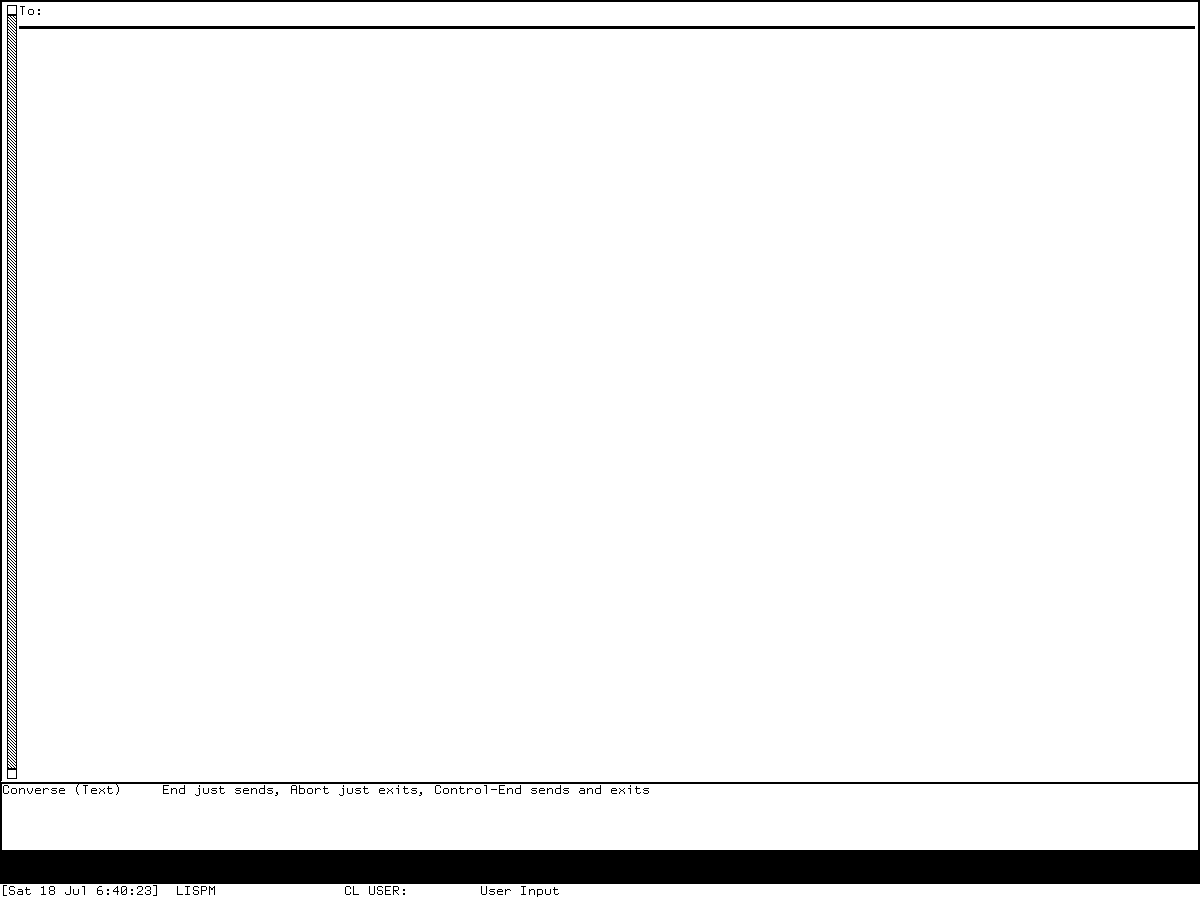
Runtime observation — Genera 8.5 System 452.22, session d09-converse-notifications-genera-20260718, generation 2, verified 2026-07-18 after local login and Select C. The reviewed 1200 by 900 PNG has SHA-256 8a8360166f24aa0d0e6b2ce2df29c9e3f3ac0ad963b2af93e5d78208dabff043 and normalized-pixel SHA-256 425d5c9c3b353fa7bb93aa824c1b85a55cbb44e4989da1841ccad8b2c6566bc9. It establishes only the fresh layout and short labels, not message delivery, command effects, or source-to-world identity. Symbolics and other applicable rightsholders retain interests in the licensed screen; this minimum image is published under the page-specific reviewed fair-use conclusion for historical criticism and reconstruction, and no endorsement is implied.
The local Help dispatcher opened successfully and described conversation grouping, the send/exit bindings, navigation, file export, listener QSend operations, and user options. That raw Help screen remains ignored because its substantial installed prose is not needed once its behavior has been checked against source. It also confirmed the article's source finding that Help is useful but not a complete command census.
Notifications is a separate retained-history viewer
Select N opened a distinct application: a title pane, a left-scrollable typeout pane, and only Help and Exit in its fixed menu. It was initially empty. After the Listener called TV:NOTIFY with pop-ups disabled, returning to the activity showed exactly one timestamped line containing the synthetic museum text. This establishes in the compiled world that TV:NOTIFY retains a record centrally and that the Notifications activity reads that history even when fallback pop-ups are disabled. It does not by itself prove the source-defined live polling interval or the ordering of multiple records.
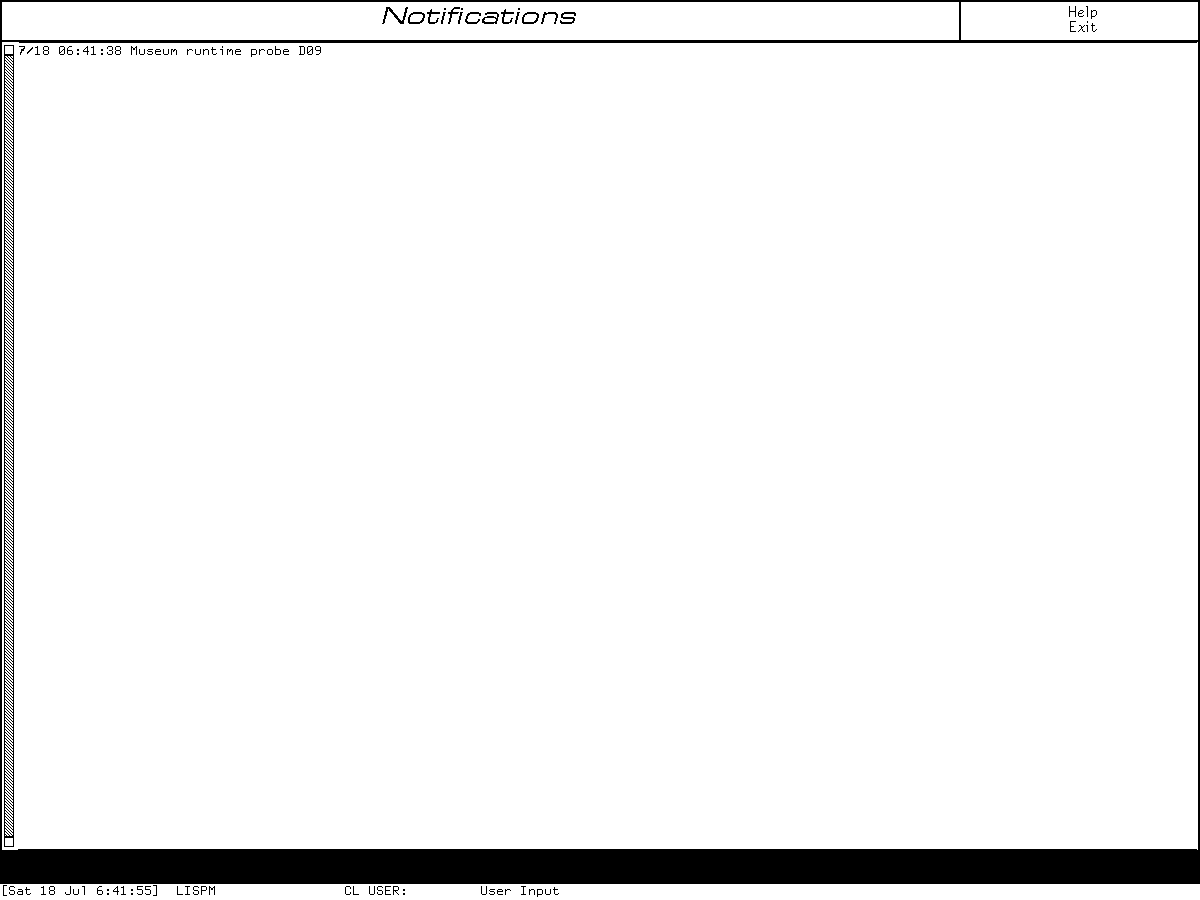
Runtime observation — Genera 8.5 System 452.22 in the same session and generation, verified 2026-07-18 after the researcher-authored TV:NOTIFY call and Select N. The reviewed 1200 by 900 PNG has SHA-256 8b9d2ed2c941eb23f344a37f839757d46e9a5e7b97aebf4780dc1af4518b7592 and normalized-pixel SHA-256 3819127ac6504aa52c226e1118a52d91ba46b301bad9b9ec365bc55acdb99d74. It establishes one retained synthetic record while fallback popups were disabled, not multi-record ordering, popup timing, or network receipt. Symbolics and other applicable rightsholders retain interests in the licensed screen; this minimum synthetic-data image is published under the page-specific reviewed fair-use conclusion for historical criticism and reconstruction, and no endorsement is implied.
Both images passed the capture-specific review in the screenshot publication policy. The first contains only functional layout and short labels; the second adds one researcher-authored record. The full Help screen, login screen, Listener transcript, and initially empty Notifications duplicate remain untracked. Exact raw mappings and image identities are in the curated Genera screenshot catalog.
The final generation-2 run record is 26,055 bytes, SHA-256 1ffacb2809fa4aee90e12fb7ff65413d1e443e0471adc82e1af2265743ad15f7. The 14-record action log is 6,881 bytes, SHA-256 742d8554f5273038b99e555d1262afbbbdb4dc2f0096f2a55f1357d7827eec03. The shutdown prompt was observed and accepted and cleanup began; the known Cold Load channel mutex stall then required bounded host termination. Final status is forced-stopped, with forced_after_confirmed_shutdown_stall=true, state_may_be_incomplete=true, and orderly_vlm_host_shutdown=false. The base and private worlds remained byte-identical, the harness invoked neither Save World nor a process checkpoint, unsaved Lisp state was discarded, and no session process remained.
The peer-dependent boundary remains
The harness has no configured Lisp Machine peer. This run therefore does not claim delivery, reply identity, multi-recipient grouping, broadcast behavior, duplicate filtering, or Converse history ordering. A later peer-enabled experiment must use a deliberately isolated, disposable site; it must not fabricate a peer or infer network behavior from these two local application states.
Findings that manuals alone do not expose
- System 46 has a complete direct-message sender, receiver, reply pop-up, and received history but no Converse application in the pinned public source.
- System 303's inbound queue and post-command hook keep network processes from concurrently editing the Zwei interval.
- System 303 accepts
:POP-UPas an undocumented alias for the documented:SIMPLEreceive mode. - System 303's
:NOTIFY-WITH-MESSAGEformatter substitutes the body where its label calls for a sender, contradicting the option documentation. - System 303's own Converse Help reverses the default
EndandControl-Endbehavior; their handlers, mode line, and release note agree with one another. - Its omitted
Control-Zcell targets an undefinedCOM-symbol rather than the source-presentCONVERSE-SEND-WITH-EXITfunction, so the apparent send-and-exit intent must not be reported as a working source-profile binding without a runtime oracle or explicit correction. - Deleting the headerless first conversation ignores
DELQ's returned list head before removing its interval, leaving strict source-profile structure inconsistent. - System 303 before-cold sets saved sends to
NIL, so the first later receive gains a literalNILsuffix; direct and transient last-message yank also disagree when no message has been received. The same selected operation retains the prior last-sender reply register. - System 303 out-of-frame QSend reverses wire-attempt and delayed-record order while returning successful recipients in their original relative order.
- Maintained SHOUT source leaves its
PERSONlocal unassigned and appears to produceSEND NILplus a body ending inNILanyone; its documented broadcast intention remains runtime-unverified. - Genera normally preserves recipient sets as conversations rather than necessarily splitting a group send into per-person conversations, but its non-consuming match test has a duplicate-address edge and is not true multiset equality.
- Genera sends asynchronously and records temporary, successful, and failed outgoing states in the same conversation model.
- A Genera CONVERSE-protocol notification intentionally bypasses every Converse history and enters the central notification system.
- Genera's Help omits several direct, prefix, and extended commands that are live in the Converse command tables.
Show Messages :Order Forwardchanges direction with the display append option; its default source behavior contradicts installed Help.- The Genera notification pop-up delay is ten seconds in executable code despite a five-second adjacent comment.
Show Notifications :Sinceand:Beforeuse strict comparisons despite inclusive wording for Since in installed documentation.- The Notifications activity ignores ordinary delivery into its own pane while independently tailing shared history, avoiding self-generated pop-ups without losing the log.
Open questions
- Which historical MIT release first introduced the full Converse application? The System 46/System 303 comparison brackets the change but does not date it.
- Can a compatible public CADR band or reproducible load procedure reach the maintained Converse frame without the System 303-0 interval initialization error?
- In such a compatible band, does
Control-Zsignal an undefined-command failure, resolve through a loaded patch absent from the selected tree, or reach some other dispatcher fallback? - What exact visible/error state follows an attempted deletion of the headerless composer in unpatched System 303 source, and can Regenerate recover it completely?
- Does live Genera confirm the source-derived
Show Messagesorder reversal in both append modes? - Does a controlled two-CADR run reproduce the maintained SHOUT source's apparent
PERSONdefect, or does a loaded patch redefine that function? - Does timing a real Genera notification confirm the ten-second pop-up throttle in this world, and is the stale five-second comment inherited from an older constant?
- What minimal isolated peer setup can exercise SEND, CONVERSE, SHOUT/site notify, reply identity, and duplicate suppression without external networking or licensed data leakage?
Sources
- MIT CADR System 46,
lmio/chsaux.113, 47,474 bytes, SHA-2561990f30c37def0129f7f36faac310f68b303687571d46ff8057b93ac0b6e316d. - LM-3 System 303,
io1/conver.lisp, 60,328 bytes, SHA-2560142dd413d30445c63fa8347ecf802418a8089066bbc69b66f168d3f8d4904ba. - LM-3 System 303,
network/chaos/chsaux.lisp, 67,218 bytes, SHA-25629fb941e5147b5f7ae51331f90dd11ffbf9ed93058c1e0835d6c6900f3803a05. - LM-3 System 303,
sys2/string.lisp, 49,754 bytes, SHA-256070c8f058bca3410ba5871ac1dbf00cb53d0d01b077111925d1fd314c29b12a5, used to verify SHOUT's symbol-to-string concatenation consequence. - LM-3 System 303,
doc/sys93.msg, 64,263 bytes, SHA-25668fe3ca6038969f7da964387e3b8c2b589f84cd63b8c7512fda95ca31bb04d55, anddoc/sys94.msg, 28,681 bytes, SHA-25685043055f5e4d7545fc9dd1fa9cef81ac467bf48a8f9060e0c003c663cb71846. - Symbolics, Editing and Mail, the Genera 8 Converse manual and command reference.
- Symbolics, Genera User's Guide, Select keys, activities, notifications, and Command Processor guidance.
- Licensed local Genera 8.5
zmail/converse/converse.lisp.~1564~, 89,288 bytes, SHA-256bd15925898941848626bb4fa051a56d70f23e9547aff58deb8bf2c6a1e493bd9;window/notification.lisp.~116~, 28,978 bytes, SHA-256b845b2795f279919e853d50668bba9f4dcb185b18f0019b347726ec6b81ac10e; andwindow/notifications-activity.lisp.~4011~, 8,339 bytes, SHA-25641f5deee29753d0a0fc26c513818cb4e125315d8be6afc5f4cbd8bada5881f02. - Licensed local Genera 8.5
network/protocols.lisp.~134~, 42,657 bytes, SHA-2563fb78acff2b08ee38be796bb4c90825c4a3e89bfc822456251fb94266ca64d64;zmail/definitions.lisp.~1552~, 98,226 bytes, SHA-256f5c96f713e3105acb78d1a79de3d0739afd361f297b3a9b6b647fd4638144aa6;zmail/commands.lisp.~1600~, 120,174 bytes, SHA-2564b00879c28268561def2e2ee34a34026f73aca9dc8f5a4cb6077a66af342adf1;zmail/mail.lisp.~1571~, 152,833 bytes, SHA-2566885d44e951270f9b9b4ebde5a2500fd674d4282599ba7c81e1fce017cb38c3a; andcp/info-commands.lisp.~129~, 19,303 bytes, SHA-2567183e0229b3be5c2e60b4d2ec50e9c2c839d3e2c131882c3aaec359a8d3c42fc. - Licensed installed Sage databases: Converse source artifact SHA-256
5aa638be69de1114893c17876145d6aaf5b0ce4a4f28289c6930a3e8301228e0; Command Processor parts 3 and 624ed5565a80c9857feae331466cffc9cecbdf6439ae30a3de0f650e0f4b1c484and26e2b0a9a81295f7d3af4aab7c91a51c0bd04c9873dec96d646d873413297d51; Window documentation part 6A70e07775eac4991beeed3b79fdbcd13d522b930eb510cc5219d26b9b794b22ac; Select Help5926571afb220b08a7dbf7583a37695dfbc77044b0d41a42fee66308f7b3cd19. - Fresh System 303 Xvfb session
d09-converse-20260718, generation 1, observed 2026-07-18; raw payload retained only in the ignored computer-use tree. - Fresh Genera Xvfb session
d09-converse-notifications-genera-20260718, generation 2, observed 2026-07-18; exact runtime, image, shutdown, and failed generation-1 preflight boundaries recorded above, with raw payload retained only in the ignored computer-use tree.
Last verified: 2026-07-18.