Converse, direct messages, and notifications reimplementation specification
Status and reconstruction claim
This specification defines D09 as five separately selectable evidence profiles:
DM-C46-SRC, the direct-message sender, receiver, reply pop-up, and received history present in the public MIT CADR System 46 source at Git revision8e978d7d1704096a63edd4386a3b8326a2e584af;DM-C303-SRC, the maintained LM-3 System 303 Converse application, QSend compatibility interfaces, SHOUT, ChaosSEND, networkNOTIFY, and TV notification machinery at Fossil check-in4df393c68d7f083ce42d5c377039d26043cc18a9031ace28258dc97f4137eb91;DM-C303-3030-RUN, the tested System303-0load-band profile, which is a negative reachability and load-failure witness rather than a running Converse profile;DM-G452-SRC, the licensed System 452.1 / Zmail 442.0 source profile for Converse, the old and new direct-message protocols, central notification delivery, the Notifications activity, networkNOTIFY, and the relevant Command Processor reports; andDM-G85-RUN, the bounded compiled-world behavior observed in the locally preserved Genera 8.5 System 452.22 world: entry to an empty Converse frame and retention of one researcher-authored notification in the separate Notifications activity.
The contract is implementation-independent. A conforming implementation MAY replace Flavors, special variables, linked editor lines, extensible strings, TV sheets, Dynamic Windows frames, Chaosnet streams, processes, and wakeup primitives with host-language equivalents. It MUST preserve the selected profile's observable state, input dispatch, ordering, address interpretation, queue ownership, acknowledgement points, partial failures, retained-history rules, visible relationships, and explicitly selected historical defects.
This specification does not claim source, package, ABI, QFASL, world-image, packet, byte-for-byte UI, font, or pixel compatibility. The source profiles do not prove that their bodies reside unchanged in either tested world. The runtime profiles do not prove unexercised source branches. No preserved run delivered a message to a peer, and this document therefore makes no runtime claim for peer delivery, replies, broadcast, duplicate filtering, group-conversation matching, or wire interoperability. A conforming implementation MAY use inert recording peers at levels below the preserved-peer comparison level.
The public System 46 snapshot contains no full Converse application, SHOUT, or network NOTIFY implementation. A runner MUST reject a request for a DM-C46-CONVERSE profile rather than substituting System 303 behavior. Conversely, an implementation MUST NOT add Genera's exact-recipient-set model, asynchronous status replacement, or central Notifications activity to a strict System 303 profile.
Licensed Genera source and world material remains an evidence-only local input. This specification is original prose and does not authorize redistribution of that source, decoded Help, world data, conversations, or extracted assets.
Normative language and evidence codes
MUST, MUST NOT, SHOULD, SHOULD NOT, and MAY have their usual requirements meanings. A requirement qualified by a profile applies only when that profile or its named feature closure is selected.
| Code | Evidence class | Establishes | Does not establish |
|---|---|---|---|
C46-SRC |
public System 46 source | the quoted QSend entry, destination split, SEND exchange, serialized incoming pop-up, reply path, and SAVED-SENDS order |
a full Converse frame, later notification system, or matching-band runtime |
C303-SRC |
maintained LM-3 source | Converse data structures, application table, queueing, options, old SEND, SHOUT, network NOTIFY, TV notification history, defaults, algorithms, and source-visible defects |
pristine historical provenance or residency in the tested System 303-0 band |
C303-RUN |
CADR Xvfb harness | absent Converse select key, failed normal load paths, direct-source initialization failure, compile-bridge boundary, and clean stop | a visible Converse frame or any network behavior |
G452-SRC |
licensed local System 452.1 / Zmail 442.0 source | exact selected source-profile state, commands, old/new protocols, request ordering, background work, notification delivery, and reports | redistribution permission, configured-site behavior, or identity with the 8.5 world |
G8-MAN |
public Genera 8 manuals | contemporary terminology, intended workflow, documented commands, and user options | every source branch, defect, timing constant, or live 8.5 result |
G85-RUN |
isolated Genera harness | live Select C and Select N entry, empty Converse layout, one retained synthetic notification with pop-ups disabled, and exact capture provenance |
peer delivery, multiple-record order, pop-up timing, group matching, or source-to-world identity |
INTERP |
stated reconstruction interpretation | a portable semantic representation justified by named evidence | a historical implementation fact |
TODO-ORACLE-* |
named unresolved oracle | the precise experiment still needed | permission to guess or silently normalize releases |
Source wins for strict source-profile branches that were not exercised. Runtime wins only for the exact observed compiled-world behavior. Manual/source and source/runtime disagreement MUST remain a selectable delta or a named oracle; it MUST NOT be smoothed into an undocumented compromise.
Compatibility profiles and levels
Release profiles
| Profile | Normative surface | Required substrate | Explicit exclusions |
|---|---|---|---|
DM-C46-SRC |
QSEND, SEND-MSG, inbound SEND, PRINT-SENDS, SAVED-SENDS, reply pop-up |
System 46 TV streams, input editor, Chaos stream adapter, login and host parser | Converse frame; SHOUT; network NOTIFY; Genera central history |
DM-C303-SRC |
Converse editor, listener QSend/reply, incoming pop-up, saved sends, SHOUT, Chaos SEND, network NOTIFY, TV pending/deferred/history facilities |
System 303 ZWEI, TV, process/queue services, Chaos and site-machine adapters | Genera CONVERSE protocol; exact-recipient-set grouping; Notifications activity |
DM-C303-3030-RUN |
observed select-key and load boundary only | exact recorded System 303-0 band and harness |
any claim that Converse became usable in that run |
DM-G452-SRC |
Converse editor and QSend, SEND and CONVERSE transports, asynchronous statuses, central notifications, Notifications activity, CP Send/Show reports, network NOTIFY |
System 452.1 / Zmail 442.0 ZWEI, TV, Dynamic Windows, CP, namespace, network-service and process adapters | CLIM; arbitrary site patches; unselected Mailer or Zmail-reader semantics |
DM-G85-RUN |
observed empty Converse and one-record Notifications states | exact recorded Genera 8.5 System 452.22 world and isolated harness | successful peer exchange, popup delivery, more than one record, or complete input execution |
DM-C303-3030-RUN and DM-G85-RUN are witness profiles. They MAY be combined with their respective source profile in a report, but they MUST keep provenance and claims distinct. In particular, DM-G452-SRC + DM-G85-RUN means “implement the selected source contract and compare the bounded states seen in the world,” not “prove every selected function is the world's loaded implementation.”
Conformance levels
| Level | Required closure |
|---|---|
L1 semantic core |
profile-tagged state; deterministic direct-message, queue, history, and notification transitions; complete error values; explicit clock, filesystem, address, network, mail, display, and scheduler adapters; inert peer permitted |
L2 interactive application |
L1 plus every effective direct, inherited, prefix, transient, menu, pointer, presentation, numeric-argument, repeat, Help, shadowing, fallthrough, and unbound input path incorporated below; frame/view lifecycles; rights-safe visual relationships |
L3 preservation fidelity |
L2 plus preserved-system comparison; exact selected wire serialization and acknowledgement order; timing-visible queue and popup behavior; isolated real peers; profile-specific defect results; and closure of every mandatory TODO-ORACLE for the claimed feature |
An L2 implementation MAY use a recording network adapter and MUST identify that adapter in its conformance label. It MUST NOT describe local acceptance or insertion of a pending record as historical network delivery. L3 requires a deliberately isolated peer configuration and must record both endpoints and all delivered bytes without publishing licensed payloads.
Feature closures
| Closure | Profiles | Requirement when selected |
|---|---|---|
DIRECT-C46 |
DM-C46-SRC |
quoted QSend macro semantics, raw sender/receiver, serialized popup, reply, arrival-order compatibility history |
CONVERSE-C303 |
DM-C303-SRC |
full structured ZWEI buffer, request queue, commands, QSend bridge, incoming modes, newest-first saved sends |
SHOUT-C303 |
DM-C303-SRC |
source-selected site iteration and strict/corrected defect mode |
NET-NOTIFY-C303 |
DM-C303-SRC |
stream request/reply, duplicate rule, single/all-host behavior |
TV-NOTIFY-C303 |
DM-C303-SRC |
pending/deferred queues, terminal command, history and selected-window behavior |
CONVERSE-G452 |
DM-G452-SRC |
exact-recipient-set model, synchronous preflight, asynchronous send worker, SEND fallback, CONVERSE parser/server |
CENTRAL-NOTIFY-G452 |
DM-G452-SRC |
history, delivery tail, process, console/remote delivery, fallback popup and delivery modes |
NOTIFICATIONS-ACTIVITY-G452 |
DM-G452-SRC |
Dynamic Windows history viewer, polling, inherited input and local commands |
CP-REPORTS-G452 |
DM-G452-SRC |
Send Message, Show Messages, and Show Notifications, including complete keyword surfaces |
NET-NOTIFY-G452 |
DM-G452-SRC |
one-packet receiver/sender, 10-second host-scoped duplicate suppression, site/local helpers |
EXPORT |
Converse source profiles | profile-specific write/append behavior; no automatic transcript implied |
HARDCOPY-G452 |
DM-G452-SRC |
hardcopy request routing only; D35 owns printer implementation |
A conformance declaration MUST name its selected closures. CONVERSE-C303 and CONVERSE-G452 are mutually versioned and MUST NOT share hidden defaults. A product offering both MUST expose the release selection before any conversation state is created.
Evidence ledger
Public source artifacts
All paths below are repository-relative descriptions of pinned public upstream artifacts. Byte counts and SHA-256 values were recomputed from the preserved copies.
| Evidence | Artifact | Bytes | SHA-256 | Role |
|---|---|---|---|---|
C46-SRC |
src/lmio/chsaux.113 |
47,474 | 1990f30c37def0129f7f36faac310f68b303687571d46ff8057b93ac0b6e316d |
QSend macro, SEND client/server, reply popup, saved sends |
C303-SRC |
io1/conver.lisp |
60,328 | 0142dd413d30445c63fa8347ecf802418a8089066bbc69b66f168d3f8d4904ba |
Converse editor, commands, requests, QSend, incoming service |
C303-SRC |
network/chaos/chsaux.lisp |
67,218 | 29fb941e5147b5f7ae51331f90dd11ffbf9ed93058c1e0835d6c6900f3803a05 |
SHOUT and network NOTIFY |
C303-SRC |
sys2/string.lisp |
49,754 | 070c8f058bca3410ba5871ac1dbf00cb53d0d01b077111925d1fd314c29b12a5 |
symbol/string coercion used to establish SHOUT's source result |
C303-SRC |
window/basstr.lisp |
81,846 | 8ba3a16e726ed043e6585c7a68b7096bb2dcc5d6f05476afd89f84a48dff2645 |
notification command, history, TV:NOTIFY |
C303-SRC |
window/baswin.lisp |
82,708 | 3b86ca413528046887da8371433d656ecd9d5f9130d6eadd764fc54f137b42f1 |
notification stream delivery, pending/deferred queues, popup selection |
C303-SRC |
sys/ltop.lisp |
42,225 | 57dd2591cfeb84ee00f1d9cb51c17b5c30f22e36026074117e3420f4e3dc943e |
distinct cold, before-cold, and once/first initialization phases |
C303-SRC |
sys/sysdcl.lisp |
25,396 | 2999f1824666171d729dae611a09204ac0bd42373f30d7d22c733f904c27a6dd |
selected Converse module and outer-system declaration |
The System 46 pin is Git revision 8e978d7d1704096a63edd4386a3b8326a2e584af. The maintained System 303 pin is Fossil check-in 4df393c68d7f083ce42d5c377039d26043cc18a9031ace28258dc97f4137eb91. They are different source lineages and MUST NOT be treated as two directories in one release tree.
Licensed Genera evidence-only artifacts
These source files remain local and untracked. Their identities can be checked by an authorized researcher; their bodies are not reproduced here.
| Artifact | Bytes | SHA-256 | Role |
|---|---|---|---|
zmail/converse/converse.lisp.~1564~ |
89,288 | bd15925898941848626bb4fa051a56d70f23e9547aff58deb8bf2c6a1e493bd9 |
editor, commands, address grouping, QSend, async send, SEND/CONVERSE services |
window/notification.lisp.~116~ |
28,978 | b845b2795f279919e853d50668bba9f4dcb185b18f0019b347726ec6b81ac10e |
notification record, history, delivery process, popup, printing |
window/tvdefs.lisp.~488~ |
68,717 | 8d4f22284a36e6e465ffda185279415a00cb3234251a6a769bd260d61ba79a5a |
notification history, TV last tick, delivery-tail definitions, and temporary-window lifecycle |
window/notifications-activity.lisp.~4011~ |
8,339 | 41f5deee29753d0a0fc26c513818cb4e125315d8be6afc5f4cbd8bada5881f02 |
Select-N Dynamic Windows activity and its local table |
network/protocols.lisp.~134~ |
42,657 | 3fb78acff2b08ee38be796bb4c90825c4a3e89bfc822456251fb94266ca64d64 |
one-packet NOTIFY client/server and site helpers |
cp/info-commands.lisp.~129~ |
19,303 | 7183e0229b3be5c2e60b4d2ec50e9c2c839d3e2c131882c3aaec359a8d3c42fc |
Show Notifications selection and filtering |
zmail/definitions.lisp.~1552~ |
98,226 | f5c96f713e3105acb78d1a79de3d0739afd361f297b3a9b6b647fd4638144aa6 |
CP communication command-area ownership |
zmail/system.lisp.~81~ |
5,673 | 7a76f3f99df71721376e5cddb247b616568ddbc420fa17cc13aa5fd3804be17b |
one-file Converse subsystem and Zmail build relationship |
sys/ltop.lisp.~754~ |
25,132 | 18f1cc03e5a5aefc06b97eaa5649cffdf2717b824f994422d8ea2111f1db6ebb |
distinct before-cold-before-save and once/first initialization scheduler phases |
The inspected patch directory identifies System 452.1 / Zmail 442.0. The runtime artifact identifies Genera 8.5. No body-by-body source-to-world comparison was performed, so those are deliberately separate profiles.
Normative evidence map
| Contract area | System 46 owner | System 303 owner | Genera owner |
|---|---|---|---|
| entry and direct send | chsaux.113:542-676 |
conver.lisp:992-1419 |
converse.lisp.~1564~:1195-1495 |
| conversation state and rendering | absent | conver.lisp:141-519 |
converse.lisp.~1564~:116-587 |
| commands and input | shared query/input editor plus chsaux.113 |
conver.lisp:523-987 and incorporated CADR companion |
converse.lisp.~1564~:593-1191 and incorporated Genera companion |
| old SEND wire behavior | chsaux.113 |
conver.lisp:992-1419 |
converse.lisp.~1564~:1513-1908 |
| new CONVERSE wire behavior | absent | absent | converse.lisp.~1564~:1513-1908 |
| SHOUT/network NOTIFY | absent | network/chaos/chsaux.lisp |
network/protocols.lisp.~134~ |
| notification delivery/history | only QSend popup in D09 scope | basstr.lisp; baswin.lisp |
notification.lisp.~116~ |
| notification viewer/report | terminal notification command only | terminal notification command and printer | notifications-activity.lisp.~4011~; cp/info-commands.lisp.~129~ |
| initialization phase scheduling | selected module-local registration | sys/ltop.lisp:647-654,691-721,727-776 plus module registrations |
sys/ltop.lisp.~754~:282-319,347-366 plus module registrations |
| runtime reachability and visuals | no D09 run | d09-converse-20260718, generation 1 |
d09-converse-notifications-genera-20260718, generation 2 |
The historical D09 dossier is an evidence narrative, not a replacement for this contract. The complete local and effective input semantics are normatively incorporated below from the two dedicated companions.
Architecture and ownership boundaries
User-interface substrates and CLIM nonrelationship
DM-C46-SRC uses TV streams, a shared input editor, a reusable pop-up text window, and a shared yes/no query reader. It is not a CLIM application.
DM-C303-SRC Converse is a one-pane ZWEI application hosted by a TV CONVERSE-FRAME, with a process/select lifecycle, editor command tables, and TV pop-up/notification facilities. It predates CLIM. Terms such as frame, command table, menu, and notification do not imply CLIM ownership.
DM-G452-SRC Converse remains a Flavors/ZWEI/TV application. It uses a TV frame, ZWEI intervals and command tables, and a Dynamic Windows margin scrollbar; it is not a DEFINE-APPLICATION-FRAME and does not use a CLIM port or CLIM command-table protocol. The separate Notifications activity is a Dynamic Windows DEFINE-PROGRAM-FRAMEWORK program with a title pane, command menu, and typeout pane. Its inherited Standard Arguments and Input Editor Compatibility tables are Dynamic Windows/Command Processor facilities, not CLIM.
The CP commands use Genera Command Processor presentations and keyword parsing. That also does not make Converse or Notifications CLIM applications. A recreation MAY be implemented on CLIM, but CLIM would be the port's substrate, not a historical compatibility claim. It MUST reproduce the specified behavior rather than exposing unselected generic CLIM gestures.
Functional layers
The specification separates seven layers whose histories and failure boundaries must not be collapsed:
- Composition and conversation: editing an anonymous
To:composer and retaining sent/received status records. - Address resolution and preflight: interpreting a destination, locating a host or service path, checking login/receive/service policy, and selecting a protocol.
- Transport: old stream
SEND, GeneraCONVERSE, or one-packetNOTIFY. - Server acceptance: parse, policy checks, optional preliminary response, body collection, local handoff, and final acknowledgement.
- Foreground/background handoff: moving completed network or send work onto the editor or notification owner's queue without concurrent interval mutation.
- Notification delivery: storing a central record, selecting a destination stream, and falling back to a popup or configured noninteractive mode.
- Views and reports: Converse, the Notifications activity,
PRINT-SENDS,PRINT-NOTIFICATIONS, and CPShowcommands.
A delivery acknowledgement is not a durable transcript commit. A Converse record is not a network queue. A notification history item is not a Converse conversation. An export file is not automatically reloaded state. These distinctions are normative.
Required subsystem interfaces
A portable implementation MUST expose or internally define the following adapters:
| Adapter | Minimum contract |
|---|---|
Clock |
monotonic ticks for delays/timeouts and wall time for displayed headers; deterministic test control |
Identity |
current logged-in user, local host, sender display identity, and source address |
AddressResolver |
profile-selected split/canonicalization, bare-user search, host menu, machine/site inventories |
DirectTransport |
open/contact, write/read/EOF, preliminary/final response, close state, failure object, timeout |
MailFallback |
normalized recipients, subject, body, submission result; separate from direct-delivery success |
Editor |
interval lines, point, insertion/deletion, linked conversation boundaries, parent command table |
FrameScheduler |
enqueue, wake, post-command hook, exposure, process start/stop, abort boundary |
NotificationSink |
selected-window delivery, pending/deferred queues, popup, delivery-mode cell, remote terminals |
Filesystem |
choose pathname, probe, read existing bytes for append profile, create/write, close, and failures |
PresentationRecorder |
Genera notification content that can be replayed to display streams without storing a live window |
Renderer |
divider/header lines, text styles, scrollbar, mode line, popup/query choices, title/menu panes |
AuditLog |
profile, ordered state transitions, adapter calls and results without retaining private message data by default |
The DirectTransport interface MUST distinguish open failure, header rejection, preliminary acceptance, body-write failure, EOF, final acknowledgement, timeout, and close. Returning one undifferentiated boolean cannot satisfy the failure-order tests.
Semantic state model
Common records
The following normalized types are INTERP abstractions. Profile adapters determine which fields exist and how they are rendered.
Address = {
  original_text, person, host, canonical_person?, canonical_host?, path?
}

MessageRecord = {
  direction, sender, recipients[], also_to[], identity?, private?, encrypted?,
  notification?, submitted_at?, received_at?, body, status, diagnostic?,
  transport_profile, display_order_token
}

Conversation = {
  profile, key, header_start, first_content, delimiter, last_content,
  append_mode, old_messages[], visible, temporary_status_ids[]
}

NotificationRecord = {
  time, replayable_text, plain_text_projection?, window_of_interest?
}
status MUST distinguish at least composer, pending, sent, mailed, not-sent, received, and notification-only where the selected profile can produce them. The implementation MUST NOT represent pending as sent merely because the UI has already restored a blank composer.
System 46 state
DM-C46-SRC contains:
saved_sends, one extensible received-message string;send_popup, a reusable 400-pixel-high TV text window with saved bits;send_lock, a global single-owner lock for incoming display/reply interaction;bell_count, default 2;- the current incoming stream, parsed requested person, derived reply sender, header, body, and notification stream; and
- no D09-defined full conversation list or automatic transcript pathname.
Incoming records append to saved_sends with two returns, so print order is oldest first. The selected file defines no cold-reset hook for this string. A strict port MUST preserve that absence as “lifetime not established by this module”; it MUST NOT invent a permanent file or assert survival across every world-save operation.
System 303 Converse state
The normalized System 303 frame contains:
C303Frame = {
  conversations[], first_conversation, last_conversation,
  anonymous_composer, request_queue, exposed, active,
  receive_mode=:NOTIFY-WITH-MESSAGE, append=false,
  end_exits=false, beep_count=2, extra_hosts=[], wait=true,
  gagged=false-or-string, last_sender?, saved_sends,
  buffer_munged_saved_conversation?
}

C303NotificationState = {
  history_newest_first=[], pending=[], deferred=[],
  last_network_notification_text=NIL
}
Each conversation owns a header start, body start, sender/recipient identity, host, delimiter, last line, append mode, and in-memory old-message list. The first entry is the headerless anonymous To: composer. A qualified group send creates one separate conversation for each recipient in this profile.
The request queue is FIFO: an ordinary enqueue appends and wakes the frame by forcing an execute event; a delayed enqueue appends without waking it. Exposure and the post-command path provide later drains. The command loop applies the oldest request and deletes it after successful application. A nonlocal exit from the handler MAY leave that request queued in the strict source profile.
saved_sends is separate compatibility state. Its first source binding is an empty extensible string, but the selected before-cold initializer sets it to NIL rather than a new empty string. Incoming text is prepended, so its print order is newest first. On the first receive after that reset, the selected string coercion appends the literal characters NIL after the new record; a fresh source load that has not run before-cold does not. Immediately after reset and before a receive, PRINT-SENDS passes NIL to the output stream's string-output operation; the exact preserved-stream result remains a runtime oracle. The same selected before-cold initializer does not assign last_sender; strict mode MUST retain its exact prior value across that operation. This is not a claim that the register survives every cold-boot or world-loading mechanism.
The distinct TV before-cold initializer clears only notification history. It does not assign the pending or deferred queues, so strict invocation MUST retain exact sentinel list identities in both. The Chaos NOTIFY duplicate filter begins as NIL, then retains the last nonduplicate packet text; a duplicate leaves it unchanged. No selected reset form clears that text register. These are operation-level source contracts, not claims that arbitrary boot or image-loading machinery preserves the values.
Genera Converse state
The normalized Genera frame contains:
G452Frame = {
  conversations[], first_conversation, last_conversation,
  anonymous_composer, request_stack, active, selected,
  receive_mode=:POP-UP, append=false, end_exits=false,
  beep_count=2, gagged=false-or-string,
  last_recipients[], last_ident?, saved_sends,
  divider_height=3/4-line, message_divider_height=1/4-line
}

G452NetworkNotifyFilter = {
  text_buffer[1500], length=0, packet_tick=0, resolved_host=NIL
}
A real conversation key is an identity when present, otherwise an exact recipient set. Recipient equality requires equal list lengths and that every candidate address matches an existing address. The selected implementation does not consume matched elements, so repeated-address multiplicity has a strict source-profile edge case: equal lengths plus membership can make [A,A] and [A,B] compare equal when every candidate finds some matching A. A corrected multiset comparator MAY be offered, but MUST be labeled CORRECTED-RECIPIENT-MULTISET; it is not strict source identity.
The Genera datagram NOTIFY filter has deterministic fresh-source state: a 1,500-character comparison buffer, zero length, zero packet tick, and NIL host. A successfully handled nonduplicate packet first assigns packet tick, resolved host, and length, then copies the payload into the retained buffer; a suppressed duplicate replaces none of them and therefore does not refresh the ten-second window. A copy failure leaves the new scalar values and an implementation-defined copied prefix in the old/new buffer because there is no rollback. The selected source establishes no initialization registration that clears this tuple. A reset extension MUST be labelled and MUST NOT be folded into strict operation semantics.
Each retained old-message entry includes a before/after flag, text, and formatting arguments. Incoming records are placed before the composer and outgoing records after it according to the profile's rendering rule. Temporary outgoing headers are identified so the completion handler can replace them. If the user deletes the conversation during a send, completion finds or recreates the destination conversation and inserts the final record there.
The frame request structure is LIFO because producers PUSH onto it. The post-command hook removes a request before applying it and catches command-loop abort. A failed or aborted handler is therefore not retried in the strict Genera source profile.
Central Genera notification state
NotificationService = {
  history_newest_first[], delivery_tail, process, wakeup,
  allow_popup=true, tv_last_notification_tick?,
  last_popup_tick_by_console{}, consoles[], remote_terminals[]
}

TerminalNotificationMode = {
  cell_state, mode in {NIL, :POP-UP, :IGNORE, :BLAST,
                       :ALWAYS-IGNORE, :ALWAYS-POP-UP},
  selected_window?, prior_io?, pending?
}
Each history record retains a time, a presentation-recording string, and optional window of interest. History is newest first. The delivery process traverses list tails so undelivered entries reach outputs in oldest-first arrival order. These two orders are both normative.
Two registrations have separate effects. The selected :BEFORE-COLD operation sets only history and its delivery-tail pointer to NIL; it leaves the TV last-notification tick and current process object untouched. A distinct :ONCE operation calls the process initializer: it kills a non-NIL prior process, clears that process slot, constructs a priority-five system process, enables :NO-KBD-ARREST, presets the notification delivery top level, and enables the new process. The process initializer leaves history, delivery-tail identity, and the TV last-notification tick untouched. Strict mode MUST expose the two operations independently and MUST NOT claim that :ONCE runs on every cold unless a selected initialization scheduler proves it. Neither operation creates an automatic transcript file.
Process recreation is ordered and nontransactional: kill prior process when non-NIL; set the slot NIL; allocate the new process into the slot; enable no-keyboard-arrest; preset its top-level function; enable it. Failure after any step retains preceding effects. Allocation failure can leave no process, while a later setup failure can leave the slot naming a partially configured process. Strict mode MUST NOT roll this sequence back.
Popup throttling state is per console, not global. The delivery process retains a console-to-last-popup-time association, updates only the console whose popup succeeded, and removes an association after its 600-tick separation interval has elapsed. This process-local map is distinct from the TV global last-notification time updated by notification insertion/delivery and from the network duplicate filter's packet time. A popup on one console MUST NOT throttle an otherwise eligible popup on another.
Invariants
Every conforming source-profile implementation MUST continuously satisfy:
- the first visible line belongs to
first_conversation; - following conversation links reaches every conversation exactly once and ends at
last_conversation; - for every retained conversation,
header_start <= first_content <= delimiter <= last_contentin visible interval order; - no network process directly mutates the editor interval;
- one anonymous composer exists while the application is initialized;
- an outgoing temporary status has at most one live completion identity;
- no acknowledgement is reported before the selected protocol's acknowledgement boundary;
- notification history insertion occurs before attempted delivery;
- a view may consume or advance a delivery tail only through the selected profile's explicit rule; viewing MUST NOT delete retained history;
- exported bytes never become authoritative in-memory history merely because the write succeeded; and
- profile selection and defect/correction mode are immutable for the lifetime of a frame.
The strict System 303 composer-deletion defect is an intentional selectable invariant violation after that command. A port claiming DM-C303-SRC+STRICT-DEFECTS MUST reproduce and detect it. A normal safety-oriented port SHOULD select CORRECTED-COMPOSER-DELETE, refuse deletion or assign the new list head, and record the correction.
Complete effective input and gesture trees
Normative companion incorporation
The exact finite input contracts are incorporated normatively from:
- System 46 and System 303 Converse direct-messaging bindings and semantics; and
- Genera Converse and Notifications bindings and semantics.
For their selected profiles, those companions own the enumerated direct keys, inherited parent-table closure, local overrides, prefix nodes and leaves, transient input-editor and popup contexts, numeric arguments, repeat behavior, menus, pointer gestures, CP keyword presentations, Help exposure, shadowing, fallthrough, and unbound results. This main specification owns state, ordering, transactions, protocols, failures, and conformance composition.
The System 303 ZWEI inventory and Genera Zmacs inventory define the generic inherited editor leaves referenced by those companions. Inheritance is normative, not a license to copy the host editor's current defaults. An implementation MUST resolve the effective tree for the selected profile and context before claiming L2.
Entry and context tree
DM-C46-SRC
├── Lisp form: (QSEND destination [message])
├── Function: SEND-MSG destination [message]
│   └── omitted message -> shared input-editor termination/abort tree
├── Function: PRINT-SENDS [stream]
└── incoming QSend popup -> shared yes/no reply tree

DM-C303-SRC
├── application selection -> Converse ZWEI table -> Standard ZWEI parent
│   ├── direct local leaves
│   ├── Help -> M local branch
│   └── extended-command name table
├── (QSEND) -> select Converse
├── (QSEND destination [message])
│   └── omitted message -> QSend input-editor local overrides -> parent editor
├── (REPLY) -> most recent sender
├── incoming popup -> local key/mouse choice tree
├── Terminal-N -> notification-history argument tree
└── listener network commands -> prompt editor and host-selection trees

DM-G452-SRC
├── Select C -> Converse ZWEI table -> Standard Zmacs parent
│   ├── direct local leaves and explicit undefined cells
│   ├── Control-X -> local prefix table -> Standard Control-X parent
│   └── extended-command name table
├── QSend/Reply -> CP/input-editor and presentation histories
├── incoming popup -> ordinary or encrypted local choice tree
├── Select N -> Notifications program table
│   ├── local Help/Exit
│   └── Dynamic Windows inherited tables
└── CP Communication/Session areas
    ├── Send Message
    ├── Show Messages -> specialized + common keyword tree
    └── Show Notifications -> specialized + common output tree
System 303 application-owned summary
The companion's exact mapping includes the following direct leaves, which this table summarizes without replacing their full effective contexts:
| Leaf | Strict source result |
|---|---|
End |
send; remain by default, exit when end_exits is true |
Control-End |
send; exit by default, remain when end_exits is true |
Control-Z |
dispatch to an installed but undefined COM-CONVERSE-SEND-WITH-EXIT target; do not silently call the similarly named ordinary function |
Abort |
deselect/bury without sending unfinished composer text |
Meta-{, Meta-} |
previous/next conversation navigation |
Control-M |
mail current composer instead of direct send |
Control-Meta-Y |
insert last received body; before any receive the direct editor path coerces NIL to the literal text NIL, while the transient QSend reader inserts no bytes |
Help, then M |
local Converse Help through the ordinary ZWEI Help dispatcher |
The direct table inherits Standard ZWEI. It installs no Converse-specific pointer table. Named commands are Regenerate Buffer, Delete Conversation, Write Buffer, Write Conversation, Append Buffer, Append Conversation, Disable Converse, Enable Converse, and Gag Converse. Gag Converse toggles without a large numeric argument; an integer argument of 2 or greater forces disable.
The hard-coded Help text reverses End and Control-End relative to the handlers, mode line, and release note and omits Control-Z. Strict command dispatch follows the table/handler, not stale prose. Help conformance MUST preserve or explicitly annotate the mismatch according to the selected compatibility mode.
The QSend prompt accepts End and Control-Z as completion, Abort as cancellation, Control-Meta-Y as last-body yank, and Control-Meta-E as transfer to Converse. Incoming popup choices, including all key aliases, who-line choices, and the two local click cells (left selects Converse; middle dismisses), are normative in the CADR companion. Every other pointer button has no local popup effect.
Genera application-owned summary
The Genera companion's exact Converse mapping includes:
| Leaf | Result |
|---|---|
End |
send; remain by default, bury when end_exits is true |
Control-End |
send; bury by default, remain when end_exits is true |
Abort |
bury without sending unfinished composer text |
Help |
direct local explanation |
Control-Meta-[, Control-Meta-] |
previous/next conversation |
Control-M |
mail rather than direct-send current composer |
Meta-Q |
fill paragraph while protecting To: and Also-to: structural headers |
Control-Z, Meta-Z, Control-Meta-Z |
explicitly undefined in this mode |
Its local Control-X prefix leaves are exactly 1 one-window, 2 two-windows, 3 view-in-two-windows, ^ grow-window, and O other-window. Every other Control-X leaf falls through to the selected Standard Zmacs prefix except where the companion marks it shadowed or unbound.
The exact extended commands are Regenerate Buffer, Delete Conversation, Write Buffer, Write Conversation, Append Buffer, Append Conversation, Compile File, Load File, Hardcopy Buffer, Bug, and Report Bug; the last two names invoke the same operation. Commented encryption cells are not commands.
The Notifications activity locally maps Help, ?, and menu Help to Help; End, Abort, and menu Exit to bury/deselect. Its inherited exact leaves include Scroll, Meta-Scroll, Super-S, Super-R, Control-Mouse-L, Control-Mouse-R, Super-W, Meta-W, Refresh, and the left scrollbar, plus the source-installed Show GC Status command. The companion defines their modifiers, contexts, fallthrough, and generic table origins.
Numeric, repeat, Help, and unbound requirements
Numeric arguments are part of command identity. A dispatcher MUST preserve at least:
- System 303
Gag Converse: integer 2 or greater means force disabled; other/no argument toggles; - Genera
Meta-Q: a positive numeric argument requests paragraph adjustment while filling; absent or nonpositive follows ordinary fill behavior; - System 303 Terminal-N: absent means pending, argument
Tmeans pending with early return when none, integer 1 means all, and integer 2 moves pending to deferred without display; - report range/count arguments and common CP output arguments as enumerated by the Genera companion; and
- inherited editor repeat and universal-argument semantics only from the selected parent table, never from a modern editor's conventions.
Explicitly undefined Genera Z chords MUST stop at the local cell. They do not fall through. The System 303 Control-Z entry MUST attempt its named command and expose the resulting undefined-target behavior unless a separately selected correction is active. A key absent locally follows the parent table; a key absent from every effective table invokes the selected profile's ordinary undefined-command path and MUST NOT insert a host character silently.
Exhaustive enumeration requirement
An L2 implementation MUST provide a machine-readable enumeration tuple for every reachable input:
(profile, frame, pane, editor-mode, transient-context, prefix-path,
 modifiers, gesture, numeric-argument-class, resolved-owner,
 command-or-presentation, result-class)
The enumerator MUST walk prefix tables recursively, detect cycles by table identity, retain local shadowing, expand inherited tables in precedence order, include presentation translators and menu accelerators, and emit explicit unbound leaves. It MUST compare the resulting finite set with the applicable normative companion. Sampling “important keys” is not conformance.
Lifecycle, concurrency, and queue contracts
System 46 incoming transaction
For an accepted old SEND connection, DM-C46-SRC MUST perform:
- parse the requested person, defaulting to
anyonewhen omitted; - remember the prior saved-string end and append the local receive heading before accepting/reading message content;
- read and append the remote first line, derive the reply sender from it, and then copy body bytes through EOF directly into
saved_sendsas they arrive; - close the transport connection after the copy completes;
- append the final two returns to terminate the committed record;
- beep
bell_counttimes, before attempting to acquire the interaction lock; - wait to acquire the global QSend interaction lock;
- on only the first failed lock attempt, report a waiting-message notice to the notification stream only when the shared popup's status is not
:SELECTED; - prepare the reusable QSend window; when it was hidden, clear it and display only the new segment rather than the entire saved history;
- remove the closed connection from the server's active registry;
- ask the shared yes/no reply question;
- on yes, call the same direct sender toward the derived sender; on no, make no outbound attempt;
- on normal completion, clear the lock and yield once to the scheduler;
- deselect and deactivate the popup only if no successor acquired the lock during that scheduling opportunity; and
- on a nonlocal exit, clear the lock only when the current process still owns it.
If LISTEN returns a connection whose state is not RFC-RECEIVED-STATE, the server skips RFC read, accept, history mutation, close, popup allocation/beep/display, reply, and all sender derivation. It still attempts REMOVE-CONN exactly once and normally returns NIL. A LISTEN failure or a failure while obtaining/comparing the state occurs before that ordinary removal; the unwind protects only an already owned popup lock and does not remove or close the connection.
An error or nonlocal exit after lock acquisition MUST still release the lock. A conforming scheduler MUST be able to prove that two simultaneous arrivals never run the visible reply interaction concurrently and that a successor cannot lose the shared selected window during handoff.
The selected unwind clause releases only a popup lock owned by the current process; it does not close or remove the connection. Because history is written incrementally, a header/body read failure can leave partial saved text and an open, registered connection without the two terminating returns. CLOSE is an ordinary post-copy, pre-display step, and registry removal is an ordinary post-display step. A later pre-display failure can leave completed history plus a closed, unremoved registry entry; a query or reply failure occurs after removal. Strict conformance MUST preserve and expose all three phase boundaries rather than inventing a general connection/history cleanup transaction.
System 303 editor ownership and drain order
Network and background processes MUST NOT edit the ZWEI interval. They create a request consisting of a handler and arguments and append it to the frame queue. Ordinary enqueue wakes the frame; delayed enqueue does not. The selected/exposed frame drains requests through its command loop or post-command hook in FIFO order.
A conformance trace MUST distinguish these states:
received -> locally saved -> request queued -> frame awakened? ->
handler started -> interval mutated -> request removed
For the strict profile, removal follows successful application. If application aborts nonlocally, the request may remain and execute again. A safety correction MAY remove-before-apply, but MUST be named and MUST NOT be presented as System 303 source identity.
The executor's DOLIST begins on the current FIFO list, while producers extend that same list tail with destructive NCONC. A request appended during a successful handler is therefore reachable in the current traversal. With initial queue [A,B], if A enqueues C, the same drain executes A, B, then C. A clone MUST NOT silently snapshot the initial length or defer C merely because it arrived mid-pass.
System 303 initialization has four distinct operation contracts:
- the cold-only action sets gag state NIL and does not assign receive mode;
- one before-cold action sets saved sends NIL while retaining last sender;
- a second before-cold action calls
FIND-CONVERSE-WINDOW, which selects an ancestor or existing frame or creates one when absent, ensures its process has a run reason, and only then clears that frame's request queue; and - the
:ONCEaction initializes the comtab, creates/activates a frame, and gives its process a run reason.
These operations MUST be testable separately. In particular, the queue-clear action can create a frame as a side effect, while the saved-send action cannot; cold gag enablement is not before-cold queue behavior; and receive mode remains unchanged by all four selected forms. The specification does not assert that :ONCE runs for every cold. Selecting the application exposes the existing frame; it does not create a durable transcript.
Genera editor ownership and asynchronous sends
Genera producers push requests onto the frame's request stack. The post-command hook removes the chosen request before application and catches command-loop abort; failed handlers are not automatically retried. A strict scheduler MUST expose LIFO order when two requests are pending before a drain.
The Genera hook traverses the list chain captured at entry. A PUSH during one handler creates a new live head outside that captured chain, so it remains for a later forced event. With A pushed then B, the initial stack is [B,A]; if B pushes C, the current pass executes B then A and leaves [C], and the next pass executes C. This is deliberately different from System 303's tail-extending FIFO traversal.
An ordinary interactive direct send MUST use this visible transaction:
- validate buffer structure, recipients, nonempty body, and address syntax;
- resolve/canonicalize recipients and perform synchronous service preflight;
- find or construct the exact-recipient-set conversation;
- insert a temporary “being sent” or “being mailed” record with an identity;
- restore a fresh anonymous composer immediately;
- start a background worker;
- attempt each selected transport or mail operation and collect its actual result;
- if a hidden-frame error requires attention, submit a central notification;
- enqueue final status replacement on the editor owner; and
- replace the temporary record, or recreate the deleted conversation and add the final record.
The preflight prompts execute before the worker. A user-declined preflight can still produce a brief pending display followed by not-sent; this is source-defined and MUST be preserved in strict mode. Restoring the composer does not mean the send has succeeded. Control-End/the exit variant MAY bury after the synchronous initiation rules, while later status completion still targets the persistent frame.
Notification-service process
TV:NOTIFY follows a non-NIL synonym stream, validates the resulting window and format control, and constructs the complete replayable record before mutation. Its no-interrupt body is ordered: push the record onto newest-first history; set the TV last-notification tick; when a window exists, add it uniquely to background-interest state and conditionally activate it; then wake the delivery process. Its normal return preserves the values of the optional window-interest branch through MULTIPLE-VALUE-PROG1—usually NIL without a window—not the record or wakeup result. Delivery is later and independent of history insertion.
Only pre-record validation/formatting failure guarantees no history mutation. The later sequence has no rollback: tick failure can leave history alone; interest-list or activation failure leaves history and tick (and possibly the interest entry); wakeup failure leaves every earlier mutation committed. Strict fault tests MUST expose each boundary.
The central process MUST traverse undelivered tails in arrival order, first attempting eligible console destinations and then remote terminals. It SHOULD execute no arbitrary caller code during this delivery pass. A destination handoff follows the mode-cell protocol specified below; fallback popup creation occurs only after that protocol returns fallback.
The separate before-cold and :ONCE operations in the central-state contract govern history/tail clearing and process recreation; they MUST NOT be collapsed into one “cold” transaction. Killing a viewer MUST NOT clear central history.
Direct-message contracts
System 46 destination and send order
QSEND is a macro. It quotes both destination and optional message and calls SEND-MSG; a port exposing Lisp compatibility MUST preserve non-evaluation of those macro arguments. A separately exposed ordinary function form evaluates arguments in the host language as usual.
SEND-MSG MUST:
- ensure a logged-in user;
- when the destination contains
@, split at the last at-sign, uppercase the person part, and parse the host part; - otherwise treat the whole destination as a host and use person
anyone; - obtain the body from the shared input editor when omitted, with its exact completion/abort tree supplied by the CADR companion;
- open the old Chaos
SEND personcontact; - write the sender/time header, then body, then EOF; and
- return
NILon success or an error string on failure.
This return is an attempt result, not a retained outgoing message record. Raw System 46 sending does not add to saved_sends.
System 303 composer validation and grouping
Before any direct or mail attempt, a command MUST verify that point belongs to a valid conversation interval, the anonymous composer has a usable To: line, body text is present, comma fields parse, and every explicitly named host exists. This verification deliberately does not resolve a bare user. Failure in the verified set before composer restoration leaves the editable content available and signals/reports the selected error.
Each recipient is sent independently and receives a separate conversation record. A bare-user lookup occurs only after the composer has been cleared; no match is then a recorded recipient failure rather than a prevalidation error. Raw SEND-MSG error strings are retained in the corresponding record. The mail branch neither integrates the mail return as a direct-message error nor clears its per-recipient failure local after an unresolved recipient. A later successful mail attempt in the same loop can therefore retain the earlier failure reason in its visible record. A port MUST not silently improve either result in strict mode. Send-with-exit exits only if every recipient succeeded.
The in-frame loop attempts recipients and appends their records in comma-input order. Every newly created peer block is inserted immediately after the headerless composer, so an all-new set ends with peer blocks in reverse creation order; preexisting peer blocks keep their positions. Validation finishes before composer restoration, but the composer is cleared before the first delivery attempt. A later failure therefore does not restore the draft or roll back earlier recipient records.
Regeneration deletes the full visible interval and rebuilds it from old-message records. Unsent composer edits are discarded. The source saves the initial anonymous conversation in buffer_munged_saved_conversation, and an internal regeneration path can restore it, but the ordinary command does not select that restoration path.
System 303 address parsing and QSend
The interactive single-destination parser treats explicit addressing and bare names differently. Explicit person@host parsing uses the first at-sign in this path. A bare person searches logged-in Lisp Machines and configured extra hosts: zero matches fails, one selects directly, and multiple matches require the source-defined host-choice menu. The lower-level raw sender retains its last-at-sign rule. These different split rules are normative; they MUST NOT be unified without a correction profile.
(QSEND) with no destination selects Converse. With a destination and omitted body it enters the transient editor. Out-of-frame QSend parses candidates in input order but pushes each valid recipient onto its work list, so wire attempts and delayed record enqueues occur in reverse input order. It pushes successful recipients again, making the synchronous return preserve their original relative input order. FIFO request drain plus front-insertion happens to restore input-order peer blocks when all of them are new; that does not change the reverse attempt order. With wait=false, it starts background work and returns NIL. Completion records are delayed editor requests, so a hidden frame may not display them until a later wake or exposure.
REPLY uses the last incoming sender. If that register is NIL, zero-argument REPLY delegates to QSend with no destination and therefore selects Converse without prompting for a body or sending. QSENDS-OFF and QSENDS-ON disable and enable server acceptance. A string-valued gag state is the rejection reason; true rejects with the default reason; false accepts.
Genera address sets and synchronous preflight
Genera canonicalizes typed addresses through its namespace/address services. A qualified name avoids bare-user search; an unqualified name may produce a host-choice menu. Conversation lookup first prefers a matching message identity, then the exact recipient-set comparator. A new-CONVERSE record supplies its parsed recipient list directly. A legacy SEND arrival lacks that field: lookup uses the sender plus addresses parsed from only the first case-insensitive newline-Also-to: header, ending at the next return. A missing header or any address-parse failure silently falls back to sender-only; later Also-to: headers are not merged.
Before spawning a send worker, QSend/send MUST:
- ensure login;
- if receiving is disabled, ask whether to continue or enable it;
- if the required direct-message service is disabled, ask whether to continue or enable it;
- resolve a path for each recipient;
- determine whether rich text/font mappings can be transported; and
- return a distinct symbolic failure for declined policy, no path, or incompatible rich content.
The exact prompt tree and acceptance leaves belong to the Genera companion. Preflight MUST NOT perform body transmission. It MAY change the chosen enablement option when the user explicitly selects the enable branch.
QREPLY snapshots the last recipients and identity before entering composition so a new arrival cannot retarget the pending reply. Listener-level QSend uses a dedicated message-string presentation history. Its completion keys are the selected input-editor End and Control-End activation gestures.
Incoming conversation handling
For both full Converse profiles, an incoming network process MUST finish parsing and local policy checks before queueing an editor mutation. At the exact source-selected point, System 303 updates compatibility saved sends and its scalar last-sender reply register; Genera updates compatibility saved sends plus its last-recipient list and last-identity registers. Genera has no separate last-sender register in the selected source profile.
System 303 hidden-frame receive modes are:
| Mode | Required result |
|---|---|
:AUTO |
select Converse and insert the message |
:NOTIFY |
send a short TV notification naming the sender |
:NOTIFY-WITH-MESSAGE |
strict source mode formats the body in the apparent sender slot; corrected mode may show sender plus body |
:SIMPLE |
use the 400-pixel incoming reply popup |
:POP-UP |
undocumented accepted alias for :SIMPLE |
Genera's default hidden-frame mode is :POP-UP. When hidden, :AUTO selects Converse, :NOTIFY emits a sender-only notification, and :POP-UP serializes the reply popup through the Converse process. Every other mode value—including the named :NOTIFY-WITH-MESSAGE value and arbitrary garbage—takes the source's notify-with-message branch. That branch includes trimmed body text unless the message is encrypted, in which case it reports only an encrypted arrival and sender. The ordinary and encrypted popups have different exact choice sets in the Genera companion. If Converse is visible, insertion MUST avoid moving point when the user is editing a nonblank partial composer.
A CONVERSE-protocol record marked NOTIFICATION YES takes a different early path: it bypasses saved sends, reply identity, and conversations entirely and calls TV:NOTIFY with sender, date, and trimmed body. That path does not suppress the body when the ENCRYPTED property is also present. A compatibility implementation MUST not conflate this protocol property with hidden-frame :NOTIFY-WITH-MESSAGE privacy behavior.
Wire and service contracts
Old stream SEND
The old service is a stream contact whose contact name includes SEND and a requested person. The client writes a human-readable sender/time header, body, and EOF. The server derives the sender for reply, reads to EOF, applies logged-in-user and gag policy as selected, and hands the completed body to local display/history.
The exact historical text encoding, Chaos packet segmentation, and implementation stream framing are outside L1 and L2; L3 requires byte capture against an isolated compatible peer. A recording adapter MUST nevertheless preserve semantic field and EOF order. Genera MAY select SEND as a fallback only under the exact condition below.
Genera CONVERSE protocol grammar
The new stream protocol begins with zero or more property lines terminated by a blank line. A strict parser recognizes:
| Property | Normal emitter form | Server acceptance |
|---|---|---|
DATE |
one textual date | zero or more lines; last parsed value wins |
FROM |
one sender | zero or more; last parsed address wins |
TO |
one primary recipient | zero or more; last parsed address wins |
ALSO |
zero or more additional recipients | every line accumulates; server restores their input order |
IDENT |
optional message identity | zero or more; last text wins |
PRIVATE |
optional; YES enables private delivery |
zero or more; last case-insensitive YES test wins |
ENCRYPTED |
optional encryption keyword/value | zero or more; last interned value wins |
NOTIFICATION |
optional; YES routes to central notification handling |
zero or more; last case-insensitive YES test wins |
CHARACTER-TYPE-MAPPINGS |
optional parsed mapping expressions | zero or more; last parsed list wins, including an empty parse result |
FONTS |
optional comma-separated declarations | zero or more; last parsed list wins |
An unknown property is a syntax error naming the offending line. Repeating a normally singleton property is accepted rather than rejected. Property names are case-insensitive because the parser uppercases the substring before the first space; mixed-case names are valid, while a property line without that separating space fails during key/value splitting. A network error while reading headers produces no fabricated response. After the blank line, the server performs acceptance checks in this order: logged-in user exists, private recipient matches that user, and Converse is not gagged. It then returns one pre-body response:
-reasonrejects and no body is accepted;%messagewarns, such as delivery to a different actual user, while permitting the client to proceed; or+Proceedaccepts the body.
The normal emitter always supplies DATE, FROM, and TO, but the server parser does not enforce those comments as required fields. Their omission has three different source-visible consequences:
- Missing
DATEis the only clean default. After preliminary acceptance and before body construction, it becomes the injected current universal time. - Missing
TOremainsNIL. In the ordinary logged-in, nonprivate, ungagged case, with a user ID other than the literal nameNIL, the source'sSTRING-EQUALcoercion makes the comparison fail: the server returns the%“deliver to the logged-in user” warning, later emitsTo: NIL, and otherwise continues. Private delivery ordinarily rejects the empty-recipient comparison before accepting a body. - Missing
FROMremains without a user/name component after claimed-host normalization. A property notification can format that NIL sender and complete, but an ordinary new conversation first mutates receive/reply history and editor structures, then passes NIL toCL:WRITE-STRINGwhile constructing its header. That raises a string-type error, leaves partial editor-state mutation, and does not append the new conversation object. Because the server has already claimed the request before queued execution, it can nevertheless reach its final delivery response. An existing identity or recipient set can instead select an existing conversation and avoid the new-header operation.
For an ordinary logged-in, nonprivate, ungagged fixture whose user is not named NIL, whose present TO matches that user, whose present FROM is valid, and which has no matching identity or recipient set, the complete presence matrix is:
DATE |
FROM |
TO |
Strict source path |
|---|---|---|---|
| present | present | present | Ordinary two-response processing |
| missing | present | present | Current-time default, then ordinary processing |
| present | missing | present | First response proceeds; queued insertion reaches the missing-address failure |
| present | present | missing | % first response and To: NIL, then ordinary processing |
| missing | missing | present | Current-time default plus the queued missing-address failure |
| missing | present | missing | Current-time default plus %/To: NIL, then ordinary processing |
| present | missing | missing | %/To: NIL, then the queued missing-address failure |
| missing | missing | missing | Current-time default plus %/To: NIL, then the queued missing-address failure |
No row licenses a parser-level required-field or cardinality check. No-login, private, gagged, property-notification, and existing-identity fixtures override only the downstream phases just identified. TODO-ORACLE-G452-MISSING-FIELDS is limited to the exact loaded-world condition presentation for the queued missing-FROM failure; the source-level mutation and failure phase above are normative.
On acceptance the client writes the body and EOF. The server optionally converts font/character mappings, performs local incoming-message handling, and returns +Message delivered. The client interprets leading + as success, - as remote error, % as warning/notification followed by the selected continuation, and any other response as a remote-protocol error. Preliminary acceptance MUST NOT be reported as final delivery.
The client chooses a service path per recipient. If a case-insensitive substring search of the remote CONVERSE error text finds CHARACTER-TYPE-MAPPINGS, it strips style information and invokes generic :SEND service selection exactly once more. The adapter may choose any then-eligible path; the source does not pin this retry to the legacy SEND protocol or to the first path. Only after that invocation returns does the source emit the compatibility notification. A thinning failure or retry failure therefore produces no warning from this branch. Other errors do not trigger the retry. A port MUST NOT retry every rejection, silently force an old SEND path, or announce a retry that did not return.
System 303 SHOUT
SHOUT obtains a body through the selected input editor and iterates the site-machine-location alist, opening an old SEND connection to every candidate. Failed opens are skipped and iteration continues; there is no separate durable broadcast transcript.
The pinned source leaves the local PERSON unassigned. With the selected string coercion rules, strict mode attempts contact SEND NIL and constructs a body suffix containing NILanyone. Implementations MUST choose one of:
SHOUT-STRICT-C303, reproduce that source-visible defect; orSHOUT-CORRECTED-ANYONE, explicitly set the intended recipient toanyone.
The corrected variant is reasonable but not a claim about the tested load band. TODO-ORACLE-C303-SHOUT requires an isolated two-machine runtime to determine whether a loaded patch changes this behavior.
System 303 network NOTIFY
The stream server receives a request beginning with NOTIFY , extracts the remaining message, submits it to TV:NOTIFY, and replies Done. It suppresses an incoming message when case-insensitive string equality matches the immediately preceding notification string. In this source profile the duplicate check is not scoped by host or time; case-only variants from different hosts can therefore be suppressed. The comparison register begins NIL, changes only for a nonduplicate, and has no selected reset form. Suppressing a duplicate leaves the immediately previous text unchanged. Strict reinitialization MUST NOT silently clear it; an implementation that offers such a clear MUST label the extension.
The single-host sender returns the peer response. The all-host operation traverses the site-machine list in source order, skips hosts its address parser rejects, and pushes every returned connection. Opens therefore follow parseable source order, while waiting, reporting, and unwind cleanup traverse the connection list in reverse parseable-host order. It waits five seconds and reports each answer, nonresponse, or connection state. One failed host MUST NOT erase other host results.
When either sender is called without a message, strict selected source calls its message reader with an explicit NIL stream. That bypasses the callee's *STANDARD-INPUT* default and reaches a stream-operation failure before the documented prompt, absent a resident repair. NOTIFY-CORRECTED-INPUT MAY omit that argument or pass the actual standard input, but MUST label the deviation. Supplying the message argument avoids this defect.
Genera one-packet NOTIFY
The Genera sender constructs a one-packet text record semantically equivalent to “from user@host: body” after stripping unsupported character bits. When the packet would exceed the selected maximum it truncates by default; with error-p it invokes the source-selected continuable error/report path instead. It chooses available paths according to error-p, waits ten seconds for multi-host replies, and reports nonresponders independently.
The receiver treats the packet as a trusted datagram for this service profile, submits a nonduplicate record to TV:NOTIFY, and returns Done. A duplicate is suppressed only when resolved source host and message length match, case-insensitive string equality matches the prior text, and arrival is within ten seconds of the retained comparison state. A same-length case-only variant from the same host is therefore suppressed; a different host or expired interval is not. Duplicate suppression changes none of the retained buffer/length/packet-time/host tuple, so it does not refresh the window. A nonduplicate assigns tick, host, and length, then copies the payload. Fresh source state is a buffer allocated at 1,500 characters, length zero, time zero, and host NIL, and no selected initializer resets that tuple. After the cache update, the receiver calls TV:NOTIFY, then marks a resolved host available, then returns Done. Copy failure can leave a partial buffer behind the new scalar tuple; TV failure leaves cache without central history; host-mark failure leaves cache plus central history without acknowledgement. Suppression itself still answers Done. Site/local helpers enumerate and sort their selected host set; obsolete Chaos aliases remain aliases rather than new semantics.
The packet's physical network headers and exact maximum payload are an L3 oracle unless the implementation selects a pinned network stack profile. L2 can conform with a datagram adapter that exposes maximum size, sender identity, timeout, and exact payload bytes.
Notification contracts
System 303 TV notifications
The System 303 notification facility is older than the Genera central service and MUST remain a separate implementation profile. TV:NOTIFY adds (time, message) to a newest-first history before attempting display. It associates an optional window of interest and may select or enqueue against a background/selected window. An ordinary call can wait for the selected stream and its locks. The careful variant may fail to display and return NIL; the history insertion remains committed.
Notification-aware streams either display immediately when the notification fits or defer/use a popup according to stream state. With the default wait-for-notifications flag true, an unselected stream queues pending messages and beeps until the selection changes. The source maintains distinct pending and deferred queues. The popup path protects three seconds of preexisting typeahead and can select the notification's window of interest with mouse-left.
The selected TV :BEFORE-COLD initializer clears only retained notification history. It does not assign pending or deferred queues. Given distinct sentinel list objects, strict invocation therefore produces history=NIL while preserving the exact pending and deferred identities. This is an operation-level assertion, not a claim that every full cold-boot path preserves the queues. A port that clears all three MUST label that safety correction.
The Terminal-N handler has four documented argument classes plus one strict catch-all class:
| Argument | Required effect |
|---|---|
| absent | show pending notifications; report that there are none when empty |
T |
open only when the detached pending/deferred list is nonempty; when it opens, strict source also prints residual old history despite the narrower docstring |
integer 1 |
show all retained notification history |
integer 2 |
move pending notifications to the deferred queue without displaying them |
| every other value | after atomic detach, neither display nor requeue the detached list; physical Terminal input produces an integer, while programmatic callers can pass other values |
For a display operation, pending/deferred inputs are detached atomically. The popup shows the most recent entry first, absorbs new pending messages while it remains open, and prompts for Space to flush. The executable loop actually accepts and discards any available input character before returning when no new notification is pending; loss of selection also returns, while a newly pending record restarts the display loop. The exact character classes, fallback-popup input, and pointer paths are specified by the CADR companion. The history printer uses newest-first indexing. There is no separate Select-N Notifications activity in this profile.
Genera selected-stream handoff
For each destination stream, the central service MUST apply this order:
- if mode is
:ALWAYS-IGNORE, report consumed without installing a handoff cell; - if mode is
:ALWAYS-POP-UP, request fallback without installing a handoff cell; - if no usable cell exists, or its state is already full, request fallback;
- otherwise install the notification in the cell and wake the destination process;
- wait at most 180 ticks, three seconds at the source's 60-tick conversion;
- attempt to take the cell back;
- if the destination already consumed it, report success;
- if the cell state is invalid, signal the notification-protocol error; and
- if the record was recovered, interpret post-timeout mode:
:IGNOREconsumes,:BLASTschedules asynchronous stream output, andNILor:POP-UPrequests fallback; every other value is an error.
The implementation MUST preserve the race at step 6: consumption immediately before the take-back still counts as success. It MUST not display the same record again through fallback in that case. :BLAST schedules output rather than executing arbitrary stream work in the central delivery process.
After console delivery, remote terminals are offered the record. An unaccepted remote delivery falls back to stream-style output. The process can wait up to 1200 ticks, twenty seconds, for an eligible selected window or newly created popup to become selected. That timeout is distinct from the three-second handoff.
Genera popup fallback
Fallback is permitted only when allow_popup is true and the delivery-mode result requires it. Popup creation/delivery obeys these source constants:
| Event | Ticks | Source conversion |
|---|---|---|
| protect unexpected typeahead | 180 | 3 seconds |
| selected-window wait | 1,200 | 20 seconds |
| selected-stream handoff | 180 | 3 seconds |
| minimum popup separation, per console | 600 | 10 seconds |
| inactive popup popdown | 54,000 | 15 minutes |
The adjacent source comment says the separation is five seconds; the executable constant and tick conversion specify ten. Strict source conformance uses ten. TODO-ORACLE-G85-POPUP-DELAY remains because the preserved world was not timed. Each console's successful popup starts only that console's interval; expired console entries are pruned independently by the delivery loop.
During the initial three-second protection interval, ordinary typein is forwarded to the previous input stream instead of dismissing the popup. Abort can force it down. After that interval, any non-Help character dismisses it; Help replaces its contents with local explanation. A mouse action on a record with a window of interest may select that window and make it available to the system's background interest-selection history.
New records arriving while the popup is active append to the temporary display and replace its flush prompt. An inactive popup deactivates after fifteen minutes. Failure while creating or delivering the popup submits a diagnostic notification; the strict source then advances its last-delivered marker to current history, potentially dropping the recent pending set from retry. A corrected retry queue MAY be offered, but MUST be named CORRECTED-NOTIFICATION-RETRY.
When allow_popup is false, records remain in central history and the service still indicates/delivers by nonpopup paths where possible. The Genera runtime witness establishes retention under this option; it does not establish every indication path.
Notifications activity
The activity is a separate view over central history, not the delivery process. On entry it creates or selects a Dynamic Windows program frame with:
- a large title pane;
- a two-cell fixed menu containing Help and Exit;
- one scrolling typeout pane with a left margin scrollbar; and
- local notification mode
:IGNORE, preventing notifications from recursively displaying in this pane.
The first redisplay reverses the newest-first history cache so records appear in chronological arrival order. The activity then polls/waits at one-second intervals and recursively catches arrivals that occur while it is displaying a batch. A separate query-I/O typeout surface handles queries; those query strings do not become notification-viewer records.
Refresh MUST reconstruct or redisplay from central history without changing it. Exit buries/deselects the activity but does not stop central delivery or clear history. Its complete local and inherited input tree is the Genera companion's normative responsibility.
PRINT-NOTIFICATIONS
The printer treats index 0 as the most recent record. Numeric endpoints are clipped to the available history and swapped when necessary so a confusing range still has a deterministic result. Output order is newest first. Let range be the exact list tail (nthcdr from history); to controls only the print count. After printing, if the current delivery-tail object is itself a tail of range, the source updates the TV last-notification tick and assigns the delivery tail to range itself—not to the end of the printed subset. Therefore printing from=0,to=0 can move the cursor to the history head and mark additional unprinted pending records delivered. A clone MUST preserve exact list-tail identity, predicate, assignment, and timestamp side effect independently of visible output.
CP Show Notifications
The command belongs to the Session area, not the Communication area. Its exact specialized keywords are:
| Keyword | Selection operation |
|---|---|
Newest |
retain the requested count of most-recent records |
Oldest |
retain the requested count of oldest records |
From |
begin at the numeric newest-first history index |
Through |
end at the numeric history index, inclusive |
Since |
keep only records strictly later than the lower time boundary |
Before |
keep only records strictly earlier than the upper time boundary |
Matching |
keep a record when case-insensitive substring search finds any supplied string in its projected text |
Excluding |
keep a record only when case-insensitive substring search finds none of the supplied strings |
Range choice precedence is Newest, otherwise Oldest, otherwise From/Through. Time filtering follows range selection. Matching/excluding follows time filtering. Default output is complete newest-first history. Common CP pagination and output destination arguments are inherited and enumerated in the Genera companion.
When Before is supplied without Since, strict source obtains the lower boundary from the third field of the first login-history entry. With nonempty history that is the default lower bound. With empty login history it becomes NIL, and the later numeric comparison fails; strict mode MUST expose that failure. When Since is supplied without Before, the upper bound is the current time.
Installed Help describes Since as inclusive. Source comparison is strict, as is Before: a timestamp exactly equal to either boundary is excluded. Strict source conformance MUST retain this discrepancy.
Histories, display order, and persistence
History matrix
| Profile/state | Stored order | Default exposed order | Reset/lifetime | File persistence |
|---|---|---|---|---|
System 46 saved_sends string |
appended, oldest first | PRINT-SENDS oldest first |
no reset established in selected module | none |
System 303 saved_sends compatibility value |
prepended, newest first; first post-reset record gains trailing literal NIL |
printed newest first after a receive; immediate post-reset stream result is an oracle | before-cold sets NIL, unlike the fresh empty-string binding |
none |
| System 303 conversation old messages | profile insertion order per conversation | prepend by default; append when option true | in-memory frame/source lifecycle | manual export only |
Genera saved_sends list |
newest first | PRINT-SENDS reverses to oldest first |
cleared before cold | none |
Genera conversation old_messages |
pushed newest first with direction metadata | rendering depends on before/after and append option | before-cold removes all old conversation/history state and rebuilds exactly one fresh headerless composer when a frame exists | manual export/hardcopy only |
| System 303 TV history and queues | history newest first; pending/deferred are distinct lists | printer/Terminal-N profile-specific | selected before-cold operation clears history only and retains pending/deferred identities | none in D09 |
| System 303 network duplicate state | immediately previous nonduplicate text; initial NIL | suppress case-insensitive-equal next text | duplicate leaves register unchanged; no selected reset found | none |
| Genera notification history/cursor | newest first | activity oldest first; Show/Print newest first | selected before-cold operation clears history/tail only and retains TV last tick/current process; distinct :ONCE recreates process |
none |
| Genera network duplicate tuple | 1,500-character buffer, length, packet tick, resolved host | suppress same host/length/case-insensitive text inside 600 ticks | nonduplicate replaces tuple; duplicate does not refresh; no selected reset found | none |
No profile automatically writes a conversation transcript. A port MUST NOT introduce automatic persistence under an unqualified compatibility mode. Optional modern persistence MAY be offered only as an explicit extension and MUST NOT affect historical regeneration, reset, or ordering tests.
Converse regeneration
Regeneration is destructive to the current interval. It removes all visible text and reconstructs structural headers, delimiters, and retained messages from the conversation objects. It discards unsent composer edits. It MUST preserve profile message ordering and must recreate exactly one anonymous composer.
The Genera Converse :BEFORE-COLD reset is an ordered, nontransactional operation:
- set saved sends to NIL;
- set last recipients to NIL;
- look up an already existing Converse frame without starting one; and
- when a frame exists, send delete-all-conversations.
Delete-all first sets the conversation list to NIL, then destructively regenerates the interval: delete its content, insert one return, create exactly one fresh headerless To: composer, set the list to that singleton, move point to the end of the new first line, and request text redisplay. Because the list is cleared before regeneration takes its old-list snapshot, no old anonymous/named conversation, old_messages record, or unsent interval text remains reachable from the rebuilt frame. If no frame exists, steps 1–2 are still committed and no frame is created.
The operation leaves last_ident, the request stack, receive mode, gag state, append/end policies, and beep count untouched. Strict mode MUST retain exact sentinel identities/values for those fields; queued work can later execute against the rebuilt frame. This is an operation-level contract, not a claim of persistence through every world-load mechanism. A corrected mode MAY clear last identity only as G452-LAST-IDENT-RESET; any additional queue/policy clear is likewise an explicit deviation.
There is no rollback. A failure after saved-send or recipient clearing retains those effects. Frame-send failure can leave the old frame otherwise intact; regeneration failure after list-NIL, interval deletion, return insertion, composer allocation, list installation, point move, or redisplay preserves every preceding mutation. In particular, a pre-composer failure can leave no registered conversation, while a point/redisplay failure can leave the fresh singleton composer installed without the later observable step. Strict fault injection MUST distinguish every boundary.
Delete conversation
Deletion first identifies the conversation at point, removes its object from the list, then deletes its visible interval. Neither selected source asks for confirmation. System 303's unassigned DELQ result creates the head/composer defect described above. Genera permits deletion only for a real recipient conversation; the anonymous composer is not a valid delete target.
Deleting a Genera conversation with a send in flight does not cancel the worker. Completion recreates or finds the matching conversation and inserts final status.
Write and append
Write Buffer serializes the whole visible interval to a newly selected output file. Write Conversation serializes the interval belonging to the conversation at point. These commands write directly through the selected file stream; they do not provide a transactional temporary-file/rename guarantee.
Append Buffer and Append Conversation open an output destination and, when a prior file exists, copy its existing contents before writing the selected interval. This is not an atomic append primitive. A failure can leave a created or partially rewritten output. Strict conformance MUST expose open/read/copy/write/close failures in order and MUST NOT roll back unless a named safe-write extension is selected.
Export does not mark conversation records as saved, does not clear history, and does not establish an import format. The source defines no command to reopen the export as live Converse state.
Hardcopy and mail
Genera Hardcopy Buffer submits the whole interval through the separate hardcopy subsystem. D09 specifies selection and request order only; D35 owns printer formats and device behavior.
Mail-current-message routes the current text through a mail composition/submission boundary rather than direct-message transport. In Genera, a failed direct Converse message can use a subject equivalent to [Failing Converse message] for a mail path, but the selected mail return is not integrated into direct-delivery success. Zmail and Mailer implementation belongs to D08/D21.
Command Processor message reports
Command-area ownership
The Genera source defines Communication as a parent subset. Conversation and Mail Reading//Sending are children. Mailer instead belongs below Site Administration. No command is installed directly in Communication at this release. Show Notifications belongs to Session.
The D09-owned Conversation descendants are Send Message and Show Messages. Mail-reading/sending descendants are incorporated only as an ownership boundary and remain specified by D08.
Send Message
The command accepts one or more address presentations, defaults from the last Converse recipients, ensures login, accepts a body, canonicalizes addresses, and enters ordinary QSend. It therefore shares preflight, background status replacement, error notification, and conversation recording. Command acceptance is not delivery success.
Show Messages
The complete specialized keyword surface is:
| Keyword | Values/default | Required effect |
|---|---|---|
Direction |
Incoming, Outgoing, All, Default | Default is incoming without people; otherwise infer from From/To |
From |
address sequence | select matching conversation/sender and incoming direction |
To |
address sequence | select matching recipient set and outgoing direction |
Recent |
No; mention implies Yes | limit each conversation to its most recent exchanged direction sequence |
Mention Empty Sequences |
contextual | default Yes with From, To, or Summarize; otherwise No |
Order |
Forward; Reverse | select per-conversation reporting order, including source defect below |
Query |
contextual | default No with From, To, or Recent; otherwise Yes |
Start |
1 | first one-based selected message number |
Stop |
omitted | last inclusive selected message number |
Summarize |
No | report matching sequences without bodies |
Common More Processing and Output Destination keywords follow the selected CP contract. If Query resolves true, Summarize MUST be forced false. Normal argument acceptance requires Start at least one; a defensive internal fallback for absent Start is not a user-visible zero-based mode.
Report ownership is global, not current-frame-only. The source traverses TV:ALL-THE-SCREENS in list order; for each screen it traverses that screen's direct :INFERIORS in returned order; it selects every direct inferior whose type is ZWEI:CONVERSE-FRAME; and within each selected frame it traverses the frame's conversation list in list order. It does not recurse through nested inferiors, restrict to the selected frame, or deduplicate frames/conversations. Only then does it apply the filters and per-conversation operations below. All mention/query/output is guarded by a non-NIL recipient list, so the anonymous headerless composer—and any other conversation whose recipients are NIL—is always silent. Mention Empty Sequences does not override that outer guard.
The Order Forward source result depends unexpectedly on the conversation's append option. Old messages are pushed newest first; selection conditionally reverses using append mode, then pushes into a result list:
| Conversation append mode | Strict Order Forward result |
Installed Help |
|---|---|---|
| false, the default | oldest first | contradicts Help's most-recent-first definition |
| true | newest first | agrees with Help |
This is a high-priority runtime oracle, not an observed transcript. Strict source mode MUST reproduce the table. A corrected report-order mode MAY decouple display append policy from semantic order but MUST be labeled.
Visible interface requirements and runtime evidence
Source-profile layout contracts
Source layout is normative independently of pixel witnesses. The companion tables hold the exact property spellings and tests; this cross-profile matrix fixes the minimum implementation state:
| Profile/view | Required source-defined structure |
|---|---|
| System 303 Converse | Converse/ZWEI frame with TV process/select mixins; process PDL sizes octal 4000 and decimal 4000; save bits true; exact conditional Disabled/Text/send-exit mode line; one exposed/selected pane named Converse; initial return, one headerless To: composer, and point at first-line end |
| System 452.1 Converse | Converse top-level editor plus new-panes-zwei-frame and TV process/select; delayed save bits promoted before use; exact Gagged/mode/style/send-exit line; one exposed Converse pane; ordered ragged-border thickness 1, white-border, and conversations scrollbar margins; initial return/composer/point and Text mode |
| System 452.1 Notifications | Dynamic Windows framework; one-line Notifications title in (:EUREX :ITALIC :HUGE); centered two-row Help/Exit menu; display/typeout pane with ignore/no-more/scroll flags; ordered border, scrollbar, left whitespace-2, ragged-1 margins; two-line top row with menu share 0.2 above even display pane |
An L2 structural test MUST enumerate these frame, pane, mode-line, margin, and constraint properties. The missing System 303 screenshot remains an independent runtime oracle and does not weaken source-property conformance.
Genera Converse witness
Select C in DM-G85-RUN opened a full-screen editor. The untouched state contains the To: structural template at the top, a thin horizontal message separator, a left margin scrollbar, a large blank composition area, and a mode line identifying Converse (Text) and summarizing End, Abort, and Control-End lifecycle behavior. An L2 DM-G452-SRC recreation MUST preserve these relationships, not necessarily the recorded pixels or fonts.
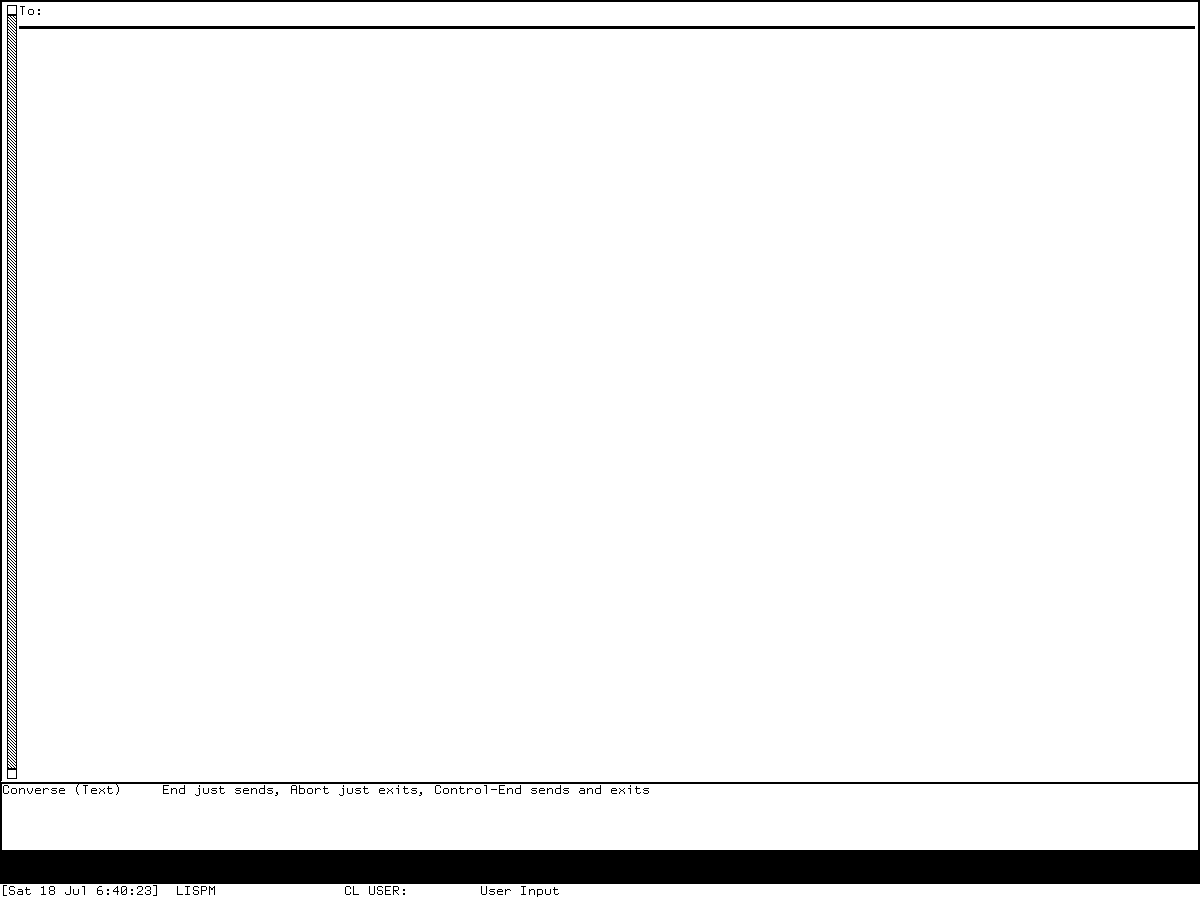
Runtime observation — Genera 8.5 System 452.22, session d09-converse-notifications-genera-20260718, generation 2, verified 2026-07-18 after local login and Select C. The reviewed 1200 by 900 image is 1,532 bytes; PNG SHA-256 8a8360166f24aa0d0e6b2ce2df29c9e3f3ac0ad963b2af93e5d78208dabff043; normalized-pixel SHA-256 425d5c9c3b353fa7bb93aa824c1b85a55cbb44e4989da1841ccad8b2c6566bc9; its four-record action prefix has SHA-256 afc0151f07823c9af72cd8fd5bf0e6366aed171422bb7059b89ea48c38693132. It establishes only the fresh visible relationships and labels, not message delivery, address parsing, command effects, history ordering, or source-to-world identity. Symbolics and other applicable rightsholders retain interests in the licensed screen; this minimum image is published under the page-specific reviewed fair-use conclusion for historical criticism and reconstruction, and no endorsement is implied.
Genera Notifications witness
The separate Select N activity has a large title, a two-cell Help/Exit menu at the upper right, a left-scrollable typeout region, and retained records below the title. After the museum set only allow_popup false and called TV:NOTIFY with researcher-authored text, returning to the activity showed exactly that one timestamped record.
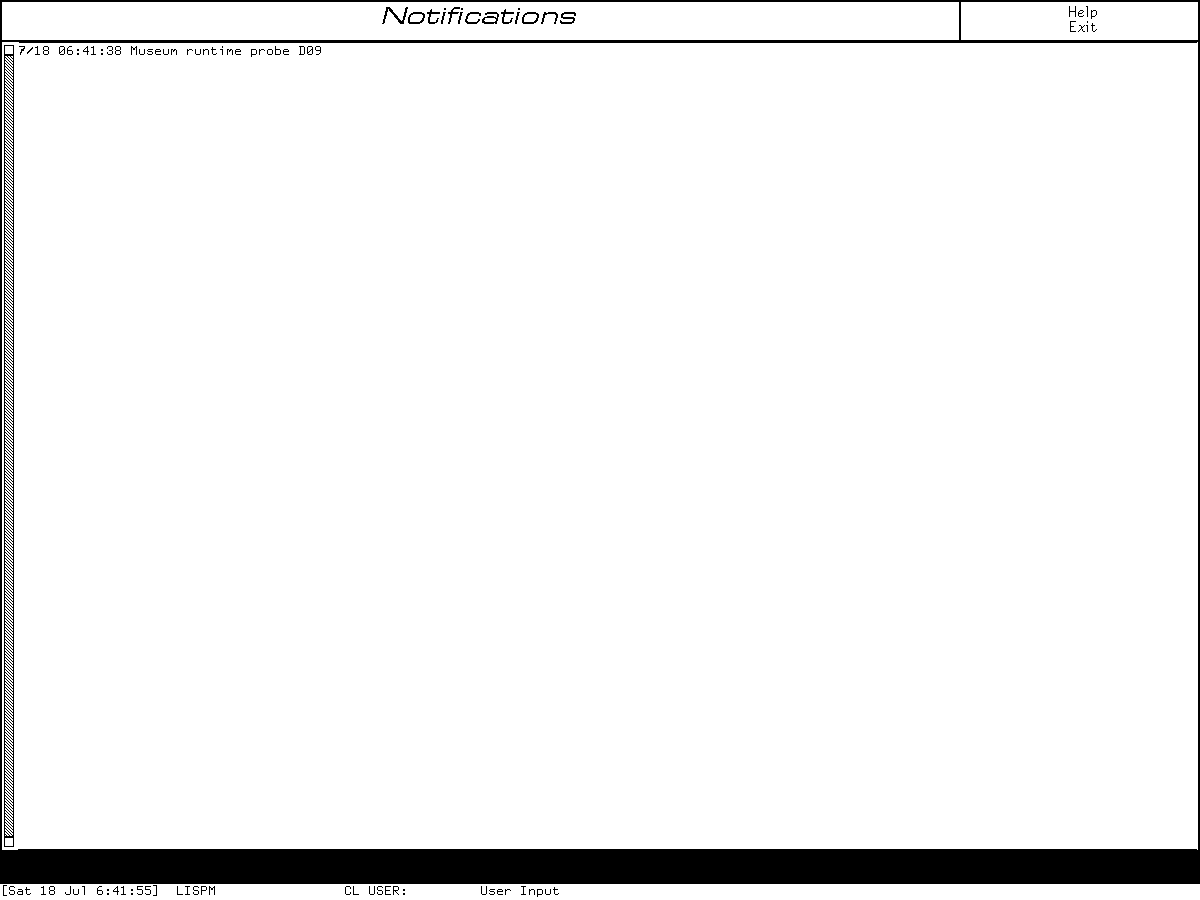
Runtime observation — Genera 8.5 System 452.22 in the same session and generation, verified 2026-07-18 after the recorded researcher-authored TV:NOTIFY call and Select N. The reviewed 1200 by 900 image is 1,803 bytes; PNG SHA-256 8b9d2ed2c941eb23f344a37f839757d46e9a5e7b97aebf4780dc1af4518b7592; normalized-pixel SHA-256 3819127ac6504aa52c226e1118a52d91ba46b301bad9b9ec365bc55acdb99d74; its 14-record action prefix has SHA-256 742d8554f5273038b99e555d1262afbbbdb4dc2f0096f2a55f1357d7827eec03. It establishes central retention and viewer visibility while fallback popups were disabled, not multiple-record order, polling, delivery-tail behavior, popup timing, or network receipt. Symbolics and other applicable rightsholders retain interests in the licensed screen; this minimum synthetic-data image is published under the page-specific reviewed fair-use conclusion for historical criticism and reconstruction, and no endorsement is implied.
Screenshot rights and exact identities
Both images are the exact curated 1200 by 900 PNGs reviewed for this scholarly D09 use in the capture-specific rights review. The first is 1,532 bytes, SHA-256 8a8360166f24aa0d0e6b2ce2df29c9e3f3ac0ad963b2af93e5d78208dabff043, pixel SHA-256 425d5c9c3b353fa7bb93aa824c1b85a55cbb44e4989da1841ccad8b2c6566bc9. The second is 1,803 bytes, SHA-256 8b9d2ed2c941eb23f344a37f839757d46e9a5e7b97aebf4780dc1af4518b7592, pixel SHA-256 3819127ac6504aa52c226e1118a52d91ba46b301bad9b9ec365bc55acdb99d74.
Publication is based on a documented U.S. fair-use conclusion for criticism, scholarship, research, and historical reconstruction. The images are sparse, functional evidence; the only substantive record text was written by this museum. They are excluded from any repository-wide software or content license. Symbolics may have an interest in the screen expression; use implies no affiliation or endorsement. The review does not approve real conversations, substantial Help, errors, popup sequences, additional captures, generic reuse, or extracted assets.
Exact raw-capture mapping, action prefixes, source-session provenance, image hashes, and shutdown results are normatively incorporated from the curated Genera screenshot catalog. A test report MUST cite that catalog rather than claiming all provenance is embedded in PNG metadata.
Runtime provenance and bounded shutdown
The Genera witness is session d09-converse-notifications-genera-20260718, generation 2, from 2026-07-18 06:39:03 through 06:42:39 EDT. Its complete action log has 14 records, 6,881 bytes, SHA-256 742d8554f5273038b99e555d1262afbbbdb4dc2f0096f2a55f1357d7827eec03. Its 26,055-byte run record has SHA-256 1ffacb2809fa4aee90e12fb7ff65413d1e443e0471adc82e1af2265743ad15f7.
The catalog incorporates the exact archive, 54,804,480-byte base/private Genera-8-5.vlod, debugger, VLM, preload, responder, configuration, toolchain, Bubblewrap isolation, X server, selected-window, ordered input, and image identities. The archive is 206,213,430 bytes with SHA-256 89fb3e76b91d612834f565834dea950b603acf8f9dbacacdd0b1c3c284a2d36e; the world SHA-256 is a8ee5e86cc7e322f7385af3e0cd579d7650d4dcfc3ce328acbf8b25515dd0672. The VLM and debugger SHA-256 values are respectively 9f5e18d5770f973879716182b6856ef5a8ee9d3b2bb907476ea0cf35986aa4c7 and 2db918cfe8f35f52c7ff4b7695b0ecd3bb85e41a3327ea5a94874edf05edb54a.
The harness used separate user, mount, network, PID, IPC, and hostname namespaces, no external route or guest file service, and an Xvfb verified not to advertise MIT-SHM. A generation-1 preflight failed before the VLM started and is not runtime evidence.
The shutdown prompt was observed, yes was accepted, and cleanup began. The known Cold Load channel mutex stall then required bounded host termination. The record is forced_stop=true, forced_after_confirmed_shutdown_stall=true, state_may_be_incomplete=true, and orderly_vlm_host_shutdown=false. Base and private worlds remained byte-identical. The harness invoked neither Save World nor a host-process checkpoint; unsaved option and notification state was discarded. This is isolation evidence, not an orderly-shutdown claim.
CADR visual boundary and load blocker
The System 303 harness session d09-converse-20260718, generation 1, ran the System 303-0 band from 2026-07-18 05:52:24 through 06:12:20 EDT. System Help had no Converse select key. MAKE-SYSTEM and the ordinary SYS load path required the unavailable AMS-BRIDGE-1 service. A direct read-only source load reached one-time initialization and failed because INTERVAL-LAST-BP received a NIL *INTERVAL*; the local compile attempt fell back to an unavailable remote data connection.
The run stopped cleanly: forced_stop=false, state_may_be_incomplete=false, emulator and Xvfb exited zero, and the base/private disk SHA-256 remained bb16e46ad81decfe1efe691d36b6aa4ce3fd4ffb82474365de3520989d397cb5. Public System, L, emulator, site, and Chaos revisions and the copied-tree, emulator, machine-artifact, toolchain, window, action, and screenshot identities are retained in the D09 dossier.
No blocker screen is a representative Converse view, and none was curated for this specification. TODO-ORACLE-C303-VISIBLE: reach a compatible public band or a reproducible corrected build, enter the actual application, capture a representative state through the CADR harness, and complete capture-specific rights review. Until then an L2 System 303 implementation uses source-defined geometry with an explicit visual oracle; it MUST NOT cite a listener error screen as the application UI.
Release deltas and strict defects
Selectable differences
| Behavior | DM-C46-SRC |
DM-C303-SRC |
DM-G452-SRC |
|---|---|---|---|
| full editor | absent | one-peer conversations | exact-recipient-set conversations |
| send execution | foreground raw send | foreground or QSend background; completion queued | preflight foreground, send worker background, temporary status replacement |
| frame request order | not applicable | FIFO append/drain | LIFO push/drain |
| hidden receive default | QSend reply popup | :NOTIFY-WITH-MESSAGE |
:POP-UP |
| compatibility saved sends | append string, oldest first | prepend string, newest first | newest-first list, printer reverses |
| End default | input editor-specific | send and remain | send and remain |
| send-and-exit | input editor-specific | Control-End; Control-Z target defective | Control-End; Z variants explicitly undefined |
| conversation delete | absent | head deletion defect | composer not deletable |
| network notification duplicate | absent | immediately repeated case-insensitive-equal text, no host/time scope | same host, equal length, and case-insensitive-equal text within ten seconds |
| central retained notification viewer | absent | no Select-N activity | Select-N Dynamic Windows activity |
| new CONVERSE protocol | absent | absent | present, with properties/preliminary/final replies |
| automatic transcript | none | none | none |
Source-visible defects and correction labels
| Identifier | Strict result | Permitted correction |
|---|---|---|
C303-HELP-END-SWAP |
local Help reverses End/Control-End while handler/mode line do not | annotate Help; never change dispatch to match stale prose silently |
C303-CONTROL-Z-TARGET |
dispatches undefined COM-CONVERSE-SEND-WITH-EXIT |
explicit alias to ordinary send-with-exit function |
C303-DELETE-HEAD |
unassigned DELQ can leave deleted composer as list head |
prohibit composer deletion or assign result |
C303-YANK-EMPTY |
direct editor yank before a receive inserts literal NIL, while transient QSend yank inserts nothing |
make both empty, with an explicit deviation |
C303-SAVED-SENDS-RESET |
before-cold stores NIL; first receive appends literal NIL, and immediate print passes non-string NIL |
allocate a fresh empty extensible string at reset |
C303-LAST-SENDER-RESET |
the selected before-cold initializer retains the exact prior last-sender value | clear the register, with an explicit deviation |
C303-TV-BEFORE-COLD-QUEUES |
TV before-cold clears history but retains exact pending/deferred list identities | clear all three, with an explicit deviation |
C303-NOTIFY-DUPLICATE-LIFETIME |
immediately-previous-text register begins NIL, changes only on nonduplicate, and has no selected reset | add a labelled reset extension |
C303-INITIALIZATION-PHASES |
cold clears gag; separate before-cold forms clear saved sends and queue, with frame/run-reason side effects; :ONCE constructs; receive mode remains |
combine or broaden mutations only as explicit deviations |
C303-MAIL-STALE-REASON |
a later successful mail record can retain an earlier unresolved-recipient reason | clear the reason before each recipient |
C303-NOTIFY-PROMPT-STREAM |
omitted-message sender passes explicit NIL as input stream |
use the actual standard input |
C303-NOTIFY-WITH-MESSAGE |
body occupies apparent sender slot | format sender and body as documented |
C303-TERMINAL-N-PROMPT |
prompt requests Space, but any available character flushes when no new item is pending | accept only Space, with an explicit compatibility deviation |
C303-TERMINAL-N-OTHER |
an unsupported argument detaches and drops pending/deferred records | validate before detach or requeue |
C303-SHOUT-PERSON |
unassigned local remains NIL, yielding SEND NIL/NILanyone |
set person to anyone |
G452-RECIPIENT-MULTIPLICITY |
equal-length membership comparison is not true multiset equality | consuming multiset comparison |
G452-LAST-IDENT-RESET |
before-cold clears saved sends and last recipients but retains the prior last identity | clear the last identity too, with an explicit deviation |
G452-CONVERSE-RESET-RETAINED-STATE |
before-cold rebuilds one fresh composer but retains request stack and all receive/gag/append/end/beep policy state | clear selected retained fields only as explicit deviations |
G452-NOTIFICATION-INITIALIZATION-PHASES |
before-cold clears history/tail but retains TV last tick/current process; distinct :ONCE recreates the process |
combine phases or clear the tick only as an explicit deviation |
G452-NOTIFY-DUPLICATE-LIFETIME |
fresh tuple is buffer/0/0/NIL; only a nonduplicate replaces it; no selected reset | add a labelled reset extension |
G452-SHOW-MESSAGES-ORDER |
Forward depends on append mode | define direction independently of display insertion |
G452-POPUP-COMMENT |
executable ten-second separation beats adjacent five-second comment | no correction; comments are not behavior |
G452-SHOW-NOTIFICATIONS-TIME |
Since and Before both strict | optional inclusive Since mode |
G452-POPUP-FAILURE-TAIL |
popup failure can advance past pending recent set | preserve retryable queue |
A conformance result MUST list each applicable defect as strict, corrected, or not exercised. “Compatible with CADR/Genera” without this matrix is insufficient.
Reference semantic protocol inventory
An implementation need not preserve Lisp names internally, but an L2 design review MUST map each semantic role below to one owned component and test.
| Semantic role | Required operations |
|---|---|
| conversation registry | create anonymous/real conversation, find by point, find by peer/set/identity, link/unlink, first/last |
| structural interval | create headers/dividers, add before/after, preserve point, validate reachability, regenerate, delete |
| outgoing lifecycle | parse, preflight, insert pending, restore composer, start worker, replace/recreate final status |
| incoming lifecycle | parse, reject policy, save compatibility record, update reply identity, choose visible/hidden path, enqueue mutation |
| request ownership | immediate/delayed enqueue, wake, drain order, remove-before/after-apply, abort result |
| QSend facade | quoted macro where applicable, listener selection, input editor, wait/background return, reply snapshot |
| address service | first/last-at split by call path, bare-name search, ambiguity menu, canonical address and set match |
| old SEND adapter | open contact, header/body/EOF, accept/reject, result/close |
| CONVERSE adapter | header grammar, preliminary response, body/EOF, mapping conversion, final response, SEND fallback |
| broadcast/notify adapter | site enumeration, parallel or path attempts, timeout, duplicate state, per-host results |
| notification history | insert newest first, delivery tail, print/index, reset, window-of-interest |
| notification destination | handoff cell, wake, timeout/take-back race, mode result, blast/fallback |
| popup | throttling, selection wait, protected typeahead, Help/dismiss, new-record append, inactivity popdown |
| viewers/reports | Notifications chronological tail, Show Messages selection/order/query, Show Notifications precedence/filters |
| export | select buffer/conversation, direct write or copy-then-append, partial failure, close |
Exact module-closure boundary
For DM-C46-SRC, D09 semantic closure is the selected region of lmio/chsaux.113 plus its TV query/input-editor, Chaos stream, login, host parser, time, and string dependencies. This does not claim that every function in chsaux.113 belongs to D09.
For DM-C303-SRC, sys/sysdcl.lisp selects SYS:IO1;CONVER and the outer system incorporates it, while notification and network owners live in their respective window/Chaos modules. Semantic closure includes the named command parents and TV interfaces from the companions. It does not imply that CONVER was resident in the tested 303-0 world.
For DM-G452-SRC, Converse is a one-file subsystem in zmail/system.lisp and is also declared in the Zmail build. Central notification, the Notifications activity, network protocols, CP reports, ZWEI parents, TV, Dynamic Windows, namespace and service selection are external dependencies. Zmail's use of the subsystem does not make the Zmail reader part of D09, and D09's mail commands do not make the Mailer daemon part of D09.
No profile claims exact source symbol, package export, macroexpansion, object-layout, compiled-call, QFASL, bytecode, wire-packet, or world closure. Those require separate manifests and compatibility levels.
Conformance test suite
Every test records profile, correction matrix, adapters, seed/clock, initial state, ordered inputs, ordered external calls, result, final state, and whether it used source simulation or a preserved runtime. Tests with message text SHOULD use researcher-authored synthetic payloads.
Artifact and profile tests
- Verify every public artifact byte count, SHA-256, Git/Fossil pin, and URL.
- On an authorized workstation, verify every licensed evidence-only identity without copying content into the test report.
- Reject
DM-C46-CONVERSEand every impossible closure/profile combination. - Prove source and runtime witness profiles can be reported separately.
- Prove changing profile requires destroying/recreating frame state.
- Emit the complete strict/corrected/not-exercised defect matrix.
- Verify no test writes licensed source, decoded Help, real message content, or world data into a tracked output.
Effective-input tests
- Enumerate every direct, inherited, prefix, menu, pointer, presentation, transient, numeric, repeat, Help, shadowed, fallthrough, and unbound tuple for each context.
- Diff the C46/C303 tuples against the normative CADR companion with no missing or extra application-owned leaf.
- Diff the Genera tuples against the normative Genera companion likewise.
- Recursively traverse every prefix table, including Genera local
Control-X, and prove cycle handling does not suppress reachable leaves. - Verify local undefined Z chords stop inheritance in Genera.
- Verify System 303 Control-Z attempts its exact undefined target in strict mode.
- Verify End/Control-End complement behavior for both values of
end_exits. - Verify the System 303 Help mismatch and Genera Help omissions do not change the effective enumeration.
- Exercise QSend completion, abort, yank, and transfer contexts.
- Before any receive, compare direct editor
Control-Meta-Ywith the transient QSend yank: strict System 303 inserts literalNILonly in the former. - Exercise every ordinary and encrypted incoming-popup key, who-line choice, and pointer gesture.
- Exercise Notifications Help/Exit menu equivalents and every inherited scroll, search, mark, kill, refresh, scrollbar, and
Show GC Statuspath. - Exercise numeric-argument equivalence classes, including boundary values 1 and 2 for System 303 gag and every documented/catch-all Terminal-N class.
- Verify unknown keys take the profile's ordinary unbound path and do not insert host text unexpectedly.
Structural conversation tests
- Create the anonymous composer and verify all line/link invariants.
- Insert incoming and outgoing messages under prepend and append modes.
- Move among first, middle, last, and anonymous conversations.
- Regenerate and prove retained records survive while unsent edits disappear.
- Delete first, middle, and last real conversations and recheck all invariants.
- Reproduce System 303 head deletion in strict mode; prove each correction avoids the dangling interval/list state.
- Verify Genera refuses composer deletion.
- Create equal, reordered, different-length, duplicate, and identity-bearing recipient sets; reproduce the strict multiplicity edge and corrected result.
- Compare explicit new-CONVERSE recipients with legacy SEND text containing no, lowercase/mixed-case, malformed, and multiple
Also-to:headers; only the first parseable header through its next return augments the sender. - Delete a Genera conversation during an outstanding worker and prove final status recreates/finds it exactly once.
- Verify a visible incoming message does not move point out of a nonblank partial composer.
Direct-send and failure-order tests
- Verify System 46 macro arguments are quoted; verify ordinary function arguments follow normal evaluation.
- Test no-at, one-at, and multiple-at destinations through every call path, including last-at raw parsing and first-at System 303 interactive parsing.
- Inject login, explicit-host parse, post-clear bare-user lookup, open, header write, body write, EOF, reply, timeout, and close failures one at a time and assert exact preceding mutations.
- Verify System 46 success returns
NIL, failure returns a string, and neither adds an outgoing saved-send record. - Send to multiple System 303 recipients with all success, first/middle/last failure, and missing host; verify in-frame attempts/records stay in input order, all-new peer blocks end in reverse creation order, partial records persist, and exit occurs only on all success.
- Verify out-of-frame System 303 QSend attempts and enqueues in reverse input order, wait=true returns only successes in their original relative order, wait=false returns immediately, and delayed FIFO/front-insertion produces its specified all-new block order.
- Invoke zero-argument System 303
REPLYwith no last sender and verify it selects Converse without body input or delivery; then verify normal captured-sender use. - In one mail loop, follow an unresolved recipient with a successful recipient and reproduce the strict stale failure reason; verify the correction separately.
- Verify Genera preflight prompt order and distinct decline/no-path/rich-content results before worker body transmission.
- Verify pending insertion and composer restoration precede background delivery.
- Verify hidden-frame worker errors create a central notification.
- Verify mail results remain separate from direct-delivery success.
- Race a new incoming sender against QReply and prove the snapshotted destination is retained.
Request-queue and concurrency tests
- Block the editor owner, enqueue three labeled System 303 requests, unblock, and assert FIFO application.
- Repeat for Genera and assert LIFO application.
- Verify ordinary System 303 enqueue wakes while delayed enqueue waits for a later exposure/command-loop wake.
- Abort a System 303 handler and verify strict remove-after-apply retention.
- Abort a Genera handler and verify remove-before-apply nonretry.
- Run simultaneous System 46 arrivals and prove only one popup/reply transaction owns the lock.
- Force nonlocal exit at each System 46 popup stage and prove unwind releases the lock.
- Instrument editor mutations and prove no network/background thread mutates the interval directly.
- Seed System 303 FIFO
[A,B]; have A append C while running and prove the sameDOLIST/NCONCpass executes A, B, C with no length snapshot. - Push Genera A then B; have B push C while running and prove the captured-chain pass executes B, A and leaves C for the next pass, which executes C.
Wire and server tests
- Record semantic old SEND order: open/contact, header, body, EOF, server handoff, result, close.
- Parse every CONVERSE property, repeated
ALSO, repeated normally singleton properties with last-write-wins, mixed-case property names, empty and nonempty mappings/fonts, and reject every unknown or no-space property line at its parse phase. - Omit
DATE,FROM, andTOseparately and in combination: prove DATE defaults to the injected clock only after preliminary acceptance; missing TO produces the ordinary%warning,To: NIL, and continuation; and an unmatched ordinary missing-FROM delivery mutates receive/reply history and partial editor structure, raises the string-type failure, and appends no conversation. Reserve only the loaded-world presentation of that condition for the named oracle. - Cut the stream at every header byte/line and verify no invented response after a network read failure.
- Test logged-out, private-user mismatch, and gag rejection in exact order.
- Verify
-,%,+Proceed, final+Message delivered, and malformed response handling without conflating preliminary and final status. - Trigger upper- and lowercase variants of the
CHARACTER-TYPE-MAPPINGSsubstring and prove one styled-to-plain generic:SENDretry with path reselection followed by the warning; prove nonmatching errors do not retry, no legacy path is forced, and thinning/retry failures emit no warning from this branch. - Send
NOTIFICATION YESand prove no saved-send, reply identity, or conversation mutation occurs while one central notification is inserted. - Run System 303 SHOUT in strict and corrected modes across success/failure host mixtures and preserve per-host continuation.
- Invoke System 303
NOTIFYandNOTIFY-ALL-LMSwithout a body and prove strict explicit-NILstream failure versus the corrected standard-input prompt. - Test System 303 network NOTIFY duplicate equality across different times/hosts and a case-only text variant from initial NIL state; strict mode suppresses an immediately preceding case-insensitive match without host or time scope, changes the register only for nonduplicates, and does not clear it under any selected reset operation. Inject host-resolution and TV-delivery failure after the cache store and prove a same-text retry can be suppressed.
- Test Genera duplicate boundaries: same/different host, same/different length, case-only variants, other same-length text, 9.999/10/exceeding-ten-second clock cases, and unchanged duplicate
Doneacknowledgement. Start from the exact buffer/0/0/NIL tuple; prove duplicate changes nothing, selected reset operations do not clear it, scalar updates precede buffer copy, and failures at copy,TV:NOTIFY, and host-available marking leave their specified partial state and acknowledgement boundary. - Test overlong Genera notice under truncate and
error-pbranches. - For System 303 all-host notice, use source list
H1, BAD, H2, H3: openH1,H2,H3, omit unparseableBAD, and report/cleanH3,H2,H1, including unwind after a mid-report failure. Test Genera multi-host timeouts and result order separately without erasing responders.
Incoming and notification tests
- Verify System 46 saved-send append order, two-return separation, hidden-window clear/new-segment display, bell-before-lock, close-before-display, registry-removal-after-display/before-query, selected/silent versus hidden/notified waiter cases, successor handoff, yes/no reply, and print result
T; inject non-RFC state, mid-copy/pre-close, post-close/pre-display, and reply failures. For non-RFC, assert only one registry removal and no accept/read/history/close/UI/ reply effect; inject LISTEN/state failure before removal. Assert partial history, connection registry, and lock cleanup independently. - Exercise every System 303 receive mode plus undocumented
:POP-UPalias. - Reproduce the strict
:NOTIFY-WITH-MESSAGEformatting defect and corrected mode. - Exercise Genera hidden
:AUTO,:NOTIFY,:POP-UP, named:NOTIFY-WITH-MESSAGE, and an arbitrary mode value with plain and encrypted text; prove the named and arbitrary values share the catch-all branch. - Send a new-CONVERSE record with both
NOTIFICATION YESandENCRYPTED; verify sender/date/trimmed body entersTV:NOTIFYwhile every Converse history/register remains unchanged. - Exercise the four System 303 initialization forms independently. For saved-send before-cold, compare fresh binding with NIL reset, first-receive literal suffix, immediate-print oracle, and retained last-sender/policy sentinels. For queue before-cold, test both an existing and missing frame: ensure ancestor/find/create, process run reason, then queue clear. Prove cold alone clears gag and
:ONCEconstructs its frame/comtab, while every form retains receive mode. Test labelled corrections separately; separately verify Genera saved-send reset. - Insert three Genera notifications and assert history newest-first but delivery oldest-first.
- Exercise
:ALWAYS-IGNOREand:ALWAYS-POP-UPbefore handoff; every cell-full, consumed-race, invalid-cell,:IGNORE,:BLAST,NIL,:POP-UP, and invalid post-timeout result after handoff. - Advance a deterministic clock through 179/180 handoff ticks and 1199/1200 selected-window ticks.
- Verify
allow_popup=falseretains history and prevents only fallback popup. - Exercise popup protected typeahead, Abort, post-delay dismiss, Help replacement, window-of-interest selection, active-popup append, and 54,000-tick inactivity.
- Verify strict ten-second popup spacing and preserve the stale five-second comment only as documentation evidence; with two consoles, prove each timestamp is independent and that expired per-console entries are pruned.
- Inject popup failure and assert strict delivery-tail advancement; test corrected retry separately.
- Verify Notifications initial chronological display, one-second tailing, recursive arrival capture, refresh, query-I/O exclusion, and nonclearing exit.
- Verify Terminal-N's four documented classes plus destructive catch-all, atomic pending/deferred detach, the
Tresidual-history discrepancy, stated-Space versus actual-any-character flush behavior, selection-loss return, and restart when a new notification arrives. - Verify
PRINT-NOTIFICATIONSclipping, swapping, newest-first output, and exact tail-identity cursor assignment. Includefrom=0,to=0with additional pending records and prove the cursor moves to the history head, updates the TV tick, and can skip unprinted records; also prove the non-tail predicate leaves both state values unchanged. - Seed System 303 TV history, pending, and deferred with distinct list sentinels; invoke only the TV before-cold operation and assert history NIL plus exact queue identity retention. Test a labelled all-clear correction separately.
- Seed Genera history, delivery-tail, TV tick, and process sentinels. Invoke
:BEFORE-COLDand:ONCEseparately: the former clears only history/tail; the latter recreates only the process. Inject failure after every ordered process setup step and assert no rollback. - Inject Genera
TV:NOTIFYfailures after record formatting, history push, TV tick, background-interest insertion, optional activation, and wake. Assert the exact committed prefix and verify normal multiple-value return comes from the optional interest branch rather than the record or wake operation.
Report and persistence tests
- Exhaust the cross-product of Show Messages Direction, From, To, Recent, Mention Empty Sequences, Order, Query, Start, Stop, and Summarize on a synthetic corpus.
- Verify contextual defaults and that Query forces Summarize false.
- Reproduce Forward order under both conversation append modes.
- Build two ordered screens with multiple direct Converse frames, a nested frame, repeated fixture identities, the anonymous composer, and a NIL-recipient named fixture; prove Show Messages uses screen order, direct inferior order, then each frame's conversation-list order, excludes the nested frame, performs no deduplication/current-frame restriction, and never outputs either NIL-recipient object even when Mention Empty Sequences is true.
- Exhaust Show Notifications range precedence, strict time boundaries, OR matching, exclusion-none semantics, case-insensitive
A/asubstring equivalence, and common output routing. - Test timestamps exactly equal to Since and Before, Before-without-Since under nonempty login history, its strict empty-login-history failure, and Since-without-Before against the injected current time.
- Write buffer/conversation and compare selected interval bytes.
- Append with absent and existing targets and inject failures at open, old-content read, copy, new write, and close; verify partial outputs are not rolled back in strict mode.
- Prove exports do not clear or mark histories and cannot be imported implicitly.
- Seed Genera saved sends, recipients, last identity, request stack, every receive policy field, named and anonymous conversations, old messages, and unsent text; invoke Converse before-cold. Verify saved sends/recipients clear; strict identity, queue, and policy sentinels remain; old frame content becomes exactly one fresh headerless
To:composer with point at the new first-line end and redisplay requested. Test no-frame behavior, each ordered failure boundary, later execution of retained queued work, and labelled corrected clears separately.
Visual, rights, and provenance tests
- Compare layout relationships against the two exact curated Genera images without requiring pixel identity.
- Verify a fresh Converse has one
To:template, separator, scrollbar, blank body, and lifecycle mode line. - Verify Notifications has title, Help/Exit menu, left scrollbar, and separate typeout history.
- Hash curated images and compare both file and decoded-pixel SHA-256 values.
- Verify every published capture has the catalog session/generation, action prefix, raw mapping, dimensions, rights basis, attribution/no-endorsement notice, and license exclusion.
- Fail publication if a test introduces real addresses/messages, substantial Help, ignored-session paths, or unreviewed captures.
- Keep
TODO-ORACLE-C303-VISIBLEfailing for preservation-fidelity claims until a representative CADR application screenshot is captured and reviewed. - Verify the Genera run is described as forced after a confirmed cleanup stall, not orderly, and the CADR run as clean.
Preserved-system comparison procedure
CADR and LM-3
- Pin the public System, L, site, Chaos, emulator, and machine artifacts and copy them through the documented harness.
- Record both public revisions and private copy-time tree hashes, load-band/base and private-disk checksums,
usim_sha256_at_start,usim_sha256_at_exec, toolchain, selected window, input actions, and final stop flags. - First enumerate the loaded world's select keys and system presence. Do not infer residency from the maintained checkout.
- Prefer a compatible band with Converse already resident. If loading is required, record every service and compile dependency and do not patch silently.
- Use two disposable isolated peers for SEND, SHOUT, NOTIFY, replies, and duplicate tests. Never route the experiment to an external site.
- Capture representative source-owned states and compare semantic traces. Curate only the minimum screenshots after capture-specific rights review.
- Stop cleanly when possible and report forced/incomplete state exactly.
Genera
- Use a private copy of the identified world and the documented Genera harness, preserving archive/world/debugger/VLM/preload/responder/configuration/toolchain hashes and Bubblewrap/Xvfb verification.
- Record each input intent before XTEST dispatch and append its success, failure, or partial result afterward.
- Use only researcher-authored identities and bodies. Keep raw captures, action logs, world copies, and licensed output in the ignored session tree.
- For local UI tests, disable only the option needed by the test and record its unsaved lifetime. For network tests, create a deliberately isolated disposable peer; the present harness has none.
- Compare source and runtime traces without assuming System 452.1 bodies match the Genera 8.5 world.
- Record prompt, confirmation, cleanup progress, forced-stall status, world hash change, Save World/checkpoint knowledge, and process cleanup independently.
- Curate only reviewed images and incorporate the catalog. Never publish licensed Help or real conversation content as a screenshot substitute.
Recorded witnesses
The current CADR witness closes only load/reachability and shutdown assertions. The current Genera witness closes only the fresh-frame visual state, local select entry, one synthetic notification's retention/view visibility with popup fallback disabled, and shutdown/isolation assertions. Every other runtime statement remains a named source-derived contract or oracle.
Known unknowns and nonclaims
TODO-ORACLE-C303-VISIBLE: reach and capture a real maintained-System-303 Converse frame in a compatible public band or reproducible corrected build.TODO-ORACLE-C303-CONTROL-Z: determine whether a compatible historical loaded system signals undefined command, supplies an unselected patch alias, or dispatches differently.TODO-ORACLE-C303-DELETE-COMPOSER: observe the exact visible/error state after strict deletion of the anonymous composer and whether ordinary regeneration can recover it.TODO-ORACLE-C303-SHOUT: exercise the apparentPERSONdefect on two isolated peers and check for a loaded patch.TODO-ORACLE-C303-NOTIFY-FORMAT: observe hidden:NOTIFY-WITH-MESSAGEoutput against a synthetic peer.TODO-ORACLE-G85-PEER: exercise old SEND, new CONVERSE, reply identity, multi-recipient grouping, preliminary/final responses, style fallback, and notification bypass with a disposable isolated peer.TODO-ORACLE-G85-SHOW-MESSAGES-ORDER: observe Forward/Reverse under both append modes in the compiled world.TODO-ORACLE-G85-POPUP-DELAY: time popup separation and selected-window/handoff boundaries in the compiled world.TODO-ORACLE-G85-DUPLICATE: observe same/different-host and ten-second boundary behavior through the actual one-packet service.TODO-ORACLE-G85-RECIPIENT-DUPLICATES: exercise repeated-address sets in live conversation lookup.TODO-ORACLE-G452-MISSING-FIELDS: observe the exact loaded-world debugger or typeout presentation for an unmatched ordinary missing-FROMqueued failure. The missing-TOwarning/To: NILpath and missing-FROMpartial mutation/failure phase are already normative source contracts.TODO-ORACLE-SOURCE-WORLD: compare selected licensed source functions with loaded world definitions before claiming body identity.TODO-ORACLE-WIRE-BYTES: capture exact old SEND, CONVERSE, and NOTIFY bytes, character encodings, segmentation, and size limits against pinned stacks.
The specification makes no claim about which MIT release first introduced Converse; System 46 and maintained System 303 only bracket the evidence. It does not claim every historical site used the maintained source defaults. It does not specify user directories, authentication security, Chaos routing, namespace database contents, mail delivery, hardcopy devices, complete ZWEI/Zmacs internals, Dynamic Windows internals, or Command Processor implementation beyond the named interfaces.
It does not claim that “private” or “encrypted” offers modern confidentiality or authentication. It does not authorize exposure to an untrusted network. It does not claim that a notification acknowledgement proves a human saw it, that an outgoing status is a durable audit record, or that a screenshot proves hidden behavior.
Artifact identities
| Artifact class | Identity |
|---|---|
| System 46 source | Git 8e978d7d1704096a63edd4386a3b8326a2e584af; exact chsaux.113 identity in evidence ledger |
| System 303 source | Fossil 4df393c68d7f083ce42d5c377039d26043cc18a9031ace28258dc97f4137eb91; exact selected file identities above |
| CADR runtime | d09-converse-20260718, generation 1; System 303-0; disk SHA-256 bb16e46ad81decfe1efe691d36b6aa4ce3fd4ffb82474365de3520989d397cb5 |
| Genera source | System 452.1 / Zmail 442.0; licensed file identities above |
| Genera archive | 206,213,430 bytes; SHA-256 89fb3e76b91d612834f565834dea950b603acf8f9dbacacdd0b1c3c284a2d36e |
| Genera world | Genera-8-5.vlod, 54,804,480 bytes; SHA-256 a8ee5e86cc7e322f7385af3e0cd579d7650d4dcfc3ce328acbf8b25515dd0672 |
| Genera runtime | Genera 8.5 System 452.22; d09-converse-notifications-genera-20260718, generation 2; action/run hashes above |
| Curated images | exact file/pixel identities above and in the curated Genera screenshot catalog |
Sources
- MIT CADR System 46,
lmio/chsaux.113. - LM-3 System 303,
io1/conver.lisp. - LM-3 System 303,
network/chaos/chsaux.lisp. - LM-3 System 303,
sys2/string.lisp. - LM-3 System 303,
window/basstr.lispandwindow/baswin.lisp. - LM-3 System 303,
sys/sysdcl.lisp. - LM-3 System 303 release notes,
doc/sys93.msganddoc/sys94.msg. - Symbolics, Editing and Mail, Genera 8 Converse manual and command reference.
- Symbolics, Genera User's Guide, Select keys, activities, notifications, and Command Processor guidance.
- Licensed local System 452.1 / Zmail 442.0 source files listed in the evidence ledger, verified by byte count and SHA-256; no licensed body is reproduced.
- Installed licensed Sage documentation identified in the D09 dossier; used only for bounded manual/help comparison.
- Fresh CADR Xvfb session
d09-converse-20260718, generation 1, observed 2026-07-18; raw payload retained only in the ignored computer-use tree. - Fresh Genera Xvfb session
d09-converse-notifications-genera-20260718, generation 2, observed 2026-07-18; portable provenance and curated images in the Genera screenshot catalog.