Spacewar on the MIT Lisp Machine
The Lisp Machine Spacewar is a complete two-player real-time game, not a static graphics demonstration. Two ships share a wraparound or reflecting playfield, accelerate and rotate under player control, fire limited-lifetime torpedoes, feel inverse-square gravity from an optional sun, collide, and can escape temporarily through risky hyperspace. Its maintained LM-3 form is also unusually Lisp-machine specific: the playfield is a selectable window and a Lisp Listener, every moving object is rendered as a character blinker, and the SHIP raster font is a sprite sheet containing the sun, torpedo, and rotated ship images.
This page documents two public implementations:
- the released MIT CADR System 46 source at commit
8e978d7, whose accompanying loader starts the game immediately; and - the maintained LM-3 System 303 implementation at Fossil check-in
4df393c, which adds the dedicated window, introductory display, System-key selection, abstract key-state input, and several tuning and lifecycle changes.
The runtime claims are narrower than the source claims. On 18 July 2026, the repository's isolated System 303 harness loaded the exact public source and public SHIP QFASL through its local FILE server, displayed the introductory window, and entered a live game. The resulting playfield showed both ship designs and the sun. Starting the game was verified; every control is established by the implementation, but this run did not separately demonstrate all ten player inputs or a complete match.
What it looks like
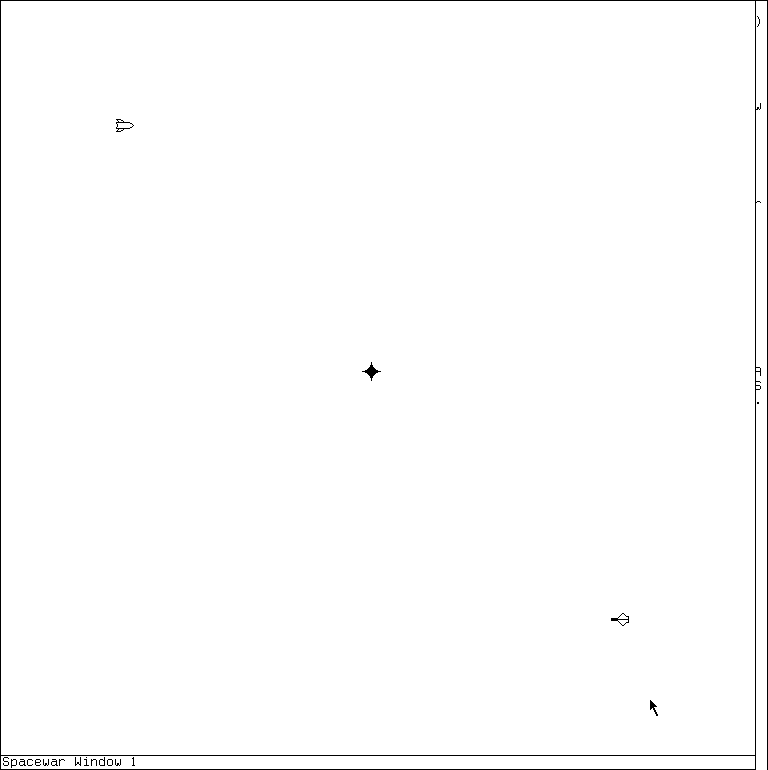
The capture shows the initial live playfield after the start modifier was pressed. The left ship begins near the upper-left pointing right, the right ship near the lower-right pointing left, and the sun at the center. The published image is a 768-by-770 crop of the exact framebuffer: it retains the complete Spacewar window and removes only an unrelated split-screen debugger beneath it. No retained pixel was redrawn.
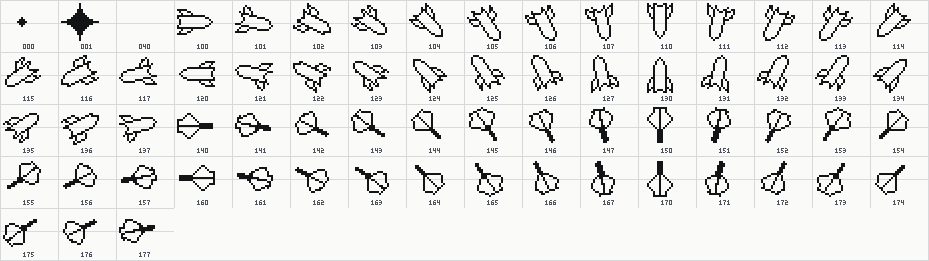
The outlines are glyphs, not vector paths or independent bitmap objects. The SHIP specimen sheet shows the underlying public raster font. The game directly addresses a torpedo and sun plus two runs of 32 ship orientations, beginning at character @ for the left design and the backquote character for the right design. The recovered QFASL contains 67 glyphs; Spacewar's source directly assigns 66 character positions. No source-backed purpose has been established for the remaining recovered glyph, so this page does not invent one.
Starting, selecting, pausing, and stopping
Released System 46 path
The public loader lmio1/load.swar declares the SPACEWAR package, loads lmio1;swar and lmfont;ship, prints the form used to stop the game, and calls SPACEWAR:SPACEWAR. A contemporary INFO-LISPM record gives the compact user route:
(load "lmio1;load swar")The released implementation creates a process and global roving blinkers. It does not define the later SPACEWAR-WINDOW, introductory Listener, or System W entry.
Maintained System 303 path
System 87 release notes instead say to load SYS:IO1;SWAR and call the entry point:
(spacewar:spacewar)SPACEWAR presets and enables the reusable Spacewar process. INIT loads SYS:FONTS;SHIP QFASL if necessary, creates and selects a square SPACEWAR-WINDOW, explains the controls, and waits until any Control, Meta, Super, or Hyper modifier is depressed. It then clears the explanatory display, creates the sun and both ships, and enters the simulation loop.
The maintained implementation registers System key W with the label Spacewar!. This selects or creates the Spacewar window through the ordinary TV system-key registry. The three explicit lifecycle operations are:
| Operation | Effect established by source |
|---|---|
SPACEWAR:SPACEWAR |
Preset the persistent process to SPACEWAR-TOP-LEVEL and enable it. The top level repeatedly initializes and runs games. |
SPACEWAR:FREEZE |
Revoke every current run reason from the Spacewar process, stopping simulation activity without deleting the game objects. |
SPACEWAR:RESUME |
Enable the existing Spacewar process again. |
SPACEWAR:STOP-SPACEWAR |
Hide every current object blinker and revoke all run reasons, stopping the process and removing ships, torpedoes, and sun from view. |
FREEZE and RESUME are additions in the maintained source; the System 46 version supplies only start and stop. Neither version has a score table, single player mode, network mode, save file, or independent settings dialog in the inspected source.
Complete player controls
The game reads the two physical shift-key banks as ten separate continuous controls. The names and directions below follow SHIP-KEY-ALIST and its source comment; they are not inferred from modern keyboard conventions.
| Ship | Lisp-machine key | Direct action |
|---|---|---|
Left ship, FOO |
Left Top | Accelerate forward while fuel remains. |
Left ship, FOO |
Left Super | Turn right at SHIP-TURNING-RATE. |
Left ship, FOO |
Left Hyper | Turn left at SHIP-TURNING-RATE. |
Left ship, FOO |
Left Control | Fire a torpedo when ammunition remains and the reload interval has elapsed; holding the key fires at the maximum allowed rate. |
Left ship, FOO |
Left Shift | Enter hyperspace when its reload interval has elapsed. This is Shift, deliberately not the Hyper key used for turning. |
Right ship, BAR |
Right Top | Accelerate forward while fuel remains. |
Right ship, BAR |
Right Super | Turn right at SHIP-TURNING-RATE. |
Right ship, BAR |
Right Meta | Turn left at SHIP-TURNING-RATE. |
Right ship, BAR |
Right Control | Fire under the same ammunition and reload rules. |
Right ship, BAR |
Right Shift | Enter hyperspace under the same delay, random-return, and failure rules. |
There is one additional start-only input: while the introductory display is visible, depressing any Control, Meta, Super, or Hyper key begins the game. The start predicate does not include Top or Shift. Once play begins, the simulation polls the ten side-specific states above on every cycle rather than consuming ordinary input characters.
The System 46 program implements the same logical five controls per ship with raw bits from the keyboard's Unibus register at octal address 764126. It also exposes RB for reading that register and DB for substituting a debugging bit mask. The maintained source removes the hardware address, bit table, RB, and DB; it uses TV:KEY-STATE names such as :LEFT-CONTROL. That is a real portability change, not merely a spelling update.
Simulation and rendering architecture
Clock and coordinate system
The maintained game requests ten cycles per second (CPS = 10) and uses 1,000 internal position units per display dot (UPD = 1000). Each cycle:
- waits until the next scheduled time;
- waits if the Spacewar window is not exposed;
- decodes held controls;
- returns any ships whose hyperspace delay has expired;
- expires old torpedoes and checks the end condition;
- detects collisions;
- moves, accelerates, and rotates objects; and
- applies gravity.
The order matters. A held control alters acceleration or angular velocity before movement physics later in the same cycle; gravity is applied after the position update and therefore affects subsequent movement. This ordering is an implementation finding not stated on the introductory screen.
The maintained window chooses its inside size from the smaller screen dimension minus 20 dots. The playable minimum is five dots inside each edge and the maximum is six dots short of the computed size. System 46 instead hard-codes a much larger coordinate rectangle, with maxima of 1,377 by 1,530 dots, and renders through global roving blinkers rather than a dedicated square window.
Objects and sprite glyphs
Each sun, ship, or torpedo is an OBJECT array structure. Its fields include type, sprite base character, collision radius symbol, position and velocity, acceleration, orientation and angular velocity, unit-vector projections, collision function, immovability, ammunition and fuel, last-fire and last-hyperspace cycles, blinker, and death state.
The rendering is deliberately small:
- a ship is a
TV:CHARACTER-BLINKERwhose character changes among 32 consecutive glyphs as its angle changes; - a torpedo is another character blinker using the first sprite character;
- the sun uses the next sprite character and is marked immovable; and
- object motion changes the blinker's cursor position after rounding internal coordinates to display dots.
This design makes the font part of the executable visual logic. Removing or replacing FONTS:SHIP does not merely change typography; it removes the shapes that communicate object type and direction. The broader sprite-font evidence is cataloged in the CADR visual-assets inventory and font-usage audit.
Motion and the playfield edge
With the default WALL-BOUNCE = NIL, an object crossing an edge reappears at the opposite edge. Setting it true reflects both position and the corresponding velocity component; the loop permits repeated reflection when one cycle would cross more than one boundary.
The collision detector sorts all objects by horizontal position, then stops comparing once later objects are too far away. This normally reduces the work from all-pairs quadratic scanning toward a linear pass. The source explicitly retains a left-edge exception in the stopping test because wraparound can put an object near the left edge in collision range of one near the right edge. The optimization is thus aware of the topology rather than treating screen coordinates as an ordinary bounded plane.
The effective collision threshold is the greater of the two objects' summed radii and TORP-TORP-COLLISION-DISTANCE. The latter is intentionally larger than two torpedo radii, making defensive torpedo-to-torpedo interception easier. The same minimum applies to any pair whose radii sum to less than it, a broader effect noted in the source comment.
Sun and gravity
The sun is stationary and does not itself take collision damage. Every movable object receives an acceleration directed toward each sun, scaled by the inverse of the squared distance. The default collision policy is :CORNER: contact sets an object's velocity to zero and moves it to the minimum horizontal and vertical coordinates. Setting the policy to true instead invokes the object's ordinary collision function; setting it to another value, including NIL, leaves no source-defined collision effect.
Torpedoes, death, and the end of a game
A fired torpedo begins just beyond the firing ship's and torpedo's combined radii. Its velocity is the ship's current velocity plus a forward component, so it inherits the motion of its launcher. Firing decrements the ship's supply and records the current cycle. Each torpedo becomes eligible for removal after its lifetime, and collided or expired torpedo objects are kept on a free list for reuse rather than repeatedly allocated.
A ship collision stops its acceleration and rotation, makes its blinker flash, and sounds a ship-specific death tone—1,000 for FOO, 2,000 for BAR—for the same fixed duration. It also schedules the game to end after the death delay.
If no ship has fuel or torpedoes and no fired torpedo remains on screen, the game beeps and schedules the same delayed ending. SPACEWAR-TOP-LEVEL then starts a new game rather than terminating the process. The inspected implementation does not record a winner, count kills, or preserve results across that restart.
Hyperspace
Hyperspace removes the ship from the active-object list and hides its blinker. After the delay, the ship returns at a random position, with a random orientation and a fixed-magnitude velocity in a random direction. It has a 12 percent chance of immediately invoking its death function. The reload timer is recorded on return, so the source-defined delay between entries is measured from reappearance, not departure.
Complete tunable game parameters
Changing parameters from the Spacewar Listener is described by the program itself as a traditional part of the game. The following table accounts for every user-designated parameter before the source's “not interesting for the user” boundary.
| Variable | Maintained default | Meaning and when it takes effect |
|---|---|---|
SHIP-ACCELERATION |
4,000 internal units per cycle squared | Forward engine acceleration while Top is held. |
SHIP-TURNING-RATE |
0.50 radians per cycle |
Signed angular velocity selected by the two turn keys. |
SHIP-TORP-SUPPLY |
40 per ship | Ammunition copied into each ship at game initialization. |
TORP-RELOAD-TIME |
6 cycles, 0.6 seconds | Minimum interval between successful shots. |
TORP-VELOCITY |
10,000 internal units per cycle | Forward velocity added to the firing ship's velocity. |
TORP-RADIUS |
3 dots | Torpedo contribution to ordinary collision distance. |
SHIP-RADIUS |
9 dots | Ship contribution to collision distance and torpedo launch offset. |
TORP-LIFETIME |
60 cycles, 6 seconds | Time from firing until expiration. |
TORP-TORP-COLLISION-DISTANCE |
10 dots | Minimum collision threshold used when summed radii are smaller. |
SHIP-FREQ-ALIST |
FOO 1,000; BAR 2,000 |
Death-beep tone chosen by ship name. |
WALL-BOUNCE |
NIL |
False wraps through edges; true reflects position and velocity. |
DEATH-DELAY |
30 cycles, 3 seconds | Delay between a death or exhausted game and the next initialization. |
SHIP-FUEL-SUPPLY |
500 cycles, 50 seconds of thrust | Fuel copied into each ship when a game starts and decremented only during acceleration. |
SUN-FLAG |
T |
Whether INIT creates a sun. Takes effect at the next game initialization. |
SUN-COLLISION-FLAG |
:CORNER |
True means ordinary collision, :CORNER relocates and stops the object, other values have no defined effect. |
MASS-OF-SUN |
expression corresponding to 2,000 in the source's ten-dot acceleration convention | Strength of inverse-square gravitational acceleration. Negative values produce repulsion, the example suggested by the introductory display. |
SUN-RADIUS |
8 dots | Sun contribution to collision distance. |
HYPERSPACE-RELOAD-TIME |
50 cycles, 5 seconds | Minimum time after a return before another entry. |
HYPERSPACE-DELAY |
30 cycles, 3 seconds | Time spent hidden and absent from physics. |
HYPERSPACE-DEATH-PROBABILITY |
0.12 |
Probability of dying immediately on return. |
HYPERSPACE-VELOCITY |
15,000 internal units per cycle | Fixed magnitude of randomly directed return velocity. |
CPS, UPD, and HALF-UPD define the simulation quantization rather than an ordinary game option. Because most defaults are expressed through them, changing those constants after the file is loaded does not automatically recompute values already stored in the parameter variables.
System 46 to System 303 changes
The two files retain the same object model, collision families, gravity, hyperspace rules, game-ending logic, and five controls per player. Their differences show how a hardware-oriented demonstration became an integrated window-system application.
| Area | Released System 46 | Maintained System 303 |
|---|---|---|
| Display ownership | Global roving blinkers and fixed screen coordinates. | Dedicated boxed Listener window sized to the current screen; simulation waits while it is not exposed. |
| Discovery | Load script starts the process and prints the stop form. | Source registers System W; SPACEWAR documents that it creates and selects the window. |
| Introduction | No source-defined introductory window. | Multi-paragraph control display and modifier-to-start gate. |
| Keyboard | Raw inverted Unibus bit register, fixed octal masks, and RB/DB diagnostic hooks. |
Side-specific TV:KEY-STATE names, eliminating the physical register address and debug mask. |
| Lifecycle | Start and stop. | Start, FREEZE, RESUME, and stop. |
| Playfield | Fixed 1,378-by-1,531-dot coordinate extent. | Square extent derived from the current screen. |
| Engine tuning | Acceleration 20, turning 0.30, sun mass 1,000 in the source's display-scale convention. |
Acceleration 40, turning 0.50, sun mass 2,000; several division/fix operations modernized to TRUNCATE or ROUND. |
| Blinkers | Older TV-DEFINE-BLINKER and direct slot/function operations. |
Window-owned TV:MAKE-BLINKER objects and message-based character, position, and visibility changes. |
| Object motion | The movement loop updates every object, including the sun. | Explicitly skips immovable objects, consistent with the sun's OBJECT-IMMOVABLE-FLAG. |
The maintained code also removes duplicate free torpedoes during initialization. These are source-established implementation differences; they should not be turned into a claim that every historical intermediate system changed at the same time.
Runtime verification
Reproduced route
Session spacewar-d55-20260718, generation 1, booted the repository's fresh System 303-0 disk under Xvfb. The local Chaos host was LOCAL-BRIDGE; the FILE server root exposed the public System tree as tree. Ordinary MAKE-PATHNAME components are canonicalized to uppercase, which does not identify the lowercase Unix files reliably. The successful route therefore used raw components:
(load (fs:make-pathname
        :host "LOCAL-BRIDGE"
        :raw-directory '("tree" "io1")
        :raw-name "swar"
        :raw-type "lisp"))

(load (fs:make-pathname
        :host "LOCAL-BRIDGE"
        :raw-directory '("tree" "fonts")
        :raw-name "ship"
        :raw-type "qfasl"))
The source reported that it loaded into package SPACEWAR; the font reported package FONTS. Calling SPACEWAR:INIT synchronously selected the real window and displayed its own introduction. A held left Control key satisfied the source-defined start predicate. The live playfield then showed both opposed ship glyphs and the central sun. The runtime did not contact an external peer, alter the public source trees, or write the base disk.
The initial attempt to call the asynchronous SPACEWAR entry from inside an unrelated nested Listener debugger left the background process unable to claim its display cleanly. That was harness setup noise, not a game defect. Returning to the Listener top level and invoking INIT produced the expected window. The article's behavioral claims rely on that successful state and the source, not on the failed exploratory screens.
Capture and session identity
| Item | Recorded value |
|---|---|
| Guest | Experimental System 303.0; load band System 303-0 |
| Session interval | 2026-07-18 11:48:05–12:17:26 EDT |
| Public and private-start disk SHA-256 | bb16e46ad81decfe1efe691d36b6aa4ce3fd4ffb82474365de3520989d397cb5 |
| Public System check-in | 4df393c68d7f083ce42d5c377039d26043cc18a9031ace28258dc97f4137eb91 |
| Public emulator revision | 330d8248ec2e12af071e287920e681600f75df9ffd854aada5f8a64c9adad64d |
| Executed emulator SHA-256 | 707a77d23e28ea1c45ae0eb0145dc181fa7ba649b9defc30044d4f847ac2c5be |
| Toolchain manifest SHA-256 | 3adae999bbe420182f22adc2499fcc82449a46eaf580a362de9c0e718fa6b37d |
| Raw capture | 0031-spacewar-game-started.png, 768 by 963; PNG SHA-256 550d87596d4cc2efd1be24ab58f8955dedf509d9b8515ee98e4492fc2d577f91; decoded-pixel SHA-256 356fb32cb25aae5b83aa324cecc4d508900a8accf0217aabd3f7e9eee82a96a5 |
| Curated crop | spacewar-game.png, 768 by 770; PNG SHA-256 c61ba8b27ae2bc50e50de89ea58b35e8825d96fc5daebc24cc2244f2417584c6; decoded-pixel SHA-256 fadbc91f7c98825bf1dac2d8a100e9992f6933e934ec58503ad0dff5e8d9cff9 |
| Raw sidecar | 4,412 bytes; SHA-256 1589849578c31e5c4952052f874c1d891c5fff7a0f27a56a8c377264c4311d83 |
| Final run record | 6,836 bytes; SHA-256 23ae924f1a71fd7aaa2def9f1a8a2e99f76d05422af1d96752cd7494405981bc |
| Shutdown | Clean; no forced stop, complete state, emulator and Xvfb exit status zero, public base disk unchanged |
Artifact provenance
All local paths below are repository-relative descriptions. Licensed Genera media was not used for this dossier.
| Artifact | Bytes | SHA-256 | Use |
|---|---|---|---|
Maintained io1/swar.lisp |
25,927 | c37346160f0c9a639a8cec5ea2b77f7b55c74c4fbaaeda9a1e6a6baff3dc06b2 |
System 303 implementation and runtime-loaded source |
Released lmio1/swar.2 |
24,006 | 476ba7e388a19e73decefb54beacf0e102311f483fef6506510b065128979d98 |
System 46 comparison |
Released lmio1/load.swar |
165 | 85085c0460fda2e11fc08ffb497d0bf11430f8d90f0650185181707e90a30c86 |
Contemporary entry and stop route |
Maintained fonts/ship.qfasl |
10,136 | 3a659de8e98c1ea337785fae1ddca3c8a9446246e3ea00cdec1db2e48e680b24 |
Runtime-loaded sprite font |
Released lmfont/ship.qfasl |
13,059 | 385a8bd82f4d3d0edf35a341fefba0259c30d773230460376a4ae1875a7af553 |
System 46 public font witness |
Recovered SHIP JSON |
35,051 | 3010fa088808509fe6594b7abf4ca971120fbfba9cd7c94baa73956738543599 |
Public normalized glyph evidence |
Recovered SHIP BDF |
15,009 | 0d092631e4f8936e324e271262c3e4b992c6221a8ab11d23efa4fbb0705e7097 |
Public interoperable bitmap font |
Recovered SHIP specimen PNG |
8,407 | f4538c4e64de8f530e4ea670ec5b02a58df4185371a32ced9bce109ad607562b |
Human-readable sprite inventory |
Maintained doc/sys87.msg |
38,059 | 59decde8a629f81ddad5f468f1d04b6e71d89d3acd30dde6725334a9dd8cc045 |
System W release-note entry and invocation |
Released lmdoc/info.lispm |
74,127 | 84f158cfbf9c0a758955f9cdfb6ca874f79696ea5d1b793576205678fcfbae67 |
1979 loader instruction |
Findings and open questions
- Observed: the maintained public source and QFASL load and produce a live game in the isolated System 303 harness.
- Source-established: all controls, defaults, physics, collision rules, Listener integration, and System-key behavior above.
- Interpretation: the shift from raw Unibus bits and global blinkers to named key states and a selectable Listener window is an integration and portability change, while the game model remains recognizably the same.
- Open: a controlled run should map every left/right modifier in the current host keyboard layer and capture a torpedo, thrust, turn, and hyperspace return. The absence of those captures does not make their code-defined behavior unknown, but it leaves emulator-keyboard interoperability unverified for each control.
- Open: the recovered
SHIPfont has one glyph beyond the 66 character positions directly assigned by the inspected game. Its intended use remains unknown. - Open: authorship and the exact revision chain between the 1979 information record, released System 46 file, and maintained System 303 edits require a separate history study. This page does not infer authorship from package or file names.
Sources
- MIT CADR System Software, released System 46
swar.2,load.swar, andSHIPQFASL, commit8e978d7d1704096a63edd4386a3b8326a2e584af. - Maintained LM-3 System source, System 303
io1/swar.lisp, Fossil check-in4df393c68d7f083ce42d5c377039d26043cc18a9031ace28258dc97f4137eb91. - CADR compiled-QFASL font recovery and font-usage audit, for the tracked
SHIPrecovery and its source-established role. - CADR computer-use harness, for the isolated runtime and provenance model used by the live observation.