LEXIPHAGE, the Lisp Machine word eater
Conclusion
LEXIPHAGE is a display demo that renders a word and makes a moving mouth consume it from left to right. The LM-3 System 303 demo registry describes its purpose directly as “the word eater” and says that it is based on a hack by John Doty. That supports the purpose and underlying-hack attribution; it does not establish that Doty wrote every preserved implementation.
In System 46 it lives in LMIO; HACKS, which the contemporary Lisp Machine Manual describes as a collection of useful functions whose organization had not yet been settled. The later System 303 menu supplies a clearer demo context than the earlier source does.
LEXIPHAGE is not a lexical analyzer, text editor, or data-destruction utility. The CADR versions change screen pixels only. Both accept optional display text, defaulting to LEXIPHAGE; System 46 returns LEXIPHAGE!, while the System 303 rewrite returns Lexiphage!.
Preserved implementations
Three related source forms survive in the public material:
| Source | Display input | Mouth mechanism | Evidence boundary |
|---|---|---|---|
MOON; LEXIPH 12 |
A separately stored LEXIMG PHAGE bitmap |
Two trigonometric line-segment jaws drawn and erased by PDP-10 TV routines | A separate PDP-10/TV Lisp implementation. The source does not state its chronological relationship to the CADR versions. |
System 46 LMIO1; HACKS 189 |
Optional text rendered in 43VXMS |
Rebinds the line rasterizer's point callback so a per-scanline frontier erases the text behind two jaw edges | The compact historical CADR implementation. |
LM-3 System 303 DEMO; OHACKS 39 |
Optional centered text rendered in 43VXMS |
Draws and erases filled jaw and tooth triangles in a dedicated window | A later window-system rewrite and the source of the explicit word-eater and John Doty description. |
The common behavior strongly indicates a family relationship, but no inspected comment supplies a complete porting history. It would be unsafe to call any one file “the original” solely from its directory, syntax, or apparent age.
Purpose and attribution
System 303 registers the function in HACKS:DEMO with DEFDEMO "Lexiphage". The short description explicitly supplies both “word eater” and “based on a hack by John Doty.” A preserved 1980 System 46 implementation does not include that prose, so the later registry is valuable corroborating context from the LM-3 Fossil tree.
The preserved program sources do not explain the construction of the name. A later retrospective does, but belongs to a different evidence class.
Retrospective origin account
A Lexiphage history page, revised in 2001 after correspondence with John Doty, reproduces his recollection that he wrote an original version possibly in late 1972 on an HP desktop calculator at the National Scientific Balloon Facility. In that account, other one-line-display animations inspired a word to enter, be chomped, and end with a burp effect. The page parses the name as roots meaning “word” and “eater” and says the program was later reimplemented on the MIT-AI PDP-10 for the Knight display.
This is useful retrospective evidence and is consistent with System 303's direct “based on a hack by John Doty” statement. It is nevertheless a recollection relayed by a third-party page almost three decades later. It neither dates nor assigns authorship to the preserved source files. The page also describes an ITS version that accepted an arbitrary word and used an old-English font, whereas the preserved moon/lexiph.12 loads a fixed bitmap. They must not be assumed to be the same revision. No inspected evidence supports associating the mouth with a particular commercial character.
How the System 46 CADR version works
The complete compact implementation is only 44 lines in hacks.189, lines 470-513. After the HACKS file is loaded, its public shape is:
(LEXIPHAGE &optional (TEXT "LEXIPHAGE"))It is noninteractive: there are no keyboard reads or controls in this function.
Text and state
The function first requires FONTS:43VXMS; if the font is unbound, it reports an error asking for LMFONT; 43VXMS QFASL. It then:
- creates or reuses a text-output structure using only
43VXMS; - clears it and writes the requested text at raster position octal
(140, 60), or decimal(96, 48); - records the cursor's resulting right edge, so traversal follows rendered width rather than character count; and
- clears a 94-entry, 16-bit array that stores one horizontal frontier per scanline.
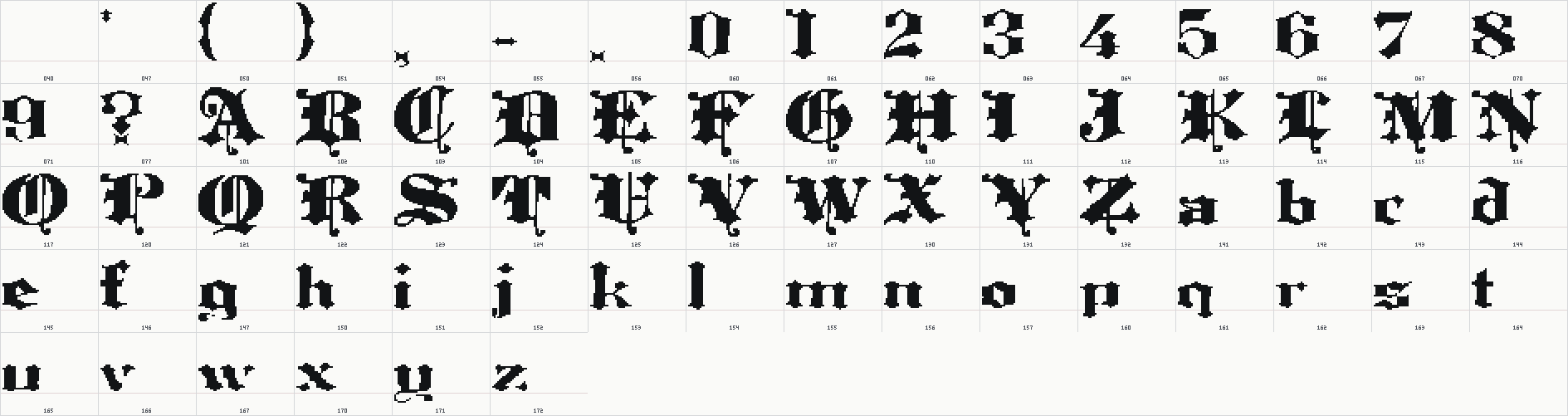
The public AST describes 43VXMS as a 43-pixel-high proportional raster font. Text beginning at y=48 therefore fits within the jaw's approximately y=44 through y=92 span. That fit is derived from the metrics and geometry; no comment explicitly says it was the design rationale. See the museum's 43VXMS specimen sheet and the broader font usage audit.
A line rasterizer turned into an erasing frontier
The key technique is a dynamic binding of DRAW-PLOT's function cell to LEXIPHAGE-1. The normal DRAW-LINE routine still chooses the raster points for two jaw edges, but each point now passes through the replacement callback.
For every scanline, LEXIPHAGE-1 remembers the previous jaw x-coordinate. When the new point moves right, it clears all pixels between the old and new frontiers; when it moves left, it removes the old frontier point. It then records and illuminates the new point. The result is a moving outline with a horizontally cleared region behind it: the pre-rendered word disappears as the jaws pass.
This is a small but instructive example of Lisp Machine dynamism. The program reuses the generic line algorithm while temporarily replacing the low-level operation that a plotted point means.
Jaw motion
The source file declares base 8, so its undecorated geometry constants are octal. For each x position, it draws two lines from a common point at y=68 decimal to endpoints at (x + d, 36 + d) and (x + d, 100 - d). The endpoints are symmetric around the centerline. d advances from 8 through 25 decimal, closing the mouth, then resets to 8. An empty 512-iteration loop paces each step; it establishes no portable frame rate.
After the traversal reaches the rendered right edge, the function returns "LEXIPHAGE!" without waiting for input.
How the LM-3 System 303 rewrite works
System 303's demo/ohacks.lisp.39 keeps the same premise but replaces the callback trick with window drawing methods:
- Load
43VXMSif necessary and create a 300-pixel-tall saved-bits window. - Measure the optional string, center it horizontally and vertically, and render it.
- Pause in a fixed busy loop so the user can read the word.
- Move an apex from 64 pixels left of the word until the mouth's leading edge has passed about 23 pixels beyond its right edge.
- Cycle a vertical opening value from 24 down to zero, drawing upper and lower filled triangular jaws plus smaller tooth triangles.
- After another fixed delay, erase the jaw shapes and filled regions swept behind them. Repeating this one pixel farther right consumes the text.
The file's base is 8, but the named MOUTH-X, MOUTH-Y, and TOOTH-Y constants use trailing decimal points and therefore specify decimal widths of 40, 4, and 10 pixels. The bare 100, 30, and HALF-STRING-HEIGHT value 30 are octal, accounting for the 64- and 24-pixel values above. The target string remains font-rendered raster text; the jaws and teeth are graphics primitives, not characters from a mouth font. As in System 46, there is no keyboard control inside LEXIPHAGE itself.
The HACKS system definition loads OHACKS, and DEFDEMO adds the resulting form to the interactive HACKS:DEMO menu. Direct calls to HACKS:LEXIPHAGE also appear in preserved diagnostic material, but the demo menu is the source-backed presentation context.
The separate PDP-10 TV Lisp form
moon/lexiph.12 uses a different graphics environment. DISPLAY-LEXIPHAGE clears a raw TV array and attempts to fill it from DSK:MOON;LEXIMG PHAGE. After a two-second pause, GOBBLE moves paired line-segment jaws toward the right while sine and cosine tables close the mouth. Low-level PDP-10 assembly routines control real-time execution and line drawing.
The same jaw engine also serves CHOMP-BAG, which loads a separate BAG LUNCH bitmap, and a HAKMEM entry point that directs the effect to a specified TTY. These names demonstrate reuse of the animation mechanism; they do not establish why the main function was named LEXIPHAGE.
The public snapshot contains the Lisp source, a compiled lexi.phage artifact, and the referenced image under the host-normalized name moon/leximg.phage. It does not contain the separate BAG LUNCH bitmap used by CHOMP-BAG. Reproducing and capturing the exact PDP-10 display remains a runtime TODO, but the main LEXIPHAGE image input is not missing.
Preservation record
The System 46 and PDP-10 observations use the public mietek/mit-cadr-system-software snapshot at Git commit 8e978d7d1704096a63edd4386a3b8326a2e584af:
| File | Size | SHA-256 |
|---|---|---|
src/lmio1/hacks.189 |
29,390 bytes | 041b2d551f22a136adbc162c8b4d17c64825bef28356b02cdd4a417d2518a871 |
src/moon/lexiph.12 |
10,705 bytes | ef898c430dfddb6a41481e6578de383e88a02c6a1ee473b23ea19e6df6f16e95 |
src/moon/lexi.phage |
5,428 bytes | 05a70c9aa284a0c8b2bbdf6575009abfd5a08361623e2b8de7db29811805ea30 |
src/moon/leximg.phage |
10,120 bytes | 078f2d1cf897423d34319c2ae9d7d3b320928154b071edeee3d0a056f4d57a76 |
The LM-3 observations use the public sys Fossil repository's system-303 check-in, 4df393c68d7f083ce42d5c377039d26043cc18a9:
| File | Size | SHA-256 |
|---|---|---|
demo/ohacks.lisp.39 |
20,605 bytes | 762ecaf7d5b2c21c860d01be4fcbc81265cb2b9d25c7aa18feefa6ac2745ecb0 |
io1/hacks.lisp.190 |
29,454 bytes | af883767227b6035e65919c72443e30fdad7d9b33d70aa166a627c5ab0137b33 |
System 303 is a maintained LM-3 restoration branch. Its explicit description and rewritten implementation are corroborating CADR-family sources, not evidence that its exact UI was present in System 46.
Open questions
- What is the exact authorship and porting sequence among the PDP-10 TV, System 46, and later window-system implementations?
- Does “based on a hack by John Doty” refer to the idea, the first implementation, or a specific intermediate version?
- Where is the separate
BAG LUNCHbitmap referenced byCHOMP-BAG? - How do the two CADR animations look and pace on the preserved System 46 and System 303 worlds? This article is based on source analysis, not a runtime comparison.
- Did contemporary documentation explain the name? None was found in the inspected public trees.
Sources
- MIT CADR System 46,
LMIO1; HACKS 189. - Separate PDP-10 TV Lisp source,
MOON; LEXIPH 12. - Lisp Machine Manual,
HACKSintroduction. - LM-3
sysFossil repository, System 303,DEMO; OHACKS 39. - Kaleberg, Lexiphage definition and retrospective John Doty account, revised after correspondence dated 6 May 2001.
Last verified: 2026-07-17.