Color inks and raster patterns in the MIT CADR software
Conclusion
The literal COLOR:COLOR-INKS object preserved in the CADR source is not a collection of icons, named paints, textured brushes, or fixed RGB colors. It is an older implementation cache containing sixteen solid BITBLT source tiles. Tile number n consists entirely of the four-bit pixel value n. A separate, mutable hardware color map determines what RGB color that number displays at any moment.
The distinction is historically important:
LMIO; COLOR 69, dated 1 June 1980 in the recovered tape inventory, contains the sixteen-arrayCOLOR-INKSimplementation.- the package declarations for System 46 select
LMWIN; COLOR QFASL, whose surviving source had already replaced those arrays with one reusable solid-fill array; - every preserved LM-3
WINDOW; COLORrevision likewise omits the ink name, while retaining the same four-bit indexed-color model; and - actual patterned fills are separate one-bit objects named
50%-GRAY,25%-GRAY,75%-GRAY,33%-GRAY, andHES-GRAY.
The public corpus therefore proves that COLOR-INKS existed in a legacy CADR source file. It does not prove that the object was resident in a particular System 46 world or that users selected it from a palette interface.
This page uses ink only in that exact source-code sense. CADR cursor pictures, switches, and other icon-like graphics are largely stored as font glyphs and are covered by the font usage audit.
What one ink contains
MAKE-INK-ARRAYS allocates an ART-Q vector of octal 20, or sixteen, entries. Each entry is an 8 by 8 ART-4B array, and all 64 elements of entry n are assigned n. The Lisp Machine Manual's array table defines ART-4B as retaining the low four bits of each element. The raw pixel payload is consequently 32 bytes per tile and 512 bytes for all sixteen, excluding Lisp array headers and the outer vector.
The tile is deliberately larger than a single pixel because BITBLT can replicate a small source array across a larger destination. With the default TV-ALU-SETA operation, the source value replaces the destination value. Other ALU operations can combine the source and destination bits; those operations are raster arithmetic, not additional inks.
The complete legacy path is:
COLOR-INKS[color]  ->  uniform 8 x 8 array of that index
                    ->  BITBLT replicates the array over a rectangle
                    ->  destination pixels contain the four-bit index
                    ->  hardware color map translates the index to R, G, B
The color screen declared by the same file is 576 by 454 pixels with four bits per pixel and a software mirror of sixteen three-channel color-map entries. Its WRITE-COLOR-MAP path accepts eight-bit red, green, and blue components. Rewriting a map entry changes the appearance of every screen pixel holding that index without changing those pixels.
What the indexes look like
There is no permanent answer such as “ink 1 is red.” The old SETUP routine leaves its proposed map initialization commented out, and functions such as RANDOM-COLOR-MAP, GRAY-COLORIZE, and COLORATE deliberately replace or animate the map. Even the default drawing argument, octal 17 or decimal 15, is not intrinsically white.
The following museum specimen reconstructs three deterministic mappings directly from the source. Columns are labeled with the four-bit index in octal. The rows are, from top to bottom, R-G-B-COLOR-MAP, SPECTRUM-COLOR-MAP, and GRAY-COLOR-MAP with base zero. The checkered spectrum cell at index 00 means “unchanged”: that routine writes only indexes 01 through 17.
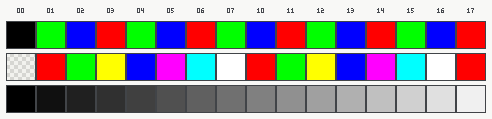
The exact logical assignments are:
| Mapping | Source-defined result |
|---|---|
R-G-B-COLOR-MAP |
Index 00 becomes black. Starting at 01, green, blue, and red repeat in that order because the source indexes the (red green blue) list by index mod 3. |
SPECTRUM-COLOR-MAP |
01-07 become red, green, yellow, blue, magenta, cyan, and white; the sequence repeats for 10-16, and 17 is red. Index 00 is not written. |
GRAY-COLOR-MAP with base 0 |
Index n receives (16n, 16n, 16n), from (0,0,0) through (240,240,240). A nonzero base rotates these levels modulo 256. |
The PNG renders the requested values as idealized 8-bit RGB swatches. It is an explanatory rendering, not a measurement or simulation of a physical CADR monitor's phosphors, analog electronics, gamma, or calibration. The tracked render-cadr-color-inks.py script generates it without third-party libraries.
System 303 establishes one additional version-specific fact: when its color hardware probe succeeds and COLOR-SCREEN is already bound, SETUP calls R-G-B-COLOR-MAP, clears the color framebuffer, and adds a Color Window entry to the system menu. That menu entry creates a window on the separate color screen; it is not an ink chooser.
Where COLOR-INKS was used
An exact-token search of the pinned System 46 source tree found a very narrow static call path:
| Code | Established use |
|---|---|
MAKE-INK-ARRAYS |
Constructs the sixteen tiles during the legacy file's initialization. No other source call was found. |
COLOR-INKS |
Read only by COLOR-BITBLT; no application reads an individual entry directly. |
COLOR-BITBLT |
Selects one tile and replicates it over the requested rectangle. Its only source callers are the horizontal and vertical cases of the adjacent line routine. |
COLOR-DRAW-LINE |
Uses COLOR-BITBLT for axis-aligned lines. No caller elsewhere in the non-binary public System 46 tree was found. |
The legacy diagonal-line branches instead write the numeric index into individual pixels. They also ignore the supplied ALU argument, unlike the horizontal and vertical branches. This is a source-observed inconsistency, not a claimed intentional design.
There is consequently no evidence that COLOR-INKS was a user-facing palette or a general application convention. It was a small implementation technique inside one preserved revision of the color graphics library.
Replacement in System 46 and LM-3
System 46's package declaration points to AI: LMWIN; COLOR QFASL, not the older LMIO; COLOR. Surviving LMWIN; COLOR versions 32 and 33 contain no INK symbol. They allocate one 8 by 1 ART-4B BITBLT-ARRAY, refill it with the requested index, and reuse it for each operation. The framebuffer and mutable color-map semantics stay the same while fifteen redundant cached arrays disappear.
The LM-3 Fossil tree preserves this progression rather than reviving the old cache:
| Source generation | Solid-fill implementation |
|---|---|
System 46 LMIO; COLOR 69 |
Sixteen cached 8 by 8 arrays in COLOR-INKS. |
System 46 LMWIN; COLOR 33 |
One refillable 8 by 1 BITBLT-ARRAY; no ink identifier. |
LM-3 WINDOW; COLOR 65 |
Retains the single array, adds RECTANGLE, and marks COLOR-BITBLT obsolete in favor of it. |
LM-3 WINDOW; COLOR 66 |
Axis-aligned lines call RECTANGLE; diagonal lines now apply the requested ALU with BOOLE. |
LM-3 System 303 WINDOW; COLOR 70 |
Retains the version-66 design and exports COLOR-BITBLT only as obsolete compatibility. |
The later APIs have real descendant call sites. An older CAFE revision calls COLOR-BITBLT; its next preserved revision substitutes COLOR:RECTANGLE. Current System 303 FED code uses COLOR-DRAW-LINE for character-box geometry. These establish continued use of the solid indexed-color operation, not continued use of the sixteen-array COLOR-INKS object.
One preservation warning remains open in CAFE: revision 9 changes only the function name while still passing endpoint coordinates, but RECTANGLE expects width and height. Static inspection therefore does not establish that the edit preserved the old geometry.
Named gray patterns are different objects
The window system does contain named repeated surface patterns, but it calls them grays or stipples, never inks. MAKE-GRAY builds one-bit periodic arrays. In the following source-faithful sketches, # is a set bit and . is a clear bit:
50%-GRAY   25%-GRAY   75%-GRAY   33%-GRAY   HES-GRAY
.#         #...       .###       #..        #...
#.         ..#.       ##.#       .#.        ....
           .#..       #.##       ..#        ..#.
           ...#       ###.                  ....
HES-GRAY is a sparse 2-of-16 pattern, or 12.5 percent set pixels. The inspected System 46 source does not expand HES, so its name should remain unexplained. System 303 additionally binds the clearer name 12%-GRAY to the same pattern while retaining HES-GRAY.
Verified uses in the System 46 source are:
HES-GRAYis the default pattern for both grayed-deexposed-window mixins and is repeatedlyBITBLTed over the relevant window rectangle.25%-GRAYmarks an empty text-scroll window until its first item is inserted.- no executable call site was found for
50%-GRAY,75%-GRAY, or33%-GRAYbeyond their definitions.
These patterns operate on the ordinary one-bit window system and combine with the destination through a raster ALU. Their alternating pixels create an optical gray on a monochrome display. They are neither entries in the four-bit color map nor members of COLOR-INKS.
Preservation and emulation
No standalone ink asset exists to extract. Both the legacy solid tiles and the named gray masks are generated from Lisp source at load time. Preserving the source and its array semantics is therefore more faithful than exporting sixteen apparently colored bitmap files whose RGB values would imply a permanence the system did not have.
The current LM-3 usim color-TV implementation follows the same indirection: it stores four-bit framebuffer pixels separately from a color-map array, then looks up each pixel while rendering. Its SDL build exposes the optional color TV with -a. That makes the source-defined map routines observable today, while still not turning the legacy COLOR-INKS cache into a required runtime object.
Preservation record
System 46 observations use the public mietek/mit-cadr-system-software snapshot at Git commit 8e978d7d1704096a63edd4386a3b8326a2e584af:
| File | Size | SHA-256 |
|---|---|---|
src/lmio/color.69 |
20,844 bytes | 7cb1cab3b96a031dc9ba83765b8b5cc285cc9e1e8a528ca828f8680cdb813cc2 |
src/lmwin/color.33 |
27,200 bytes | d9d12f0cb03a1d24b2d35fe80aa9ac20846cfb701b07ab04360606ab80fa782e |
src/lmwin/color.qfasl |
24,416 bytes | 5ca940ec55dfa2ac03c04b6a9458c054e63363beced30fcb16ff574292238294 |
src/lmwin/scrman.144 |
30,539 bytes | 15c29e616fa464a45327f51c8ae63fd4740e29ddf92486c0715aae709d5b9878 |
The inventory records LMIO; COLOR 69 at 1 June 1980 03:25:04. System 46's release announcement is dated 7 October 1980, but the inspected corpus does not establish the exact date on which the cached arrays were replaced.
LM-3 observations use the sys Fossil repository's maintained system-303 check-in, 4df393c68d7f083ce42d5c377039d26043cc18a9. The current window/color.lisp.70 artifact is 7c3be6f919d0c63138bd6128ee8620c127d30735e3be98ec12bd3d7a70193c1f, 32,431 bytes, with SHA-256 38e577c94d4ff73e92a48d8368aecb5298f33112bb57421e579168a97b674d62. System 303 is a restoration branch; its 2025 Fossil check-in date is not the creation date of the historical Lisp code.
The generated specimen docs/assets/mit-cadr-color-inks/palettes.png is 1,248 bytes with SHA-256 006a8cba86d252ab449e146a8b96ad75c58714e47f088b80e0bac2c8eefce404. That exact compressed byte stream was reproduced with CPython 3.14.6 and zlib 1.3.2. The script fixes the pixels and layout, but a different zlib version may encode the same image into different PNG bytes; use --check as a byte-level test of the current toolchain. Regenerate or verify it with:
python3 scripts/render-cadr-color-inks.py
python3 scripts/render-cadr-color-inks.py --check
Open questions
- Was
COLOR-INKSresident in any preserved pre-System-46 load band, or was the source already superseded before compilation into a distributed world? - What physical color monitor, phosphors, and calibration correspond to the 1980 program's nominal eight-bit RGB values?
- What did
HESmean in the sparse gray-pattern name? - Does
CAFErevision 9 display incorrect geometry because of its argument-shape migration fromCOLOR-BITBLTtoRECTANGLE?
Sources
- MIT CADR legacy color source,
LMIO; COLOR 69, with its date in the recovered media inventory. - MIT CADR System 46 package declaration,
PKGDCL 230, and active window-system color source,LMWIN; COLOR 33. - Lisp Machine Manual,
ART-4Barray representation andBITBLTALU behavior and source replication. - MIT CADR window-system grays,
LMWIN; SCRMAN 144, and empty-scroll-window use,LMWIN; TSCROL 41. - LM-3 System 303,
WINDOW; COLOR 70,CAFEmigration, and FED line drawing. - LM-3
usimcolor display at check-in330d8248ec2e12af071e287920e681600f75df9f, especiallycolortv.candsdl3-video.c.
Last verified: 2026-07-17.