CADR audio, beeper, and Votrax reimplementation specification
Status and reconstruction claim
This is the Phase 1 contract for C-M11: deterministic audio-event production, queue transport, and clean-room PCM rendering for the selected CADR-WEB System 303 profile. The M11 build owns one model per machine, maps IOB address 0764110 to a post-slot beeper event, and exposes an isolated v7 worker subhandler in the narrow M12 Wasm profile. Its synthetic C, Node, O0/O2 Wasm-export, and Worklet-queue tests are supplemented by one source-bound System 303 %BEEP runtime observation and one selected-Wasm Chromium/AudioWorklet continuity observation seeded from the independent synthetic fixed-table snapshot. No physical audio-device, guest-generated browser PCM, Votrax, or System 46 runtime equivalence is claimed.
ABI1.11 now adds a source-only M13 transport slice without changing ABI1.10 or the frozen public v7 operation tree. The core is the sole consumer-epoch issuer; the new opt-in Wasm export returns CDRM11O1, and a private source adapter binds rendered frame counts to CDRPCM1 identities so neither a page caller nor an AudioWorklet can choose the frame count used for acknowledgement. Synthetic O0, O2, mutation, stale-epoch, zero-frame UART, and eight-record backpressure tests pass. The selected-Wasm browser slice described below now proves one synthetic packet survives pause and is consumed exactly once after resume; it is not a guest-generated playback observation, so C-M11 remains open.
It claims:
- semantic event compatibility for the explicitly selected profiles below;
- a fixed little-endian 64-byte event representation and a reproducible SHA-256 witness for accepted events; and
- a defined backpressure, partial-acknowledgement, reset, and stale-consumer contract.
It does not claim:
- emulation of a CADR analog beeper, a Votrax device, an SC-01/SC-01A, or any hardware timing;
- PCM, pixel, timing, perceptual, browser, or AudioWorklet identity;
- a System 46 runtime observation, or a Votrax runtime observation on any system;
- historical device, PCM, or browser identity;
- generic
CDRSNAP1inclusion of the audio queue: it restores a fresh M11 model; - a preserved-system or hardware observation of the selected M8/M11 order.
MUST, MUST NOT, SHOULD, and MAY are normative in the contract sections. The model is deliberately independent of the shared core until an integration gate is satisfied. It therefore does not change the frozen earlier profile merely because the files are present in the repository.
Evidence and selected profiles
ABI1.11 M13 audio records
cadr_wasm_m13_audio_open() exists only in the opt-in ABI1.11 build. It first calls cadr_audio_model_start_consumer_session() and then emits exactly 48 bytes:
| Offset | Field |
|---|---|
| 0 | "CDRM11O1" |
| 8 | version:u32le=1, length:u32le=48 |
| 16 | generation:u64le |
| 24 | consumer_epoch:u64le |
| 32 | queued_frames:u64le |
| 40 | queue_packets:u32le |
| 44 | renderer_profile:u32le=2 |
One PCM delivery record is exactly 64 + 2 * frame_count bytes, hence 66 through 1,088 bytes because frame_count is never zero:
| Offset | CDRPCM1 field |
|---|---|
| 0 | magic "CDRPCM1\0" |
| 8 | version:u16le=1, header_bytes:u16le=64, flags:u32le=0 |
| 16 | total_bytes:u32le, sample_rate:u32le=8000 |
| 24 | generation:u64le, consumer_epoch:u64le, sequence:u64le |
| 48 | frame_offset:u32le |
| 52 | frame_count:u32le in 1..512 |
| 56 | channels:u16le=1 |
| 58 | sample_format:u16le=1 |
| 60 | renderer_profile:u32le=2 |
| 64 | frame_count signed-16 little-endian mono samples |
Generation and epoch are nonzero; sequence may be zero. frame_offset + frame_count must not exceed 512. The outer v8 envelope supplies the SHA-256, which is verified before the sample copy reaches the Worklet. Zero-frame Votrax/UART records never become CDRPCM1: the private source acknowledges their exact M11 cursor with frames=0 and emits no silent Worklet cell.
Evidence codes
| Code | Class | Establishes | Does not establish |
|---|---|---|---|
303-SRC |
Public System 303 source | The Votrax demo's explicit serial-stream arguments and its byte/sentinel producer | A physical Votrax waveform or the loaded System 303 image's behavior |
S46-SRC |
Public System 46 source snapshot | The separately preserved Votrax source and the pinned serial-stream defaults: 300 baud, seven data bits, even parity, and one stop bit | The behavior of a particular System 46 load band |
USIM-SRC |
Pinned public usim source |
Current SDL3 software's use of an 8 kHz signed-16 sine-oriented backend and %BEEP inputs |
CADR hardware behavior or cross-platform PCM equality |
USIM-WITNESS-PREP |
Disposable, content-pinned public-usim source closure | The exact M11 source anchors, patch, and compile-only executable identity can be reproduced without copying media or launching a machine | An observed beep, any PCM output, or CADR behavior |
303-RUN-M11 |
Isolated System 303 Xvfb session plus the source-injected public-usim witness | The selected Listener form invoked the source-defined beeper path; the retained witness establishes ordered trigger/job and PCM-block metadata for that one session | PCM audible-device output, hardware behavior, browser/Wasm equivalence, Votrax, or a System 46 result |
INF-M11 |
Clean-room inference | The event queue, canonical record, witness, and failure rules needed for deterministic browser transport | Their use by the historical CADR |
TEST-M11 |
Synthetic C test | The listed reference-model transitions and byte layouts | A preserved-system or hardware runtime result |
TEST-M11-FIXED |
Independent Python reference plus native and selected-M12 Wasm differential execution | The declared synthetic event, witness, snapshot, fixed-table PCM, and pause/adopt/resume cases agree across three implementations | SDL3/device waveform identity, browser integration, or CADR hardware behavior |
TODO-RUNTIME-M11 |
Further oracle obligation | The exact additional run it names when completed | Any claim outside its selected input, artifact, and runtime path |
The selected source profile wins for its own source-level claim. The Phase 1 queue, wire records, and safety-oriented backpressure rules are INF-M11; they are not attributed to historical CADR software. A later runtime result may refine only the profile it exercises.
Compatibility profiles
| ID | Exact target | Selected rule | Evidence and status |
|---|---|---|---|
CADR-IOB-BEEPER-REF-303-v1 |
System 303 IOB beeper trigger | A read/write at IOB address 0764110 is represented by synthetic %BEEP arguments: half-wavelength and duration in microseconds |
USIM-SRC; semantic input reference only |
NO-AUDIO |
Headless/deterministic output policy | Record events and witnesses but produce no host sound or PCM | INF-M11; Phase 1 normative output policy |
USIM-SDL3-SINE-330D8248-CANONICAL-v1 |
usim check-in 330d8248ec2e12af071e287920e681600f75df9ffd854aada5f8a64c9adad64d |
Reserve a mono 8 kHz signed-16 sine render target | USIM-SRC; explicitly a current software model, not hardware |
VOTRAX-SERIAL-303-300-8E2-v1 |
System 303 Votrax source | 300 baud, eight data bits, even parity, two stops; the source passes -1 to :TYO, but its wire-level disposition is unobserved |
303-SRC; semantic stream-call events only |
VOTRAX-SERIAL-S46-300-7E1-v1 |
System 46 Votrax comparison profile | 300 baud, seven data bits, even parity, one stop | S46-SRC; source-level defaults, with loaded-artifact behavior untested |
The System 303 Votrax source constructs its serial stream with eight data bits, two stop bits, parity/framing checks, and baud 300; its speech loop passes serial values and then -1 to the stream's :TYO operation. The public source establishes that call sequence, but not whether the serial implementation suppresses, transforms, or transmits the negative value on a particular artifact. The public System 303 source supports that narrower claim. The System 46 Votrax source calls MAKE-SERIAL-STREAM without arguments, and the pinned implementation defines those defaults as 300 baud, seven data bits, even parity, and one stop bit. The Votrax call and the pinned serial defaults establish the source-level 300/7E1 profile. Whether a particular loaded System 46 artifact retains those defaults remains a runtime question.
The current upstream SDL3 path fills signed-16 samples from a sine function, asks for 8 kHz mono audio, and receives %BEEP half-wavelength and duration inputs. That is why USIM-SDL3-SINE-330D8248-CANONICAL-v1 is a useful software comparison target, but its host-library math and audio-device behavior are expressly not a CADR hardware specification. Pinned sdl3-audio.c and the IOB dispatch were verified on 2026-07-29.
A second local source check used repository worktree revision f6d3212c03e563b54b19082a97080eb697d6b060 and content hashes for usim/iob.c, usim/sdl3-audio.c, and usim/Makefile.usim. The disposable M11 witness preparer copies only source-form inputs, applies a two-file exact patch in an ignored closure, and records scalar half-wavelength, full-wavelength, duration, and PCM-block metadata only if a separately authorized native run supplies a new output path. The 2026-07-29 closure and SDL3 compile succeeded; it was not run. This is USIM-WITNESS-PREP, not a sound, timing, or CADR runtime observation.
Conformance levels
| Level | Includes | Reserved |
|---|---|---|
M11-L0 |
Synthetic event construction, ordering, queue operations, witness, and explicit failures | Shared-core integration and wire transport |
M11-L1 |
M11-L0 plus selected IOB core mapping, pointer-free CDRAUDS1 queue-state transport, composed M8/M9/M11 protocol-v7 operations, and M12 direct-Wasm CDRM12S1 adoption |
Protocol-v7 M9 continuation and preserved-runtime ordering evidence |
M11-L2 |
M11-L1 plus deterministic fixed-table signed-16 PCM and a bounded AudioWorklet queue |
Actual device behavior and hardware comparison |
M11-L3 |
M11-L2 plus browser pause/worklet/oracle campaigns |
Votrax or SC-01 acoustic identity |
M11-L0 through the isolated portions of M11-L2 are implemented and tested. One source-bounded synthetic slice of M11-L3 is also observed in real Chromium; the complete level remains reserved. This does not claim an exact historical source interface: the source’s Lisp stream API, devices, phoneme tables, load behavior, and preserved-runtime comparison remain outside this C semantic boundary.
Architecture and ownership boundaries
selected M11 IOB producer
    -> machine-owned C-M11 semantic event model
        -> `CDRAUDS1` semantic sidecar / isolated protocol-v7 subhandler
            -> deterministic signed-16 PCM / bounded AudioWorklet queue
-> optional host audio device- The guest-facing producer owns a source event and supplies only selected, already-decoded scalar inputs.
- The M11 model owns queue order, generation, acknowledgement state, and witness.
- The isolated worker subhandler owns transport publication and pause/resume coordination; it MUST NOT invent or reorder guest events.
- The deterministic renderer owns PCM bytes. It MUST NOT alter the event witness; its fixed table is a clean-room approximation of the selected public software profile, not an SDL3, CADR, or hardware implementation.
- A host audio device is not an emulator authority and has no role in guest time.
The C model has one serialized owner. Each API call is an atomic model transition: it has no callback and either makes the documented change or leaves the model unchanged. This is not a promise of C11 lock-free operation; an integrating producer and consumer must serialize access or provide an equivalent synchronization boundary.
Semantic data and state model
Canonical event
An event has native fields only for manipulation. Native structure alignment, byte order, and padding are never transferred. cadr_audio_event_encode emits exactly 64 bytes in this order:
| Byte offset | Field | Rule |
|---|---|---|
| 0 | sequence:u64le |
Assigned from the external accepted-sequence high-water; never decreases or resets within one authority lineage |
| 8 | generation:u64le |
Nonzero delivery epoch; reset increments it |
| 16 | post_slot:u64le |
Guest scheduler boundary chosen before production |
| 24 | intra_slot:u32le |
Starts at zero at a new post-slot; increments for each later event in that slot |
| 28 | kind:u32le |
1 beeper or 2 Votrax UART |
| 32 | frame_count:u32le |
Beeper packet frames 1..512; UART is zero |
| 36 | flags:u32le |
Synthetic/not-ready or synthetic/UART bits; unknown bits are invalid in v1 |
| 40 | primary:u32le |
Beeper half-wavelength in microseconds, or UART byte 0..255 |
| 44 | secondary:u32le |
Beeper source duration in microseconds, or serial format (8E2/7E1) |
| 48 | payload:u64le |
Beeper segment frame offset, or UART baud 300 |
| 56 | source_profile:u32le |
1 beeper 303, 2 Votrax 303, or 3 Votrax System 46 |
| 60 | reserved0:u32le |
Zero |
The v1 numeric serial codes are 8E2 = 0x00020208 and 7E1 = 0x00010207; the low byte is data bits, the next byte is parity (2 = even), and the next byte is stop bits. A canonical UART primary is exactly 0..255. The source-side -1 utterance call has no canonical UART event in this bounded profile because its wire disposition is unknown; 0xffffffff and every other larger primary are invalid. This is a profile nonclaim, not evidence that the preserved stream suppresses that call. There is no phoneme lookup, voice-ROM access, or synthesis implicit in a UART event.
Invariants
- The logical queue contains at most 64 packet records and each beeper record carries at most 512 frames. Thus its maximum queued synthesized extent is 32,768 frames; UART records occupy a packet but zero audio frames. One accepted beeper job may retain additional not-yet-enqueued frames in explicit pending state.
- Accepted records are ordered by the host authority's monotonically increasing sequence, and within a generation by
(post_slot, intra_slot). Sequence does not restart on a semantic reset. A new post-slot cannot be opened while the 64-packet queue is full. - The head offset is in
[0, frame_count)only for a beeper head. A UART head has offset zero and is acknowledged with exactly zero frames. - A copied native cursor names generation, numeric authority provenance, an integer address token captured while the authority was live, a non-recycled incarnation, the authority's model-issued consumer epoch, sequence, head offset, remaining frame count, and all 64 canonical event bytes. Address token and incarnation must both match the current live authority. Cursor validation never dereferences the saved address token. Two live objects with the same provenance ID cannot cross-ack, and later reuse of the same address cannot revive an old cursor. Neither local capability value is put on a wire or in a snapshot.
head_sequenceis the sequence at the logical head, ornext_sequencewhen empty. At every valid boundary,next_sequence - head_sequence == queue_packet_count, and the first queued event, when present, has sequencehead_sequence. In addition,next_sequenceMUST equal the separate host authority'saccepted_sequence_high_water. Event append validates both relationships before assigning a sequence, so jointly rewinding both serialized claims still cannot emit a duplicate.H_before_logical_headis the cumulative witness immediately before the current logical head. It changes only when a complete head record is removed. Partial acknowledgement leaves it unchanged.- The final witness is cumulative accepted-record evidence, not a digest of the current queue. Pumping a newly available pending-job packet extends it once; acknowledging, peeking, copying, or rendering cannot otherwise change it.
- A pending beep job retains its source arguments, total frame count, next unqueued frame offset, and post-slot. While pending, the ring is full, the next offset is a nonzero multiple of 512 smaller than the recomputed total, and no other producer event may pass it.
Cumulative witness
Let LE32 and LE64 be fixed-width little-endian encodings, E_(g,k) the canonical 64-byte event accepted at zero-based ordinal k within generation g, and SHA256 standard SHA-256. E_(g,k).sequence is the independent global authority sequence and need not equal k. The exact Phase 1 witness is:
H_(g,0) = SHA256("CDRAUDW1" || LE32(1) || LE32(6) || LE64(g))
H_(g,k+1) = SHA256("CDRAUDW1" || H_(g,k) || E_(g,k))
The domain bytes contain no NUL terminator. Reset starts H_(g,0) for its new generation without resetting global event sequence. H_before_logical_head starts at H_(g,0); removing complete event E_(g,k) sets it to H_(g,k+1) and increments the semantic head_sequence. Therefore a verifier folds every logical queue event over the head anchor and MUST obtain the final witness, while independently requiring the exact head_sequence/queue/next_sequence relationship and equality between next_sequence and the non-adopted authority high-water. The semantic pair alone is not trusted: jointly rewinding it is rejected against the authority. The witness anchor detects distinct acknowledged prefixes even when surviving queue bytes are identical. This hashes canonical bytes, never native structure memory. It is an INF-M11 transport witness and is not a historical CADR checksum.
Lifecycle, ordering, and failure contract
Initialize and reset
cadr_audio_authority is a host-owned object outside adoptable semantic state. It contains one nonzero transport-lifetime provenance identity, one monotonic consumer epoch, one monotonic accepted-sequence high-water, and lifecycle/attachment state. It has no paired current/high-water fields. Authority storage MUST be zero-initialized. Construction is one-shot: it rejects zero identity, zero epoch, non-virgin storage, an already live authority, an attached authority, and retired authority storage without mutation. The trusted wrapper supplies the nonzero provenance ID; live native capability identity includes the address of the particular authority object, not the numeric ID alone. Initialization captures that address as self_address_token. Every attach, use, detach, and retirement validates it before following the allocator or owner pointer. An initialized authority MUST NOT be moved, relocated, or byte-copied for its entire live or retired storage lifetime.
Each authority lifetime also receives a nonzero incarnation from a zero-initialized, one-shot cadr_audio_incarnation_allocator. One allocator covers one live capability domain and is accessed under the same serialization boundary as authority construction. It issues monotonically increasing values and never recycles them. When its next value is UINT64_MAX, construction returns OVERFLOW without changing allocator or authority. The allocator must outlive construction and every authority it registered, but cursors retain only the issued integer, not an allocator pointer. It holds 64 simultaneous live address/incarnation leases; construction with no free lease returns BACKPRESSURE. Allocator initialization also captures its own address; the allocator MUST NOT be moved, copied, or relocated during that capability-domain lifetime.
The allocator lease is the external check that a self-address token alone cannot provide. Authority use requires the allocator's active entry at that address to carry the same incarnation. Copying detached initialized bytes to another address fails the self-address check; copying those bytes back to the original address after retirement still fails because the old lease is inactive. A legitimate new object at the reused address receives a new incarnation.
Model initialization receives an existing authority, a nonzero generation, and a renderer policy (NO-AUDIO or the reserved SDL3-sine comparison target). It empties the queue and pending job, initializes both semantic sequence claims from the authority's accepted high-water, and derives H_(g,0) for both witness values. A caller that supplies generation zero receives one. Model storage also starts zeroed. Phase 1 uses a single-owner attachment rule: exactly zero or one model is attached to an authority. A second attachment or reinitialization of an attached model fails atomically. All access to the model and authority shares one caller-provided serialization boundary. The authority also stores the exact attached-model owner address. Every stateful operation requires authority.owner == model; a byte-copied model alias therefore cannot acknowledge, reset, start a session, adopt state, or detach/destroy the real owner's authority. Model initialization likewise captures model.self_address_token, and every public model operation tests it before any authority dereference. An initialized model MUST NOT be moved, relocated, or byte-copied for use during its attached lifetime; a copy is never an alias handle.
model_destroy() requires a live attached authority, detaches it, and zeroes the model so no API retains a dangling authority pointer. authority_destroy() is permitted only after detachment and retires the storage permanently; it does not make that storage virgin again. The authority object MUST outlive its attached model. Freeing, moving, byte-copying, or zeroing it while attached is outside the C API contract; public operations never detach, retire, or reinitialize it implicitly. Outstanding cursors need not be counted or explicitly destroyed: they contain no dereferenceable authority pointer and become inert stale values after detach, retirement, session advance, or incarnation change.
Legal teardown is ordered: destroy the exact owner model, retire the now-detached exact authority, then release their storage. A stale byte-copy of the model checks its own mismatched self token first; ack, reset, session advance, and destroy therefore reject it without dereferencing the freed authority address.
start_consumer_session() accepts no caller-selected epoch. It atomically increments the authority's sole consumer epoch. At UINT64_MAX it returns OVERFLOW without mutation. Consequently the public transition from session 1 can be only 2, then 3; it cannot return to 1 and revive a session-1 cursor. Reset is atomic: it increments generation and consumer epoch, clears queue/order/pending state, retains the accepted-sequence high-water as both empty semantic sequence claims, and derives a new H_(g,0); exhaustion of generation or consumer epoch fails without mutation. A pre-reset cursor is stale after success.
adopt_semantic_state(destination, decoded) ignores any authority pointer attached to decoded. It attaches the destination's existing authority to a temporary candidate, validates witnesses, queue relations, and the candidate's next_sequence against the authority accepted high-water, checks epoch capacity, then atomically increments the authority epoch and publishes the semantic candidate. Thus a copied model with both head_sequence and next_sequence rewound, or with a forged epoch/authority attached, cannot roll back the destination authority.
No cadr_audio_authority byte is part of CDRSNAP1. Exact sequence and session continuity across a full host-process restart cannot be proven from the AUDIO chunk alone, especially for an empty queue. A restart that must accept delayed external acknowledgements or preserve exact sequence lineage requires a separately trusted wrapper/head-lineage anchor containing authority identity, consumer epoch, and accepted-sequence high-water. Without that anchor, the wrapper MUST establish a new unique authority identity and close or reject every old delivery channel; it MUST NOT claim continuity from snapshot semantic claims. Starting a session changes no semantic queue, sequence claim, pending job, slot, or witness.
The incarnation allocator closes address reuse only inside its live capability domain. A process restart or allocator-lineage loss has the same boundary as other authority loss: exact continuity requires the separately trusted wrapper/head lineage anchor and a non-reused capability domain. Otherwise all old cursors and delivery channels must be rejected rather than treated as resumable.
Slot reservation and deterministic backpressure
Before a UART event for a guest post-slot, the producer MUST call begin_slot. It first checks queue capacity and the absence of a pending beep. If all 64 packets are occupied or a beep continuation is pending, it returns BACKPRESSURE without changing the active slot. Otherwise the new slot must be strictly later than the currently open slot and no earlier than the last emitted event; it becomes the sole active producer slot.
This rule intentionally makes a full queue visible before the next guest slot is advanced. A producer MAY emit several events within the active slot. It MUST treat BACKPRESSURE as a scheduling boundary, not discard or coalesce the event, and retry only after an acknowledgement has made capacity available.
Synthetic beeper producer
accept_beep_job(post_slot, half_wavelength_us, duration_us) accepts the slot and complete source job at one atomic boundary. It requires a strictly later post-slot, a nonzero argument pair, no earlier pending job, and at least one free queue record. It computes with checked integer arithmetic:
total_frames = ceil(duration_us * 8000 / 1,000,000)
packets = ceil(total_frames / 512)
Acceptance preflights the sequence and intra-slot range for the entire job. It then commits the new active slot and exact pending-job state atomically, emits as many canonical packets as the ring can hold, and retains the next offset if packets remain. Each packet repeats the source arguments, records a zero-based source-frame offset that is a multiple of 512, and has exactly min(512, total_frames - offset) frames. A complete head acknowledgement immediately pumps newly available capacity from that same job before another producer may advance the slot. A partial acknowledgement creates no packet capacity and does not pump.
Thus a 4,096,001 microsecond job computes 32,769 frames: 64 packets of 512 are initially queued and the final one-frame packet is emitted after the first complete head acknowledgement. A ring containing 63 UART records can atomically accept a 513-frame beep into one queued 512-frame packet plus a one-frame pending continuation. If the ring is already full, the same call returns BACKPRESSURE and leaves slot, queue, sequence, witness, and pending state byte-for-byte unchanged. A half-wavelength is semantic input only; Phase 1 must not turn it into samples.
Synthetic Votrax UART producer
enqueue_votrax(profile, byte) requires an open slot, no pending beep, one selected Votrax profile, and a byte in 0..255. It enqueues one zero-frame event with selected 300/8E2 or 300/7E1 format. The model does not apply parity, framing, baud delay, word/phoneme translation, or an audio waveform. Those remain future source-profile and runtime obligations.
Peek, copy, acknowledgement, and render
peek snapshots only the logical head into a cursor and does not mutate model state. copy validates that cursor, copies exactly its 64 canonical bytes when its output capacity is at least 64, and otherwise reports WRONG_LENGTH with zero written. It does not consume anything.
ack(cursor, frames) revalidates the cursor atomically. A zero-frame UART event requires frames = 0 and is then removed. A beeper requires 1 <= frames <= frames_remaining. A short acknowledgement advances only the head offset; an exact remaining acknowledgement removes the head. An empty queue reports EMPTY; a cursor from a prior offset, another acknowledgement, reset, or consumer session reports STALE. Removing a complete head advances H_before_logical_head and then pumps one or more pending-job packets into newly available capacity. The acknowledgement plus pump is atomic: an internal validation failure rolls back the entire operation.
render_pcm_s16le validates a current cursor and renders only a beeper selected for USIM-SDL3-SINE-330D8248-CANONICAL-v1. It uses a fixed signed 32-phase table and integer phase accumulation at 8 kHz; it neither calls sin nor links host libm. The result is deterministic clean-room PCM, not bit-identical SDL3 output, CADR analog behavior, or a host-device observation. It never acknowledges frames. NO-AUDIO, UART, a stale cursor, and an invalid renderer input report the documented failure without fabricating silent PCM.
CDRM11FIX1 fixed-table differential oracle
M11-T20 has an independent Python reference that constructs the canonical CDRAUD1 records, CDRAUDS1 snapshots, witness chain, and signed-16 bytes without loading the C model or a Wasm module. It compiles the actual cadr_audio_model.c twice (native O0 and O2) and imports the same synthetic states into newly created selected-M12 Wasm O0 and O2 instances. Each native and Wasm semantic result must be byte-identical to that reference; agreement between native and Wasm alone is insufficient.
The inner canonical payload is CDRM11FIX1. The outer CDRM11FIX2 result keeps semantic results separate from provenance: it records the complete selected-M12 source/header closure, Makefile and build-script hashes, native executable identities, freshly forced O0/O2 Wasm sizes and hashes, and Guix/clang/wasm-ld build identities. Both layers are compact canonical JSON with one trailing newline; duplicate keys, alternate whitespace, booleans in numeric fields, extra keys, and any non-exact fixture state are rejected.
The fixed table is the signed 32-phase Q0.15 sequence in cadr_audio_model.c. For half wavelength h, event-frame offset e, cursor offset c, and rendered index i, the normative clean-room reference is:
step = floor((1,000,000 * 2^32) / (2 * h * 8,000))
table-index = ((((e + c + i) mod 2^32) * (step mod 2^32)) mod 2^32) >> 27
sample[i] = sine32[table-index]
The product and phase are explicitly reduced modulo 2^32, matching the selected unsigned-C operation rather than host floating-point arithmetic. This fixture's short 500-microsecond / 1,058-microsecond case contains exactly nine signed-16 samples:
0, 23170, 32767, 23170, 0, -23170, -32767, -23170, 0Their little-endian signed-16 SHA-256 is 8184a534d19b4bc250487a11cb896191d3d34837af8c91cd3536af9e9c1d06cb. A separate 1,025-frame job uses a 499-microsecond half wavelength, partially acknowledges 200 frames, and serializes the resulting 825-frame CDRAUDS1 state as a transport pause, destroys the source native model, adopts that snapshot into a fresh native model before resuming, and does the corresponding fresh-instance Wasm adoption. The exact long-packet hashes are: frames 0..511, 295b2a187b03b4cd96cbbf3f46e189f20e6b0453d4df67bd3b3f10a200ed88dd; the partial frames 200..511, 5468d03d776da739f624a63ce3a85dc8a0d6c1f01838cacf6bda5a51a6f05563; frames 512..1023, 18057f330bac60216ca485aa36eabeaf1343bfa22b55bfe1875eddd895734f38; and frame 1024, 8f96c15501bef61baf5bd943201979595736b66b6a7e3b35c353729ab8d9a561. The reference obtains the 499-microsecond half wavelength and each event-frame offset by decoding the canonical CDRAUD1 event, and obtains the cursor offset from the selected render cursor. Its explicit mutant instead forces both offsets to zero for every resumed packet; every such mutant hash must diverge, preventing a fixed-zero-offset implementation from ratcheting these results. The final adopted state is exactly the empty queue with head and next sequence 3, zero queued frames, and both witness values equal to the established final witness. “Pause” here means that pointer-free transfer boundary; it does not claim an historical CADR audio pause command.
This is TEST-M11-FIXED evidence for the clean-room fixed-table renderer and the selected Wasm transport. It is not evidence that SDL3's floating-point oscillator, an audio device, the CADR beeper, or a listener's audible output has those hashes. The public SDL3 implementation carries oscillator phase across repeated jobs, while the clean-room table starts from each event's encoded frame offset; identical jobs can therefore have different SDL3 hashes without falsifying this fixture.
Transfer and snapshot representations
CDRAUD1 event-queue transfer
CDRAUD1 is a proposed Phase 1 transport record, not an existing shared-core serializer. It carries the logical queue from head to tail; it does not expose a C ring-array layout.
| Offset | Field |
|---|---|
| 0 | magic "CDRAUD1\\0" (8 bytes) |
| 8 | version:u16le = 1 |
| 10 | header_bytes:u16le = 168 |
| 12 | flags:u32le = 0 in v1 |
| 16 | protocol_version:u32le = 6, followed by renderer_profile:u32le |
| 24 | generation:u64le |
| 32 | authority_identity:u64le |
| 40 | consumer_epoch:u64le |
| 48 | accepted_sequence_high_water:u64le |
| 56 | head_sequence:u64le |
| 64 | next_sequence:u64le |
| 72 | queue_packet_count:u32le, followed by head_frame_offset:u32le |
| 80 | queued_frames:u64le |
| 88 | witness[32] |
| 120 | H_before_logical_head[32] |
| 152 | canonical_event_bytes:u32le = 64, followed by reserved0:u32le = 0 |
| 160 | total_bytes:u64le = 168 + 64 * queue_packet_count |
Exactly queue_packet_count 64-byte canonical events follow at byte 168, in logical head-to-tail order. The three authority values appear because this is a live transfer record, not snapshot semantic state. Native address-token/incarnation capability is intentionally absent. A receiver MUST compare the values with its trusted transport authority and bind any resulting native cursor to that exact local authority lifetime; it MUST NOT treat equal numeric IDs as object identity or overwrite retained authority from an untrusted or replayed record. It also rejects another version, a nonzero reserved value, an unknown flag, a zero identity/epoch, unequal accepted-high-water and next_sequence, an inconsistent head/next/count relationship, an invalid event, a sequence/order/head-witness/final-witness mismatch, or a total/count mismatch.
CDRAUDS1 semantic-state sidecar
CDRAUDS1 is the implemented pointer-free semantic queue sidecar. It is distinct from CDRAUD1 live transport and is not a CDRSNAP1 chunk. The first 16 bytes are the magic "CDRAUDS1", version:u32le = 1, and total_bytes:u32le. The remaining 172-byte header, followed by logical head-to-tail canonical events, is:
| Offset | Field |
|---|---|
| 16 | generation:u64le, then head_sequence:u64le, next_sequence:u64le |
| 40 | last_post_slot:u64le, active_post_slot:u64le, queued_frames:u64le |
| 64 | pending_total_frames:u64le, pending_next_frame:u64le, pending_post_slot:u64le |
| 88 | queue_packet_count:u32le, head_frame_offset:u32le, last_intra_slot:u32le, have_last:u32le |
| 104 | slot_open:u32le, renderer_profile:u32le, pending_active:u32le, pending_half_wavelength_us:u32le, pending_duration_us:u32le |
| 124 | witness[32], then H_before_logical_head[32] |
| 188 | 64 * queue_packet_count canonical event bytes |
No cursor, authority identity, native address, or consumer-epoch capability appears in this payload. Import accepts only an empty live destination, validates the whole record before publication, retains a fresh local authority, and starts a fresh consumer epoch; all pre-import cursors are stale. The generic core CDRSNAP1 path does not include this sidecar and restores a fresh empty M11 model. A caller that needs audio continuation MUST save and restore CDRAUDS1 separately and MUST NOT claim that a generic snapshot carried its pending continuation or acknowledgement state. In the M12 direct-Wasm profile, CDRM12S1 composes an unchanged CDRSNAP1 followed by CDRAUDS1 and CDRM12C1; it stages the audio adoption before publishing the replacement machine. Bare CDRSNAP1 still restores an empty audio model, and lower profiles remain byte-for-byte unchanged.
Worker, pause, and rights contract
The narrow M12 Wasm profile includes the isolated v7 M11 operations audio-state, audio-peek, audio-render, audio-ack, and audio-snapshot-{size,save,restore}. The Wasm adapter retains the native cursor and transfers only scalar identity plus PCM or CDRAUDS1 bytes; it never transfers an authority token or pointer. The same v7 build also exports the existing M8/M9 CDRINP1 ingress surface. A strict native composition test accepts CDRINP1 at a ready boundary before the same boundary's IOB BEEP produces its M11 post-slot event; those two streams intentionally retain distinct sequence domains.
The AudioWorklet accepts only bounded signed-16 PCM supplied by the Wasm bridge. It reports a distinct staging receipt only after its private queue owns the complete record, converts samples to Float32 output, and reports a render acknowledgement only after the whole posted packet has reached an output block. The main-thread bridge acknowledges the core only after that report. A generation clear removes queued stale PCM. Worklet clock time, device latency, underruns, and mute state are output observations, not guest-time or ordering evidence.
Nonterminal activation, core acknowledgement, pause, and ordinary device-loss operations share one ordered asynchronous lifecycle tail. Queue admission is the linearization order. An acknowledgement admitted before a control therefore finishes first, publishes the core's authoritative queue counts, and resolves its ack-committed receipt; the later control then invokes the core and adopts the returned post-control counts before it settles. If pause or ordinary loss wins the reducer order, a later stale acknowledgement never reaches the core. Preparation and reopen are fenced while a nonterminal control is pending or executing.
Terminal worker close is deliberately outside that tail. It immediately revokes boundary ownership, disconnects every currently reachable browser candidate, retires all receipt waiters stale, and fixes DEVICE_LOST; it does not wait for an unsettled candidate start, core open, or core acknowledgement. The only terminal core operation is synchronous request-free terminalRelease, an adapter tombstone used by the worker owner before terminating the worker. It MUST NOT issue open, ack, pause, or ordinary deviceLost, so it may run while one earlier nonterminal core request is unsettled without concurrent mutation of a non-reentrant core. A late open settlement is observed only after that open returns and may invoke the same tombstone with its retired epoch; a late acknowledgement cannot publish counts or a receipt. A candidate whose start allocates after terminal cancellation is disconnected again on either late resolve or reject. Thus nonterminal core requests never overlap; terminal revocation may overlap only as this no-request tombstone.
Worker-event admission captures the consumer object, epoch, generation, event ordinal, and control-admission watermark before awaiting the record digest, and rechecks all five plus terminal state afterward. An old-epoch event whose digest crosses pause/resume, loss/resume, or close therefore returns false without posting to the fresh Worklet or reporting device loss against it. Activation similarly captures its control watermark: a successfully started candidate is disconnected on core-open rejection, exception, malformed success, or intervening close. Nonterminal open failures consume the prepared candidate but permit an explicit fresh prepare and retry; close denies retry. Tests bound the maximum live candidate count at one.
No SC-01 or SC-01A behavior is enabled by this specification. An optional device profile is gated on all of: an exact public source commit, a separately licensed and identified ROM or equivalent evidence, a documented clock-rate source, a complete wire/protocol contract, and synthetic plus preserved-runtime conformance tests. No ROM, voice table, phoneme payload, or recovered audio belongs in this repository until its own provenance and rights review permits it.
C-M11 conformance gates
C-M11 is closed only when every gate is green. Passing a lower gate does not imply a later one.
| Gate | Required evidence | Current Phase 1 disposition |
|---|---|---|
C-M11-01-MODEL |
Strict C test proves 64-byte LE events, canonical validation, order, external-authority rollback resistance, head-sequence/head-witness/final-witness integrity, resumable 64x512 queueing, atomic backpressure, partial ack, reset/restore stale ack, UART profiles, and NOT_READY rendering |
Passes locally for the standalone model |
C-M11-02-CORE |
M11 core mapping for 0764110, post-slot enqueue, and composed M8/M9/M11 v7 test with no M6/M7/M10 regression |
Passes: the native composition test fixes CDRINP1-before-post-slot-BEEP order; a runtime comparison remains open |
C-M11-03-SNAPSHOT |
Pointer-free CDRAUDS1 round trip, malformed-sidecar rejection, fresh local authority, stale-cursor-after-adoption, and composed M12 rollback/publication tests |
Passes. CDRSNAP1 remains frozen; M12 carries the sidecar in CDRM12S1, while protocol-v7 generic restore remains blocked on M9 continuation. |
C-M11-04-PCM |
Deterministic fixed-table signed-16 render fixtures with no host libm drift |
Passes for CDRM11FIX2: an independent reference, native O0/O2, and freshly forced selected-M12 Wasm O0/O2 agree through fresh CDRAUDS1 adoption; SDL3/device identity is not claimed |
C-M11-05-WORKLET |
AudioWorklet queue generation clear, whole-packet acknowledgement, bounded backpressure, and selected-Wasm pause/resume continuity | Node queue tests pass. A fresh real Chromium 151 campaign proves one independently generated synthetic 512-frame selected-core packet is retained across pause, redelivered under a fresh consumer epoch, and acknowledged exactly once; guest-generated playback and physical-device output remain open. |
C-M11-06-ORACLE |
Non-destructive, source-bound preserved-system or hardware comparison for each historical claim retained | The System 303 %BEEP path now has a source-bound runtime witness; Votrax and System 46 remain open |
Focused Phase 1 test command:
make -C cadr-web m11-unit
python3 scripts/cadr-m11-fixed-table-oracle.py --output build/cadr-oracle/cdrm11fix2.json
python3 scripts/cadr-m11-native-audio-oracle.py prepare
python3 scripts/cadr-m11-native-audio-oracle.py build
make -C cadr-web m11-selected-playback
The latter two commands create/compile a disposable ignored source closure only; they do not start usim and do not close C-M11-06-ORACLE.
The following is the exact standalone native-capture form. Replace only the bracketed private-runtime path and the date/session fields; the configuration and disk must be current-owner regular non-symlink files inside a 0700 private runtime, and the output directory must be a new empty 0700 directory under build/cadr-oracle/.
python3 scripts/cadr-m11-native-audio-oracle.py native-capture \
  --prepared build/cadr-oracle/m11-audio-witness-campaign-20260729-v2 \
  --config <private-runtime>/usim.ini \
  --private-runtime <private-runtime> \
  --private-disk <private-runtime>/disk-sys-303-0.img \
  --output build/cadr-oracle/m11-runtime-YYYYMMDD \
  --session-id m11-YYYYMMDD-1 --execute
The command requires explicit --execute, copies the pinned public executable into a fresh child of its output directory, clears locale/timezone ambient state, and rejects a changed private disk or an empty/non-real witness. A successful capture records hashes and byte counts for the copied witness, configuration, disk before and after, executable, source closure and patch, stdout/stderr logs, toolchain, ordered actions, and clean process exit; it stores none of the disk or PCM bytes. CDRM11USIM1 schema version 2 records a SHA-256 of each canonical "CDRM11E1" || half-wavelength:u32le || wavelength:u32le || duration:u32le beep event and a SHA-256 of each little-endian signed-16 PCM block. Those hashes make a later controlled capture comparable without redistributing audio samples. It does not materialize a private runtime itself; the repository's separate private-runtime preparation policy remains the prerequisite. A refused or invalid capture exits nonzero.
System 303 runtime beeper observation
Runtime observation, 2026-07-30: the isolated Xvfb harness booted a fresh System 303 session, visibly reached Lisp Listener 1, evaluated exactly (SI:%BEEP 500. 100000.), and returned NIL.
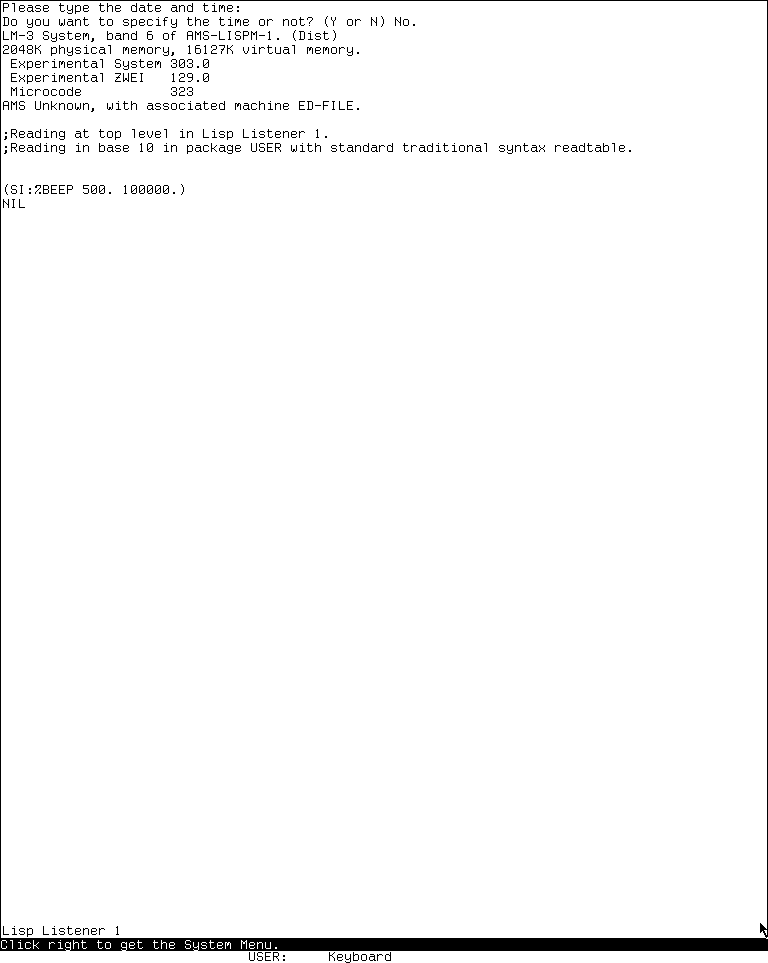
The image is the reviewed exact 768-by-963 runtime framebuffer. It establishes the invoked form, Listener return, and surrounding System 303 context; it does not depict or redistribute the sound samples. Its portable provenance and capture-specific fair-use conclusion are in the curated screenshot catalog.
The native witness contains 399 strict alternating records: one header, 199 beep-job records, and 199 corresponding pcm-block records. Every job precedes its PCM block, uses a 500-microsecond half wavelength and 1,000-microsecond wavelength, and reports a 1,058-microsecond per-call duration. Every PCM block contains 9 frames, 18 bytes, at 8,000 Hz. The complete stopped witness is 71,375 bytes with SHA-256 017d26bc3fa0b86cb0e477a2a6def04d71363f70298bf48ef9a6e39b0fed4b25. The trigger ledger's earlier 27,218-byte observation-time prefix has SHA-256 daba28043df2454bb8518ed5dd580644eeccc55a3938584051bbe3518e89d61f; a prefix rehash against the complete stream matched exactly. The distinction matters because the guest continued repeated beeper calls after the first complete pair until the form returned.
The session used System check-in 4df393c68d7f083ce42d5c377039d26043cc18a9031ace28258dc97f4137eb91, load band System 303-0, and identical start/execution usim SHA-256 8b181ceb3207c8356659ffccf52ead64bebf659820a0022a73b1f236cbe3dcea. The prepared executable and runtime configuration SHA-256 values were 8b181ceb3207c8356659ffccf52ead64bebf659820a0022a73b1f236cbe3dcea and c7572f6354263598af7949cd1e95d5fa905f6e45c55da8995bc02bc74b479faf; authenticated Xvfb had MIT-SHM disabled and live-verified absent. Shutdown was clean (forced_stop=false, state_may_be_incomplete=false, both processes exit 0), no children remained, and public and private base-disk SHA-256 stayed bb16e46ad81decfe1efe691d36b6aa4ce3fd4ffb82474365de3520989d397cb5.
This closes the selected System 303 %BEEP trigger and native ordering portion of C-M11-06-ORACLE. It does not yet establish Votrax bytes, System 46 loaded behavior, browser AudioWorklet equivalence, or full C-M11.
| Test ID | Gate | Synthetic setup and pass condition |
|---|---|---|
M11-T01 |
C-M11-01-MODEL |
A beeper event encodes exact LE fields; validation rejects reserved/flag/duration/offset/frame-count boundary mutations |
M11-T02 |
C-M11-01-MODEL |
Partial ack leaves both witnesses correctly related; external authority advances sessions 1→2→3, forged source authority is ignored during adoption, and every older cursor remains stale |
M11-T03 |
C-M11-01-MODEL |
A 4,096,001-microsecond beep queues 64 exact 512-frame packets, retains offset 32,768, and pumps one final frame after complete head ack without duplicate events or witness steps |
M11-T04 |
C-M11-01-MODEL |
After 63 UART records, a 513-frame beep is accepted atomically as one queued and one pending packet; a completely full ring rejects another job without mutation |
M11-T05 |
C-M11-01-MODEL |
UART API and canonical validation accept byte 255 and reject 256 and UINT32_MAX for both selected profiles |
M11-T06 |
C-M11-01-MODEL |
Distinct acknowledged prefixes leading to identical current head events retain distinct head anchors and final witnesses |
M11-T07 |
C-M11-01-MODEL |
Reset clears a pending job, changes generation and external consumer epoch, preserves accepted-sequence lineage, rejects the old cursor, and fails atomically at exhaustion |
M11-T08 |
C-M11-01-MODEL |
After acknowledging sequences 0 and 1 to empty, jointly rewinding serialized head/next claims to 1 fails verification and adoption against external high-water 2, and append refuses duplicate sequence 1 |
M11-T09 |
C-M11-01-MODEL |
Two distinct authority objects with the same nonzero provenance ID and equal semantic events/epochs reject cross-object cursors by native capability; epoch/adoption and accepted-sequence exhaustion fail without mutation |
M11-T10 |
C-M11-01-MODEL |
Zero identity/epoch, live or attached reinitialization, second attachment, attached retirement, double detach, and retired-storage reuse are rejected atomically; detach then retirement succeeds |
M11-T11 |
C-M11-01-MODEL |
A byte-copied model alias cannot ack, reset, start a session, adopt, verify, or destroy; the exact owner and authority remain unchanged and usable |
M11-T12 |
C-M11-01-MODEL |
A detached authority copy fails at another address and when replayed back into the retired original address because its allocator lease is inactive |
M11-T13 |
C-M11-01-MODEL |
Legitimate reuse of the identical authority address with equal provenance, epoch, and event leaves the old cursor stale by incarnation; allocation of UINT64_MAX-1 and subsequent exhaustion are atomic |
M11-T14 |
C-M11-01-MODEL |
After exact owner detach, authority retirement, and freeing both heap objects, alias ack/reset/session/destroy reject without dereferencing the stale authority address under ASan/UBSan |
M11-T15 |
C-M11-04-PCM |
The fixed-table SDL3-comparison profile has exact signed-16 fixture samples and NO-AUDIO still returns NOT_READY with zero frames |
M11-T16 |
C-M11-02-CORE |
A real M11 core machine maps IOB 0764110 to the selected duration/half-wavelength inputs, preserves the first slot event, and rejects a second same-slot beeper request |
M11-T17 |
C-M11-03-SNAPSHOT |
CDRAUDS1 round trips valid semantic state, rejects malformed bytes atomically, and leaves pre-import cursors stale after fresh-authority adoption |
M11-T18 |
C-M11-05-WORKLET |
The Worklet queue emits Float32 converted from supplied PCM, acknowledges only a fully rendered packet, bounds frames, and clears stale generations |
M11-T19 |
C-M11-02-CORE |
The cumulative ABI 1.10 composed M12 profile accepts M8 CDRINP1 before an M11 BEEP at the ready boundary, retains independent input/audio sequence domains, and exposes both surfaces through v7 without widening v6 |
M11-T20 |
C-M11-04-PCM |
CDRM11FIX2 requires a standalone Python event/witness/snapshot/fixed-sine32 reference, native O0/O2, and freshly rebuilt selected-M12 Wasm O0/O2 to agree on every exact semantic field. Its 1,025-frame 499-microsecond fixture derives wavelength and event offsets from CDRAUD1, retains the 200-frame partial acknowledgement, and proves that forcing the resumed event/cursor offsets to zero diverges. It rejects alternate canonical-state values, malformed JSON, duplicate keys, wrong long hashes, and direct resume that bypasses fresh CDRAUDS1 adoption. |
M11-T21 |
C-M11-05-WORKLET |
An isolated exact signed-base-plus-patch stage forcibly builds selected ABI1.11 O2 Wasm and adopts the independent 380-byte synthetic multi-packet CDRAUDS1. The first suspended real AudioWorklet returns an exact staging receipt after enqueue but zero render acknowledgements before pause; the selected core snapshot remains byte-identical. A fresh epoch stages the identical cursor and PCM, produces the sole render acknowledgement, and an explicit committed promise resolves only after the core ack returns, the source drops its retained record, and boundary counts become two packets and 513 frames. Deferred lifecycle tests prove exact ack-before-pause, pause-before-ack, ack-before-loss, pause/loss-before-reopen, and close-before-later-open order; digest-spanning pause/resume, loss/resume, and close fences; cleanup and exact retry behavior after thrown, rejected, or malformed core open; and a close fence around unresolved open. Earlier successful acknowledgements publish their receipt and counts, control results reconcile host counts to the core snapshot, stale acknowledgements never enter the core, close settles remaining waiters, and maximum core-operation and live-context counts are one. The report binds every selected source and served byte, build and externally selected browser executable, browser-reported Wasm bytes/hash, exact activation booleans, AudioContext states/sample rates/disconnect flags, status sequence, exact empty pageErrors and unhandledRejections arrays, a closed loopback request set, CDP network observations, cleanup, terminal resolve/reject observations, every never-settling hook stage, and explicit nonclaims. The independent verifier exact-key validates every consumed nested report object, including both staging wrappers and their delivery/receipt children, binds wrapper equality to the canonical delivery list, and rejects missing and unknown-field mutants at every wrapper, including physicalDeviceAudible: true. It separately reconstructs the initial/final snapshots, PCM and cursor hashes, queue deltas, and exact delivery/staging/commit identities; it rejects a targeted semantic mutant for every listed browser field and an individual shape and semantic mutant for every terminal field in every resolve/reject and never-settling branch. |
The M11-T21 report verifier enumerates exactly 41 consumed wrapper paths. Its named physicalDeviceAudible mutation is injected in both staged and resumed wrappers, so neither receipt can acquire a physical-audibility claim by an unknown nested field. Terminal evidence is separately an exact decision matrix: immediate late allocation has resolve and reject leaves, while before-module, after-module, and after-node have their own still-pending never-settling leaves. The verifier removes and replaces each individual terminal field, then changes its value, so a branch cannot silently omit the close, second-disconnect, or terminal-state result.
M11-T21 correction, 2026-08-11: terminal worker loss is not ordered behind a never-settling candidate start, core open, or core acknowledgement. It immediately revokes boundary ownership, releases every browser candidate that can be disconnected, settles live receipt waiters stale, and fixes terminal DEVICE_LOST. Its sole core hook is the synchronous request-free terminalRelease tombstone, which is permitted to overlap an unsettled nonterminal request precisely because it does not mutate or call the non-reentrant core. Late settlements are fenced; a late valid open is observed after open returns and only tombstones its retired private epoch. A late candidate allocation is disconnected on both resolve and reject. A malformed prepared candidate is disconnected when possible. A valid private open followed by a reducer or frozen port-handler installation failure aborts that reducer epoch and releases candidate and core before a retry. During indefinite successful playback, the boundary retains at most eight staged and eight committed already-settled receipt objects. Receipt identity is exact closed-key data before it is keyed: generation, epoch, and sequence are positive/ranged primitive BigInt values as applicable, and frame offset is a safe u32 integer. Eviction does not relax duplicate or ordering checks because those remain authoritatively bound to live posted records and reducer state. The v3 evidence report records and the independent verifier recomputes the exact base tree, untracked count, and worktree/index equality from the replayed stage; it also binds the externally selected Chromium launcher, the launcher-discovered and live-observed Chromium payload, the policy flags, and the Playwright sync-API module identity. These provenance fields identify a browser evidence run; they do not establish guest-generated PCM, physical audibility or output, Votrax, System 46, or full C-M11 closure.
Runtime closure probes and known unknowns
| Obligation | Safe setup and discriminating action | Claim closed |
|---|---|---|
TODO-RUNTIME-M11-01 |
Closed 2026-07-30: isolated System 303 Xvfb session evaluated (SI:%BEEP 500. 100000.); retained 199 ordered job/PCM pairs, reviewed screenshot, exact source/load-band/run provenance, and clean shutdown |
Selected beeper trigger and native ordering established; browser equivalence remains a separate gate |
TODO-RUNTIME-M11-02 |
Use an isolated serial observation fixture for System 303 Votrax and capture the stream calls, emitted bytes, and utterance boundary | Stream configuration, byte ordering, and the exact wire-level disposition of the source's :TYO -1 call |
TODO-RUNTIME-M11-03 |
Repeat the isolated probe for one pinned System 46 artifact | Whether that loaded artifact exhibits the source-default 300/7E1 profile |
TODO-RUNTIME-M11-04 |
Closed 2026-07-30: execute the standalone fixed-sine32 reference against native O0/O2 and freshly rebuilt selected-M12 Wasm O0/O2, including partial-ack snapshot adoption into fresh instances | C-M11-04-PCM for the narrow synthetic clean-room profile only |
TODO-RUNTIME-M11-05 |
Partial synthetic observation 2026-08-11: selected ABI1.11 Wasm in Chromium stages one packet in a suspended real AudioWorklet, pauses before render acknowledgement, resumes with a fresh consumer, and commits the retained packet once. Retain this TODO for a guest-generated browser packet and supported physical output path. | Selected-Wasm/browser pause-resume continuity for the independent synthetic fixture only; guest generation, audibility, device identity, Votrax, and full C-M11 remain open |
Selected-Wasm browser pause/resume observation
Local runtime observation, 2026-08-11: Chromium 151.0.7922.108 loaded the freshly built 218,989-byte selected ABI1.11 O2 Wasm with SHA-256 0768c02a0be066cd71ded1882e00e0cdae64e4d1a7197bf89a23801190722c76. The independent fixed-table oracle supplied its 380-byte multi-packet-partial-ack-pause CDRAUDS1 snapshot, SHA-256 020f91f0d950016d7cd9a159644d8db0f83c0730377b1f457ceb7db98ccea30d. No licensed artifact or private runtime entered this campaign.
The campaign reconstructs an isolated tree from the verified signed base and the sealed proposed patch, requires the reproduced Git tree and index/worktree bytes to match, and forcibly rebuilds the selected Wasm there. Its canonical report inventories the transitive source closure, build tools, the 14,424-byte externally selected Chromium launcher (SHA-256 a21701bae5daa6d9256cec064cc90de6f135f6447abc4cc8c6769ca6d5224100), the 320,265,304-byte live-observed Chromium payload executable (SHA-256 5feed0a15033c4230d070cd042800d9aa44b94ada7dc98aec7c7a7b437c5391b), exact network-policy flags, and Playwright 1.62.0 sync-API module identity, every served response, the exact loopback request multiset, CDP-observed HTTP traffic, and cleanup. A separate verifier repeats patch application, source hashing, the forced build, fixture generation, and semantic checks. It independently regenerates the initial and post-512-frame-ack CDRAUDS1 bytes, PCM and 88-byte cursor hashes, head/next/count deltas, and the exact delivery-to-staging-to-commit binding. Its Chromium executable is a required external CLI selection rather than a pathname accepted from the report, and in-memory mutants of those semantic fields and browser identity must reject. This avoids treating a timestamp-reused Wasm or a report-authored identity string as authority.
The selected playback and production runtime import one shipped browser-candidate factory. Terminal worker loss immediately fixes boundary DEVICE_LOST and performs its first candidate-disconnect pass even while start is deferred. For an in-flight start, disconnect records one close request and arms a bounded deadline that starts the one context close even if an AudioWorklet module load or hook never settles. The start finally cancels that deadline and idempotently rechecks the close; every close rejection is consumed. When the deferred start later settles, the boundary performs its second disconnect, which disconnects a node published after the first pass. Real Chromium observations cover both late resolve/reject and all three never-settling hook locations, record one close call and a closed context, and retain exact empty pageErrors and unhandledRejections arrays. The portable document names launcher and payload roles only; exact host paths remain sealed evidence rather than publication claims.
The first user-activated AudioContext loaded the real Worklet but was deliberately suspended. The Worklet returned a staging receipt only after its queue owned generation 1, sequence 0, offset 0, 512 frames, with PCM SHA-256 295b2a187b03b4cd96cbbf3f46e189f20e6b0453d4df67bd3b3f10a200ed88dd. Pause disconnected that consumer with zero render acknowledgements: the before/pause snapshots were byte-identical, retaining three packets and 1,025 frames. Resume created a fresh consumer epoch, redelivered the same semantic cursor and PCM, and the running Worklet produced exactly one render acknowledgement. An explicit committed receipt resolved only after the selected core accepted that acknowledgement, the private source removed its retained record, and the boundary adopted the returned counts. The final selected-core state had head sequence 1, two packets, and 513 frames, with snapshot SHA-256 1fa5e9b62c5e7fc670046834f46bb470a529edcb4513bcdec743f23475c0ae74. Canonical reports and their verifier outputs remain ignored under build/cadr-m11/; their exact hashes belong to the campaign handoff because embedding a patch-bound report hash in the patch itself would be self-referential.
This proves browser consumption and selected-core cursor continuity for that synthetic packet. It does not show that a CADR guest generated the packet, that a person or physical device produced audible output, or that the browser waveform matches CADR hardware, SDL3, Votrax, or the preserved %BEEP session. Those remain HOLDs.
The reviewed Listener screenshot above is appropriate only for the now-completed runtime invocation claim; the queue and waveform claims remain hash/record evidence. Any future CADR runtime observation must use the repository's computer-use harness and retain the session, artifact identities, ordered input, hashes, and termination status under the documented policy. Raw sound captures, voice data, and unreviewed browser recordings remain out of the tracked documentation.
Artifact identities and sources
| Role | Identity | Publication boundary |
|---|---|---|
| System 303 source | sys Fossil 4df393c68d7f083ce42d5c377039d26043cc18a9031ace28258dc97f4137eb91; Votrax source hash observed locally: a56933ee5038508d612165685bcf0768cff548dc6fd5d09f75bc7995a3f4ec31 |
Public source; only small original descriptions are used here |
usim comparison source |
Fossil 330d8248ec2e12af071e287920e681600f75df9ffd854aada5f8a64c9adad64d; selected source-map policy is tracked |
Public BSD-derived source; no guest media is imported |
| Prepared public-usim witness | preparer, exact patch, and inert witness | The ignored closure binds its input/executable hashes; the 2026-07-30 System 303 harness campaign executed it and retained only evidence hashes in tracked prose |
| System 46 comparison source | commit 8e978d7 |
Public snapshot; source defaults are 300/7E1, loaded-artifact behavior remains untested |
| Phase 1 model | cadr_audio_model.h, cadr_audio_model.c, and synthetic test |
New clean-room implementation; no private media, waveform, or ROM |
Last verified: 2026-08-11.