Flavors, classes, CLOS, and the Flavor Examiner
The direct lineage is not “CADR Flavor Examiner becomes Genera Flavor Examiner.” The CADR releases expose object-system inspection primarily through Lisp and ZWEI commands. Genera retains command-processor and Zmacs forms of those tools and also gives Flavors a dedicated Flavor Examiner activity, selected with Select X. Genera's co-resident CLOS implementation has an analogous but separate eight-command inspection family; those commands do not turn the Flavors-only activity into a CLOS browser.
This distinction matters historically. The public System 46 tree also contains an older entity-and-class facility whose DEFCLASS is not the Common Lisp Object System. Genera 8.5 has both New Flavors and CLOS, with different class precedence, slot/initialization, method, and inspection models.
“Complete” on this page means every object-inspection command and option in the inspected release sources, every fixed Flavor Examiner menu entry, and the documented editor navigation controls. It does not mean every operator in either object system, commands added by a site, or every presentation translator that a separately loaded product might install.
Evidence and release boundaries
MIT CADR System 46
The historical source is the public System 46 snapshot at Git revision 8e978d7d1704096a63edd4386a3b8326a2e584af.
| Public file | Bytes | SHA-256 | Evidence supplied |
|---|---|---|---|
src/lispm2/flavor.164 |
72,844 | a2fa9725c9dce174efda6306432b5bedba87d0383f9aa30beb0c48dd3d7a7178 |
Flavors representation, composition, methods, instances, and textual description |
src/lispm2/class.73 |
23,948 | 99dd518019540269e4070b249412f62314688433103e6ffa0cb7805e7204deb3 |
pre-CLOS entity/class system |
src/nzwei/comf.25 |
29,106 | fff824c7bd91421f46feebca6b68e1d87aa28b0ddc21a0a11358289013c41f7a |
Describe Flavor implementation and mouse-sensitive output |
src/nzwei/emacs.comdif |
7,950 | 6fec019a836715bc19be9ba36eec97e58d2fd23b4d1541ae9be07942eb0526c3 |
generated visible-command evidence |
src/nzwei/_comnd.1 |
37,158 | 9cbd632e763c8ff150941f84ddb082edf56f123d513ff3e6c9ff2e6a3e598f36 |
generated command descriptions |
src/nzwei/nzwei.tags |
57,884 | 5d00a87d730ad417b903be596a9f284c0736f664311c1ab3427d710bf54343c7 |
definition-name cross-check for source absent from the snapshot |
src/lmman/flavor.16 |
37,116 | c4b2635572fcca68a5d86798821170668fc46644f168718f91087b6d692db7ba |
contemporary Flavors manual source |
The System 46 tree preserves complete source for Describe Flavor. Its generated command lists and tags also establish Edit Methods, List Methods, Edit Combined Methods, and List Combined Methods, but the corresponding section source is absent. This page therefore does not project the later implementation details of those commands backward as System 46 fact.
Maintained LM-3 System 303
The runnable later release is backed by the maintained LM-3 System repository at Fossil check-in 4df393c68d7f083ce42d5c377039d26043cc18a9031ace28258dc97f4137eb91, tag system-303. This is public restoration work and is kept distinct from the historical System 46 snapshot.
| Maintained file | Bytes | SHA-256 | Evidence supplied |
|---|---|---|---|
zwei/comg.lisp |
24,115 | 920c5f11e55658b04190e63f4ad64687f3c1e9f01205855236951ea99f6c8da1 |
evolved Describe Flavor |
zwei/poss.lisp |
76,797 | e00c9f4080e3699bc568f8ec13701790fbadbafa6eb1e42549d68925c8ce15cb |
flavor component/dependent/method possibility commands |
zwei/sectio.lisp |
65,249 | 57b11d071f0d3784bdb5b6b1118a10cde58e7203c7c954c70a9f379a13ac7230 |
operation and combined-method commands |
man/flavor.text |
140,146 | 327b365a82dfff9a12ce705265c42c08d1d19d41a9fc750b755f0bfe85374f14 |
maintained Flavors manual and editor workflow |
The byte counts and hashes above are from the private read-only source copy made by the runtime session from that exact public check-in.
Licensed Genera 8.5 implementation
The Genera implementation observations use the locally purchased Open Genera 2.0 archive and the Genera 8.5 world it supplies. The source files remain ignored, are identified here only by release pathname, evacuated version, size, and hash, and are not linked or redistributed.
| Release pathname | Version | Bytes | SHA-256 | Evidence supplied |
|---|---|---|---|---|
sys.sct/flavor/examine.lisp |
4032 | 116,658 | a77cce235d5e58daba7fae09921ce6ade746948741dfb7317f46e5435c0bd649 |
ten Flavors commands, output generation, and presentation actions |
sys.sct/flavor/examine-window.lisp |
4012 | 11,939 | dad4ec739d436bff81d46f0bb435092bb954647c8c3d7cd0a7220ad2a47b58eb |
Flavor Examiner frame, menu, panes, and command routing |
sys.sct/flavor/examine-help.lisp |
4012 | 13,582 | 32c49e6e7a257b99d0f353fc9df923113c1e52a9180635ad923dd949c7b32b70 |
in-program overview and Help commands |
sys.sct/clos/examine.lisp |
26 | 68,075 | ca6248810edfa460ae4f2148a6f0f2e0deede4bfbd358a9de79a6e66c60660a8 |
eight CLOS inspection commands |
sys.sct/zwei/flavor.lisp |
50 | 36,786 | 52af01a7653cdd67ac58a10bab2266ae8ff61896b3f76a8dc552871698a8b324 |
Zmacs front ends for both command families |
The intended public behavior is cross-checked against Symbolics's Program Development Utilities, Genera 8. The public manual and pinned source links were verified 2026-07-18.
What the object systems are
CADR Flavors
System 46 represents a flavor with a named structure that records local and composed instance variables, component and dependent relationships, local method entries, initialization metadata, a package, and a composed select-method. DEFFLAVOR records the declaration. DEFMETHOD records methods; the source also supports wrappers and the usual before, primary, and after daemon pattern.
Composition is deliberately lazy. Creating an instance ensures that the flavor combination and method combination have been built, allocates an instance with an instance descriptor, establishes initial values, applies initialization keywords, and invokes initialization behavior. Redefining a method can selectively recompose the affected message; changing storage layout can leave existing instances attached to the old descriptor. Inspection is consequently not merely pretty-printing a declaration: it exposes computed component order and composed dispatch state.
VANILLA-FLAVOR supplies baseline printing, description, operation enumeration, and evaluation inside an instance unless :NO-VANILLA-FLAVOR is requested. DESCRIBE-FLAVOR reports direct components and dependents, any already-computed transitive components, instance layout, local methods by message and method type, automatic accessors, initialization metadata, arbitrary remaining properties, and the composed select-method when available.
The CADR entity/class facility is not CLOS
System 46's class.73 defines a separate older object facility:
- an entity instance is a closure over instance variables plus a class method symbol;
- the class method symbol's function cell contains a select-method;
- a class object is itself an entity, normally named by a symbol ending in
-CLASS; - redefining a class makes a new class method symbol, leaving older instances attached to their former class version; and
- a method local to one instance is implemented by creating a phantom subclass and transmuting that instance to it.
Its DEFCLASS, arrow-style message send, accessor generation, and class hierarchy are historically interesting, but they are neither ANSI Common Lisp DEFCLASS nor evidence that CLOS was installed on the CADR. ZWEI's List Methods deliberately searches this class hierarchy as well as the Flavors registry, which is why its manual says “classes and flavors.”
Genera New Flavors and CLOS
Genera's Flavors system retains components, mixins, instance variables, initializations, internal flavor functions, and combined handlers, but integrates them with named generic functions. An operation can be an explicit generic function, a traditional message, or a generic function declared compatible with a message. That is why the tools distinguish methods—the implementation view—from operations—the interface supported by an instance.
CLOS has a separate class precedence list, direct and effective slots, initargs, generic functions specialized on argument classes or objects, and effective methods. Genera's CLOS commands answer analogous questions, but their data types and algorithms are not aliases for Flavors. In particular, the manuals explicitly warn that CLOS and Flavors precedence algorithms can choose a different order when local constraints leave alternatives.
CADR inspection and editing tools
Complete release-bounded command lineage
| Command | System 46 evidence | System 303 behavior |
|---|---|---|
Meta-X Describe Flavor |
complete source | prompts with completion and emits one mouse-sensitive structural report |
Meta-X List Methods |
generated command list and tags | lists class and flavor methods for one operation in a possibilities display |
Meta-X Edit Methods |
generated command list and tags | skips the list display and begins visiting matching definitions |
Meta-X List Combined Methods |
generated command list and tags | lists methods participating in one flavor/operation handler |
Meta-X Edit Combined Methods |
generated command list and tags | begins visiting those participating methods |
Meta-X List Flavor Components |
not established | lists the complete computed component order |
Meta-X Edit Flavor Components |
not established | visits component DEFFLAVOR definitions |
Meta-X List Flavor Dependents |
not established | lists all recursive dependents |
Meta-X Edit Flavor Dependents |
not established | visits all recursive dependent definitions |
Meta-X List Flavor Direct Dependents |
not established | lists only immediate dependents |
Meta-X Edit Flavor Direct Dependents |
not established | visits only immediate dependent definitions |
Meta-X List Flavor Methods |
not established | lists methods defined locally by one flavor, excluding inherited methods |
Meta-X Edit Flavor Methods |
not established | visits those local method definitions |
There is no dedicated Flavor Examiner activity or System X registration in the inspected System 303 tree. These are editor tools. The lower-level DESCRIBE-FLAVOR function is also callable from Lisp, while ordinary DESCRIBE on the internal flavor record delegates to it.
Describe Flavor output and mouse behavior
System 46 and System 303 both show:
- direct dependencies, direct inclusions, and direct dependents;
- the computed full component list when available;
- local and inherited instance variables and instance size;
- local and inherited methods, grouped by defining flavor and operation;
- before, primary, after, wrapper, and other method types;
- generated getter/setter methods, initable variables, accepted init keywords, external access macros, and default initialization properties; and
- unconsumed flavor properties.
System 303 improves the report rather than merely copying it. It composes the component list if necessary, handles arbitrary method types and :CASE suboperations, sorts several lists, wraps long lines, and uses package-aware printing. Flavor names and method function specifications are typeout items. Their menus can describe or edit the selected object; the default action normally enters the source-navigation path.
Genera Flavors command family
The following ten commands are the complete inspected Flavors command table. Nine appear in the Flavor Examiner's fixed command menu. Show Flavor Differences is installed as a command but deliberately omitted from that menu.
| Command | Required inputs | Complete keyword surface | Question answered |
|---|---|---|---|
Show Flavor Components |
flavor | :Match, :Duplicates, :Brief, :Instance-Variables, :Methods, :Initializations, :Functions, :Detailed |
What components make this flavor, in what order, and where do selected attributes originate? |
Show Flavor Dependents |
flavor | :Match, :Duplicates, :Brief, :Levels, :Instance-Variables, :Methods, :Initializations, :Functions, :Detailed |
What flavors inherit from or require this one? |
Show Flavor Instance Variables |
flavor | :Match, :Sort (Alphabetical or Flavor), :Locally, :Detailed |
What state is local or inherited, and with what initialization/access properties? |
Show Flavor Methods |
flavor | :Match, :Sort (Alphabetical or Flavor), :Using-Instance-Variable, :Locally |
What methods are local or inherited, optionally restricted by state they use? |
Show Flavor Initializations |
flavor | :Match, :Sort (Alphabetical or Flavor), :Locally, :Detailed |
What public and internal initialization forms apply? |
Show Flavor Functions |
flavor | :Match, :Sort (Alphabetical or Flavor), :Locally |
What DEFUN-IN-FLAVOR and DEFMACRO-IN-FLAVOR definitions apply? |
Show Flavor Operations |
flavor | :Match, :Detailed |
What generic functions and messages can an instance accept? |
Show Flavor Differences |
two flavors | :Match |
How do component order, state, methods, initializations, and functions differ? |
Show Generic Function |
generic function or message | :Flavors, :Methods |
What is the operation's argument contract, method combination, compatibility, implementors, and methods? |
Show Flavor Handler |
generic function/message and handling flavor | :Code = No, Yes, or Detailed |
What combined handler runs, in what method order, and optionally with what reconstructed Lisp outline? |
An empty string is the default substring matcher. The inspected implementation contains an older wildcard matcher only as commented-out code; the live commands perform substring matching. :Locally excludes inherited material. :Brief removes structural indentation. :Detailed is command-specific rather than one global verbosity switch.
Mouse actions on semantic output
Flavor names, internal flavor records, method specifications, accessors, and even presented instances can translate into the flavor-name command family. Generic function records and method specifications can similarly translate into a generic function name. The same generated actions are installed for command-processor output and ZWEI output.
| Presented object | Left | Middle | Right |
|---|---|---|---|
| flavor, components action | component tree | brief component list | tree including duplicates |
| flavor, dependents action | dependent tree | brief dependent list | tree including duplicates |
| flavor, operations action | operations | prompt for substring match | detailed arguments |
| flavor, instance-variable action | variables | prompt for substring match | detailed initialization/access data |
| flavor, methods action | methods | prompt for substring match | sort by defining flavor |
| flavor, initializations action | public initialization keywords | prompt for substring match | internal details too |
| generic function | general attributes | flavors implementing it | methods implementing it |
Click Right also exposes these as named menu actions rather than forcing the default gesture. The source contains a disabled attempted handler action for a generic function: unread command-processor arguments were not accepted by the substrate, so it is not counted as a working gesture.
The Flavor Examiner activity
Select X or Select Activity Flavor Examiner enters a Dynamic Windows program framework with one title pane and five functional panes:
+----------------------+---------------------------------------------+
| command menu         | second-to-last command output               |
|                      +---------------------------------------------+
|                      | previous command output                     |
| command input        +---------------------------------------------+
|                      | current output with retained history        |
+----------------------+---------------------------------------------+
The source names six panes because the title is a separate pane. The in-program Help calls the interface five panes because it describes the five functional areas and not the title strip.
Genera CLOS inspection commands
These eight commands are available from the CLOS command area and through Zmacs. They are not entries in the Flavor Examiner's fixed menu.
| Command | Required inputs | Complete keyword surface | Result |
|---|---|---|---|
Show Class Superclasses |
class | :Brief, :Detailed, :Duplicates, :Match, :Initargs, :Slots, :Methods |
precedence/superclass structure with optional attached features |
Show Class Subclasses |
class | :Brief, :Detailed, :Levels, :Match, :Duplicates, :Initargs, :Slots, :Methods |
recursive subclass structure to a chosen depth |
Show Class Slots |
class | :Detailed, :Direct, :Sort (:Alphabetical or :Class), :Match |
direct or inherited slot definitions |
Show Class Initargs |
class | :Detailed, :Direct, :Match, :Sort (:Alphabetical or :Class) |
accepted initialization arguments, slots, defaults, and &allow-other-keys state |
Show Class Generic Functions |
class | :Detailed, :Match |
generic functions applicable to the class and optionally their specializable arguments |
Show Class Methods |
class | :Direct, :Stop-At, :Match |
methods specialized on the class and selected superclasses |
Show CLOS Generic Function |
generic function | :Classes (No, Yes, or by class), :Methods (No, Yes, or Detailed), :Specialized, :Sort (:Alphabetical or :Heuristic) |
generic-function contract, defining classes, and selected methods |
Show Effective Method |
generic function and specializers/objects | :Code |
applicable methods in evaluation order and optionally the computed effective form |
Each Zmacs command normally asks only for the primary object. A numeric argument uses the command processor's full typed argument reader so the keyword surface is available. Presented classes can offer superclasses, subclasses, slots, initargs, generic functions, methods, and Edit Definition. Presented CLOS generic functions can offer the corresponding generic-function report and source editing.
Findings visible in source but easy to miss in manuals
CADR findings
Describe Flavoris computational: System 303 composes an uncomposed component list before showing it. A report can therefore populate cached flavor state.List Methodssearches both the old class hierarchy and the Flavors registry. Treating every result as a flavor would be wrong.List Combined Methodsmay offer to compose a handler, then derives a navigation order from debugging metadata. It is not merely a text search.- The possibilities buffer is executable navigation state stored on lines. Saving only its visible text would discard the actions and hierarchy.
Genera Flavors findings and limitations
- Indentation is capped at 40 percent of the output width; deeply nested trees deliberately reduce their indentation rather than running off the screen.
Show Flavor Differencesis explicitly experimental in the source and omitted from the frame menu even though it remains a usable CP and Zmacs command.- In dependent-tree pruning, one predicate checks
Initializationstwice and omitsFunctions. With only:Functionsrequested, nonmatching branches can remain in the pruned traversal. This is a source-level behavioral defect, not a documented promise that the filter is exact. - Detailed operation arglists for implicit generics and messages use a general heuristic rather than reconstructing the methods of the selected flavor.
- Requesting source from
Show Flavor Handlercalls a path whose own source comment says inherited combined methods are not returned. The schematic code should not be mistaken for a complete decompilation in that case. - The frame's recent-result panes copy presentations as well as pixels/text. Older results remain semantic input to later commands.
Genera CLOS findings and limitations
Show Class Initargsfinalizes inheritance when necessary. Inspection can thus force a lazy class-finalization step.- The implementation notes that
Show Class Methodssorts by generic function but does not yet apply its preferred secondary ordering within each method group. Show CLOS Generic Function :Methods Detailedis accepted by the parser, but the inspected body treats it like any other true:Methodsvalue; a formerdetailed-pdistinction is commented out. The advertised choice does not produce a distinct detailed path in this version.:Briefsuperclass/subclass displays bypass the attached slot, initarg, and method matchers. The superclass command warns about some ignored match keywords, but this is not a general composable brief-plus-filter mode.
Runtime observations
LM-3 System 303 Describe Flavor
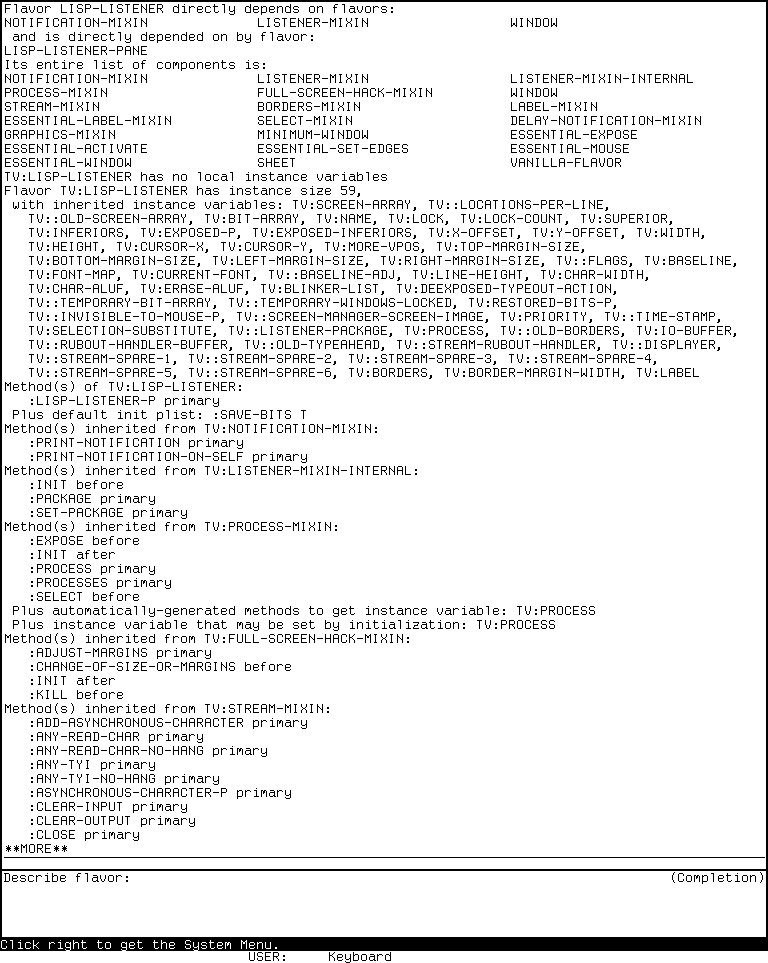
Runtime observation: System E, Meta-X Describe Flavor, and TV:LISP-LISTENER produced this live report in the preserved System 303-0 band on 2026-07-18. The screenshot catches the first page at **MORE**; it establishes the visible breadth and pagination behavior, not that the first page is the whole report.
The report visibly showed direct components and one direct dependent, the entire computed component list, local and inherited instance variables, local and inherited methods grouped by contributing flavor, generated accessors, and initialization information. This matches the implementation's data flow. An exploratory Right click while the **MORE** pause was active caused no visible change and is not treated as proof against the source-defined item menu.
| Provenance field | Value |
|---|---|
| Session | flavors-d16-20260718, generation 1 |
| Interval | 2026-07-18 05:13:37–05:16:52 EDT |
| Guest | System 303-0; visible Zmacs/Flavors report |
| Disk | base and private-start SHA-256 bb16e46ad81decfe1efe691d36b6aa4ce3fd4ffb82474365de3520989d397cb5; base unchanged at stop |
| Source | system check-in 4df393c68d7f083ce42d5c377039d26043cc18a9031ace28258dc97f4137eb91; private tree SHA-256 21f5215de973aa6ccbddb817f2d64edd95ee1014c3028a9b0711ea7c741b807e, unchanged during the run |
| Emulator | executed usim SHA-256 707a77d23e28ea1c45ae0eb0145dc181fa7ba649b9defc30044d4f847ac2c5be |
| Raw capture | 0006-describe-lisp-listener-flavor.png, 768 by 963, 10,994 bytes; PNG SHA-256 06644ddb231c619ee3de8c6db75c296973e0ca6f9b5a751d53659f0fcaa6e9ee; pixel SHA-256 f3c5b45855f2850cc2811364b1194c5532b0862e9aca3b829e0f5e300d070ea2 |
| Sidecar | 4,418 bytes; SHA-256 5073fd875c044ed2a65fb4fac2f3499579a84ee74d597259f25de5178daa8f5e |
| Run record | 6,820 bytes; SHA-256 8b8cbb0c8b69416c8b8f3248ca00e62ca4529a8b333f1bf62f4f1f4c484c0a61 |
| Shutdown | clean; usim and Xvfb status 0, forced_stop=false, state_may_be_incomplete=false |
The ordered user-visible action sequence was: decline the boot time entry with Return; System E; Meta-X; type Describe Flavor; type TV:LISP-LISTENER; wait for output; capture; make the non-result exploratory Right click; and stop. No definition was edited and no world or public disk was saved.
Genera 8.5 Flavor Examiner
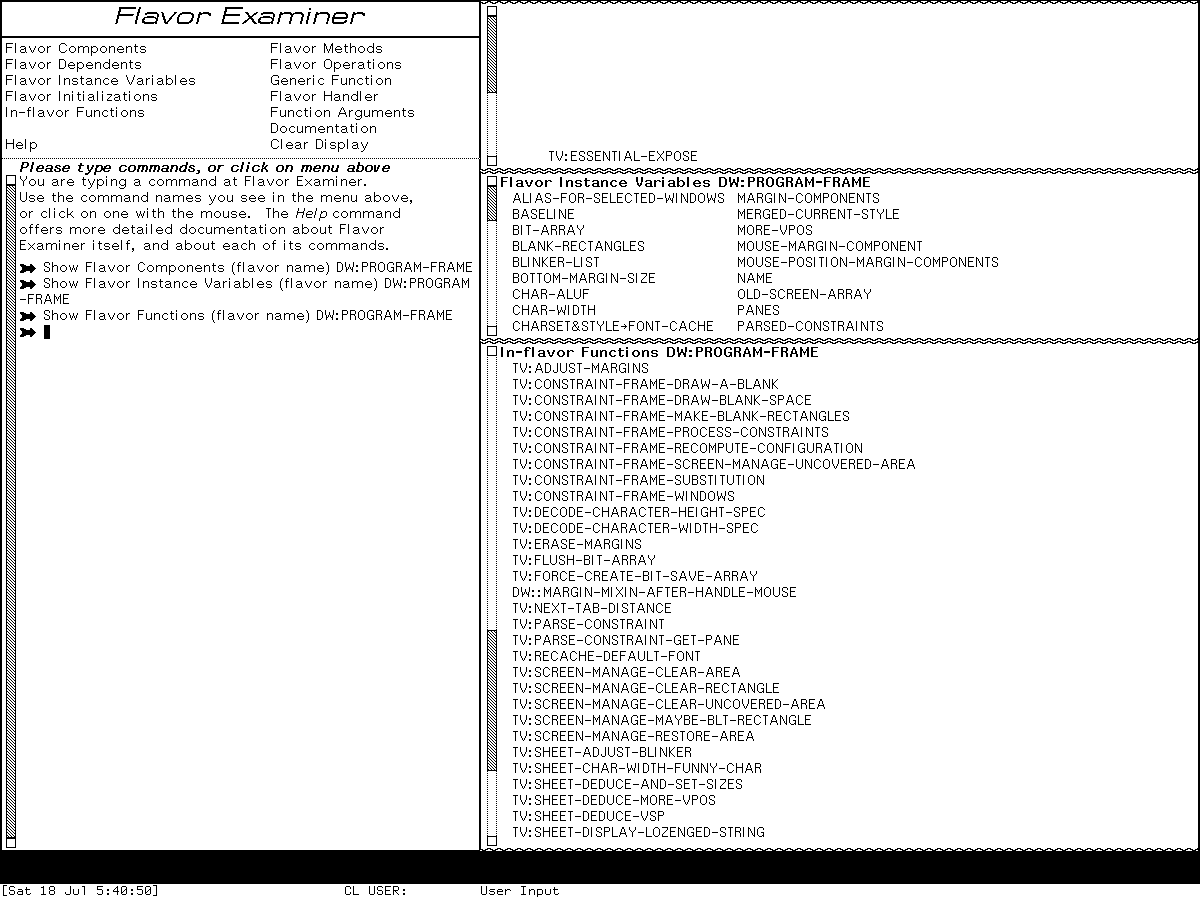
Runtime observation: Select X opened the Flavor Examiner, then three nonmutating commands inspected DW:PROGRAM-FRAME on 2026-07-18. The selected capture is published to establish the application's actual layout and semantic result rotation beside source/manual analysis; Symbolics retains interests in the licensed software, and inclusion implies no endorsement.
The initial frame visibly matched the source definition: the fixed thirteen-entry menu occupied the upper-left, a short built-in introduction and command prompt occupied the lower-left, and three empty result histories filled the right. The harness then entered, in order:
Show Flavor Components DW:PROGRAM-FRAME;Show Flavor Instance Variables DW:PROGRAM-FRAME; andShow Flavor Functions DW:PROGRAM-FRAME.
The first result displayed the full component chain down through FLAVOR:VANILLA. After the second command, that result moved to the middle-right history while the current instance-variable list appeared below it. After the third, the component result moved to the top, the instance-variable result to the middle, and the function list became current at the bottom. This directly confirms the three-generation rotation described by the implementation. It also confirms that Select X opens a dedicated frame rather than merely printing a report in the Listener.
Genera CLOS command surface
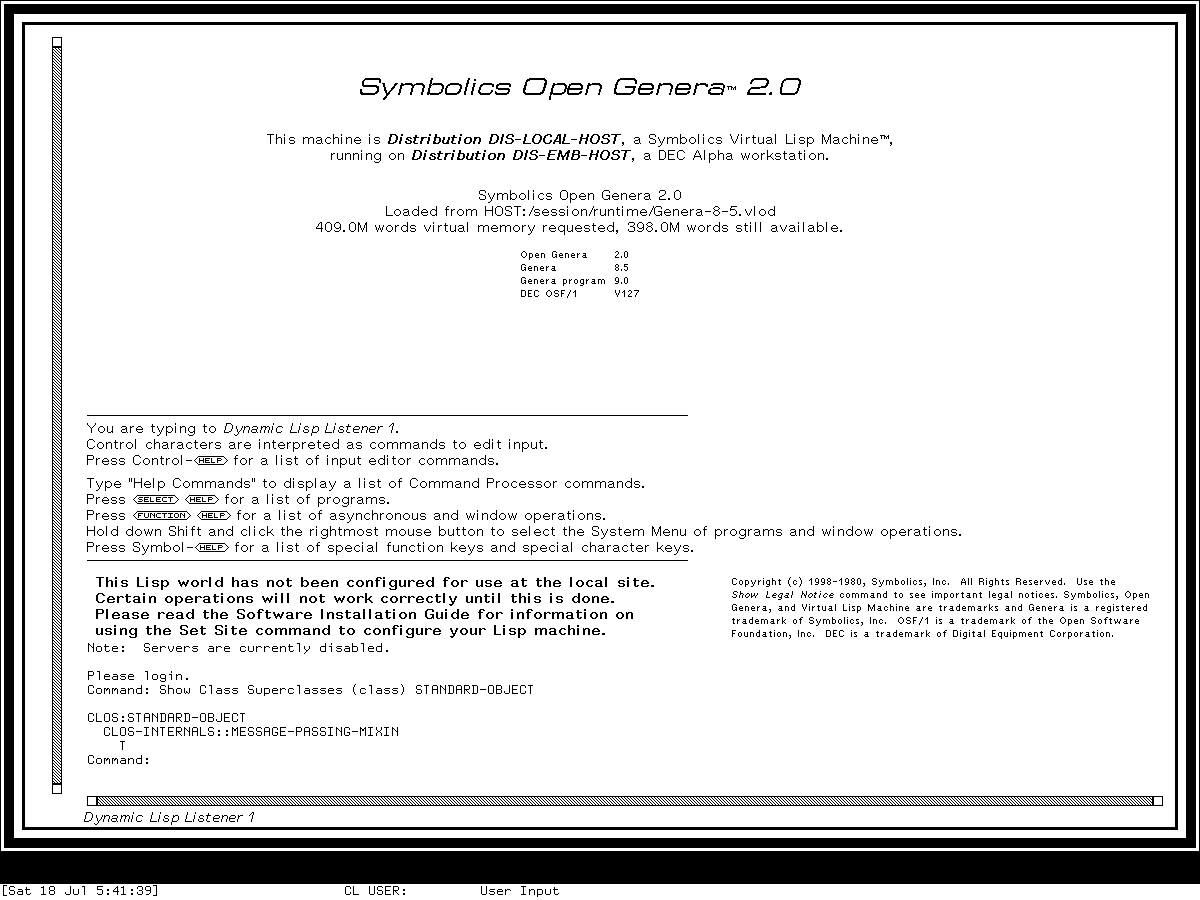
Runtime observation: after returning from the Flavor Examiner with Select L, the Listener accepted Show Class Superclasses Standard-Object and displayed the live CLOS precedence chain on 2026-07-18. The image is published to establish that the separate CLOS command surface is available in the base world; inclusion implies no Symbolics endorsement.
The result was CLOS:STANDARD-OBJECT, CLOS-INTERNALS::MESSAGE-PASSING-MIXIN, and T. This is intentionally a separate runtime observation from the Flavor Examiner: it confirms a CLOS command through the ordinary Command Processor and does not imply that CLOS classes are browsed in the Flavors-only frame.
Genera session provenance
| Provenance field | Recorded value |
|---|---|
| Session | flavors-d16-genera-20260718, generation 1 |
| Interval | 2026-07-18 05:39:23–05:42:11 EDT |
| Licensed input | opengenera2.tar.bz2, 206,213,430 bytes; SHA-256 89fb3e76b91d612834f565834dea950b603acf8f9dbacacdd0b1c3c284a2d36e |
| World | Genera-8-5.vlod, 54,804,480 bytes; SHA-256 a8ee5e86cc7e322f7385af3e0cd579d7650d4dcfc3ce328acbf8b25515dd0672 at start and stop |
| VLM and debugger | VLM SHA-256 9f5e18d5770f973879716182b6856ef5a8ee9d3b2bb907476ea0cf35986aa4c7; debugger SHA-256 2db918cfe8f35f52c7ff4b7695b0ecd3bb85e41a3327ea5a94874edf05edb54a |
| Flavor capture | Raw 0005-flavor-three-result-history.png, 1200 by 900, 14,236 bytes; PNG SHA-256 59fedf36cf98ca2a2b6b66a2e26a4c61cbf8e4c5ace187ad0fda213272978af4; normalized-pixel SHA-256 45b8207457cafc59e8760b098f6455e498ef4debef8f840a2abd3a6c9b69fcfd; action prefix 8 records, SHA-256 993216233ad206a2cdbe1bdd040139d0b63aa170badc3bd2824d65bf793bca47 |
| CLOS capture | Raw 0007-clos-standard-object-superclasses.png, 1200 by 900, 12,015 bytes; PNG SHA-256 434dd770bec9bff8b0f67d078099b1b9622bf7b8e29ee73144a6f18d339e3f0a; normalized-pixel SHA-256 f669af2afa6fb2585902b82a0cd64079bdaea38c9e734d21395874f555e9bb87; action prefix 12 records, SHA-256 e40e7fb78ca413c69a5b40ac19af160f5cc51fd47e74bb211b1873a4496e35ce |
| Complete action log | 12 linked intent/outcome records, 5,953 bytes; SHA-256 e40e7fb78ca413c69a5b40ac19af160f5cc51fd47e74bb211b1873a4496e35ce |
| Final record | 25,689 bytes; SHA-256 8d9815ad729e1dd6e92c71eed80238a0b5786deb6dc897ee8116780da90b2901 |
| Isolation | Private Xvfb; separate user, mount, network, PID, IPC, and hostname namespaces; no default/external route or guest-visible host file service; MIT-SHM absent |
| Shutdown | Prompt observed, yes sent and accepted, cleanup progress observed, then the known Cold Load channel stall required bounded host termination; forced_after_confirmed_shutdown_stall=true, no Save World or process checkpoint, private and base worlds unchanged |
The exact ordered input was Select X, the three Show Flavor commands above, Select L, and the Show Class command. No presented item was clicked, no source definition was opened or edited, and no object definition or world was saved.
Preservation and rights boundary
The CADR screenshot is output of public software and public source and is included as functional historical evidence after an image- and use-specific review. The two selected Genera captures also passed a use-specific review: one is the minimum image that proves the dedicated frame and its result rotation, and the other prevents that Flavors evidence from being misused as proof of the separate CLOS tools. They contain functional interface layout, short command/result text, and no source, manual pages, private user data, or third-party artwork. The asset catalogs record exact raw mappings and provenance. The Open Genera world, source, unselected raw screenshots, and full session records remain ignored licensed research inputs. Publication does not authorize redistribution of the underlying world or source.
Open questions
- Did a separately distributed late CADR or Lambda band provide a standalone Flavor Examiner before the Genera implementation inspected here? No such program is present in the bounded System 46 or System 303 evidence.
- The System 46 snapshot's generated command lists establish four method commands whose section source is absent. Recovering that exact source would allow their implementation details to be compared without relying on System 303.
- Runtime-check the documented presentation menus after dismissing pagination; the exploratory click during
**MORE**is deliberately inconclusive. - Determine whether a loaded optional Genera system extends the CLOS presentation menus or installs a dedicated class browser; do not infer this from the base source set.
Sources
- MIT, System 46 Flavors implementation, entity/class implementation, and ZWEI
Describe Flavor, pinned public revision; verified 2026-07-18. - LM-3 project, System 303
Describe Flavor, possibilities commands, method commands, and Flavors manual, pinned maintained revision; verified 2026-07-18. - Symbolics, Program Development Utilities, Genera 8, “Programming with Flavors,” “Show Flavor Commands,” “Flavor Examiner,” and CLOS programming tools; verified 2026-07-18.